
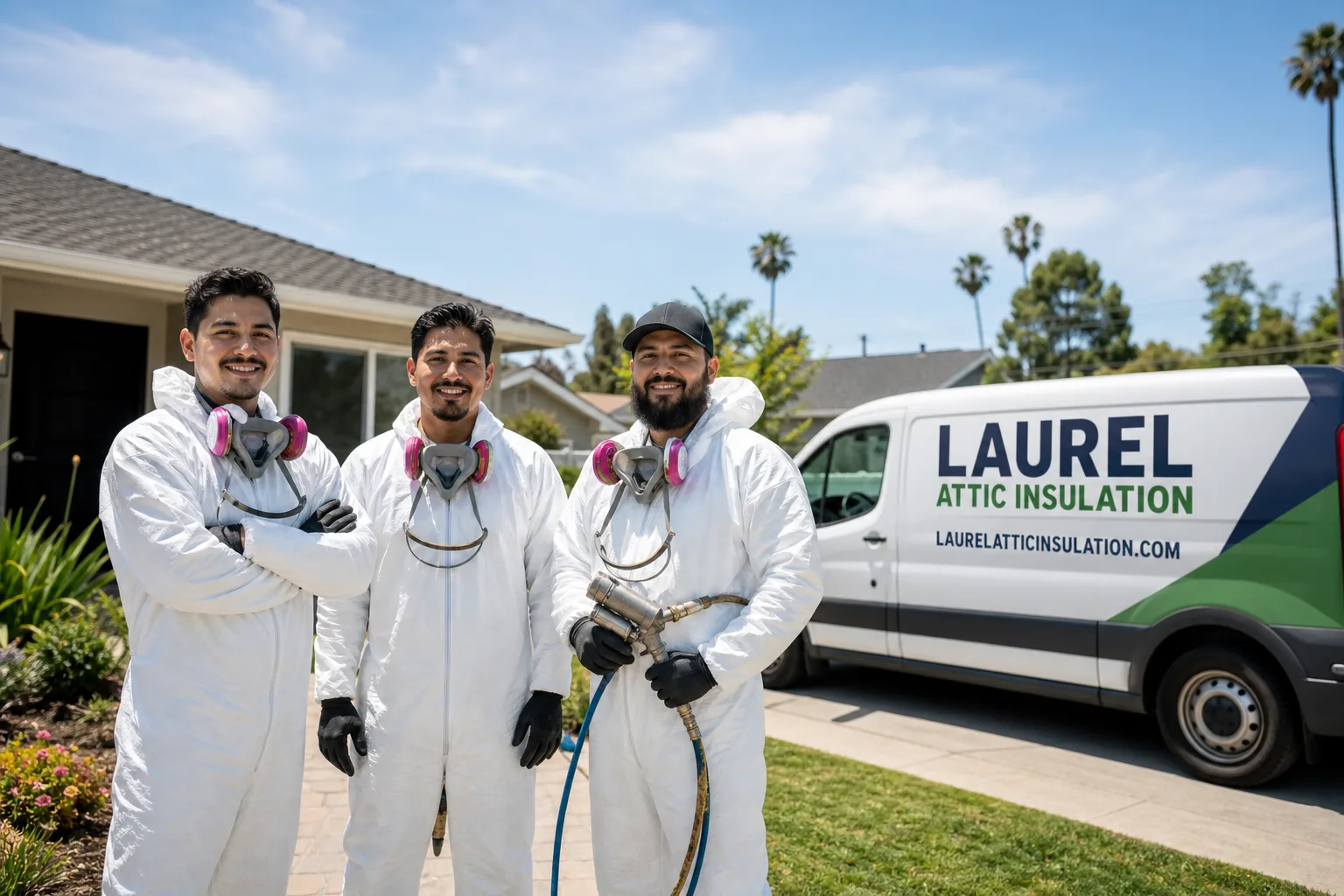
Fast, Reliable Attic Insulation Across Half Moon Bay
Attic insulation in Half Moon Bay has to be built for salt air. That’s the honest reality. Our crews work along the coast from El Granada down to Miramar, and we see the same pattern everywhere: metal fasteners corrode, batts sag away from the joists, and fog dampness creeps into the insulation long before the material would fail inland. If your home near Kelly Avenue, Frenchmans Creek, or along Highway 1 has cold drafts or a musty attic smell, call Laurel Attic Insulation at (361) 315-4177. We’ll inspect what’s actually happening up there and give you a written price before any work starts.
Most attic insulation jobs in Half Moon Bay run between $900 and $2,400 depending on square footage, the R-value you need, and whether we’re topping up existing insulation or replacing corroded, sagging batts. That price is locked before we start. No door-step surprises.
Why Laurel Attic Insulation Is Half Moon Bay’s Preferred Attic Insulation Company
Half Moon Bay homeowners don’t have time for vague quotes or no-show contractors. That’s why our booking works like the apps you already use: book in a tap, get a live arrival time, and receive before-and-after photos of your attic. It’s called The Relay Standard, and it’s included on every job. No waiting around a four-hour window wondering if anyone will show.
Our technicians are background-checked and uniformed. They arrive at a live, trackable time. And the calls are answered by a live person, 24/7. No voicemail, no callback queue. If you call at 6 a.m. because you found water staining on your ceiling, a human picks up.
Chase Whitaker leads our team, and the standard is simple: if the work isn’t done right, we make it right. Every job carries our 365-Day Done Right Promise in writing. If the repair fails within a year, we come back at no charge. If it needs a second visit, that’s free too. No argument, no fine print.
We’ve been part of the Relay Home Co. family since 2003, and we’ve built our reputation in coastal communities one attic at a time. Half Moon Bay’s fog belt means we know what to look for before the insulation itself tells you something’s wrong.
Attic Ventilation in Half Moon Bay
Attic ventilation in Half Moon Bay is not an optional add-on. It’s the difference between insulation that performs for decades and insulation that grows mold in three years. The town’s fog belt keeps roof decking damp for months at a time, and without proper airflow, that moisture settles directly into your insulation. In many older Half Moon Bay homes, we find corroded or painted-shut vents that haven’t moved air in years.
A full attic ventilation job in Half Moon Bay typically runs between $400 and $1,200 depending on the number of vents, the soffit configuration, and whether we’re adding baffles. That includes assessing airflow, installing or replacing vents, and confirming the attic can actually breathe.
Corrosion inspections come first
Before we quote any ventilation upgrade, we check what’s already up there. Salt air eats vent screens and fasteners fast. In a 1960s ranch house near Kelly Avenue, we found attic vents so corroded they’d sealed themselves shut, which explained why the insulation below was soggy and failing. We replaced the vents with salt-resistant hardware and restored airflow the same day.
Moisture-driven insulation failure
When attic air doesn’t move, condensation forms on the underside of the roof deck every foggy night. That moisture drips onto paper-faced batts, and mold follows. We’ve pulled insulation from Half Moon Bay attics that looked fine from the living room but crumbled to the touch up top. Proper ventilation prevents this cycle.
Radiant Barrier in Half Moon Bay
Radiant barrier in Half Moon Bay does something most homeowners don’t expect: it helps with moisture, not just heat. A properly installed radiant barrier faces a reflective surface toward the roof deck, which reduces the amount of radiant heat that hits your insulation. But in our coastal microclimate, it also creates a drier attic by helping regulate the thermal cycle that drives condensation. This is why we recommend it alongside ventilation upgrades in fog-prone zones.
Installing radiant barrier in a typical Half Moon Bay attic runs between $800 and $1,800 depending on roofline complexity and whether it’s paired with new insulation. It’s most effective when stapled to the underside of rafters, and in salt-air conditions, we use stainless staples exclusively. Galvanized fasteners fail too quickly here.
When radiant barrier makes sense
If your attic runs noticeably hot in summer even though Half Moon Bay stays cool, you’re losing conditioned air or absorbing radiant heat through the roof deck. Radiant barrier reflects that heat away. Combined with R-38 or higher insulation, it drops attic temperature by a measurable margin.
Why fasteners matter as much as the film
Radiant barrier film itself holds up fine in coastal air. The staples holding it up don’t. We use stainless staples on every radiant barrier job in Half Moon Bay, and we log the fastener type on your written guarantee. It’s the kind of detail that keeps the barrier from sagging into the insulation six months later.
Trusted Brands We Service in Half Moon Bay
We install and service materials from Owens Corning, GreenFiber, and Johns Manville, along with insulation from five other leading manufacturers. What matters in Half Moon Bay is what we pair with those brands: stainless fasteners, salt-resistant vent hardware, and batts that hold their shape in high humidity. We keep local stock in our Bay Area dispatch office, so a top-up or a repair on a home near Main Street doesn’t wait on a freight delivery. If your existing insulation is from Knauf or another major brand, we can match it.
Common Attic Insulation Problems We See in Half Moon Bay Homes
- Salt-corroded staples and fasteners. The staples holding fiberglass batts to the joists rust through in as little as seven years along the coast. The batts detach, sag, and create gaps near the eaves where cold air pours in.
- Mold on paper-faced batts. Persistent fog keeps attic humidity high. Paper-facing traps that moisture, and mold colonies form on the kraft surface and along the roof decking.
- Dead ventilation and trapped moisture. Older homes near Kelly Avenue, Purissima, and along Miramar Road often have vent screens corroded solid. Zero airflow means condensation degrades insulation from below even if the material is technically intact.
- Settled and compressed insulation. Blown-in fiberglass and cellulose compact over time in humid air, losing R-value. A home built in the 1970s with R-19 may be performing at R-11 now, and the homeowner won’t know until the PG&E bill spikes.
Pricing for Attic Insulation in Half Moon Bay, CA
Here’s what our Half Moon Bay customers typically pay. Attic insulation top-up runs $900 to $1,600 for a standard 1,200 to 1,800 square-foot home. Full replacement with R-30 or R-38 fiberglass batts runs $1,400 to $2,400, and that includes removing the old material. Blown-in attic insulation runs $1,100 to $2,100 depending on depth and R-value. Radiant barrier installation runs $800 to $1,800, and attic ventilation work runs $400 to $1,200. These are real ranges, not guesses. Your written price comes before we touch anything.
Half Moon Bay’s coastal conditions mean we sometimes add corrosion remediation to a quote: stainless fastener replacement, vent screen replacement, or baffle installation. You’ll see every line item before you approve it. Call (361) 315-4177 for a free estimate.
We Also Serve Cities Near Half Moon Bay
Our crews cover Half Moon Bay and the surrounding Peninsula communities, including El Granada, Burlingame, Millbrae, and Belmont. If you’re inland from the fog line, check our Attic Insulation service page for what changes. If you’re still in the coastal zone, see how we approach Attic Insulation in Half Moon Bay and schedule an inspection.
Serving Half Moon Bay, CA - Our Local Coverage Area
We’re based in the Half Moon Bay area and know this community well. Use the map below to see our service coverage - if you’re nearby, we can almost certainly help.
FAQs About Attic Insulation in Half Moon Bay
Salt-laden marine air is the answer. Half Moon Bay’s fog belt keeps attic surfaces damp far longer than inland Peninsula cities like San Mateo, so the metal staples and fasteners holding your insulation corrode first, then the batts sag and lose contact with the joists. San Mateo attics deal with heat; Half Moon Bay attics deal with salt and moisture. Call (361) 315-4177 for an inspection that looks at hardware before material.
Every two to three years if you’re within half a mile of the ocean, and every five years if you’re further inland but still in the fog zone. Corrosion moves fast near the coast, and catching rusted staples before the batts detach saves a full replacement. We’ll inspect your attic and document the condition with photos as part of any service call.
Yes, indirectly. Radiant barrier stabilizes attic temperatures and reduces the thermal swings that create condensation on the roof deck at night. It’s most effective when combined with working ventilation. Call us for a written price on a combined radiant barrier and ventilation package.
Blown-in fiberglass and rigid foam board both outperform paper-faced batts in coastal humidity because there’s no kraft paper to trap moisture and no metal staples to corrode. If you want batts, we use foil-faced or unfaced fiberglass with stainless fasteners. The material matters less than how it’s fastened and whether the attic breathes.
In most Half Moon Bay homes built before 1990, yes. The existing vents are often corroded or painted shut, and installing new insulation without fixing airflow just traps moisture in the new material. We’ll include a ventilation assessment in every replacement quote and show you exactly what’s being added and why.
Written by Chase Whitaker, Owner at Laurel Attic Insulation, serving Half Moon Bay and the surrounding coastal Peninsula.