
Fast, Reliable Spray Foam Insulation Across Castro Valley
Spray foam insulation in Castro Valley runs about $1,800 to $6,400 for a typical attic or crawl space job, and we can usually be on site the same day you call. That’s not a generic national estimate. It’s what we actually see on 1950s and 60s ranchers off Lake Chabot Road, Crow Canyon, and Redwood Road, where vented attics and pier-and-beam crawl spaces behave very differently than newer construction. If your upstairs bedroom bakes by 2pm or your floors feel like they’re breathing fog up from underneath, call (361) 315-4177. We’ll give you a written price before anything starts.
Why Laurel Attic Insulation Is Castro Valley’s Preferred Spray Foam Insulation Company
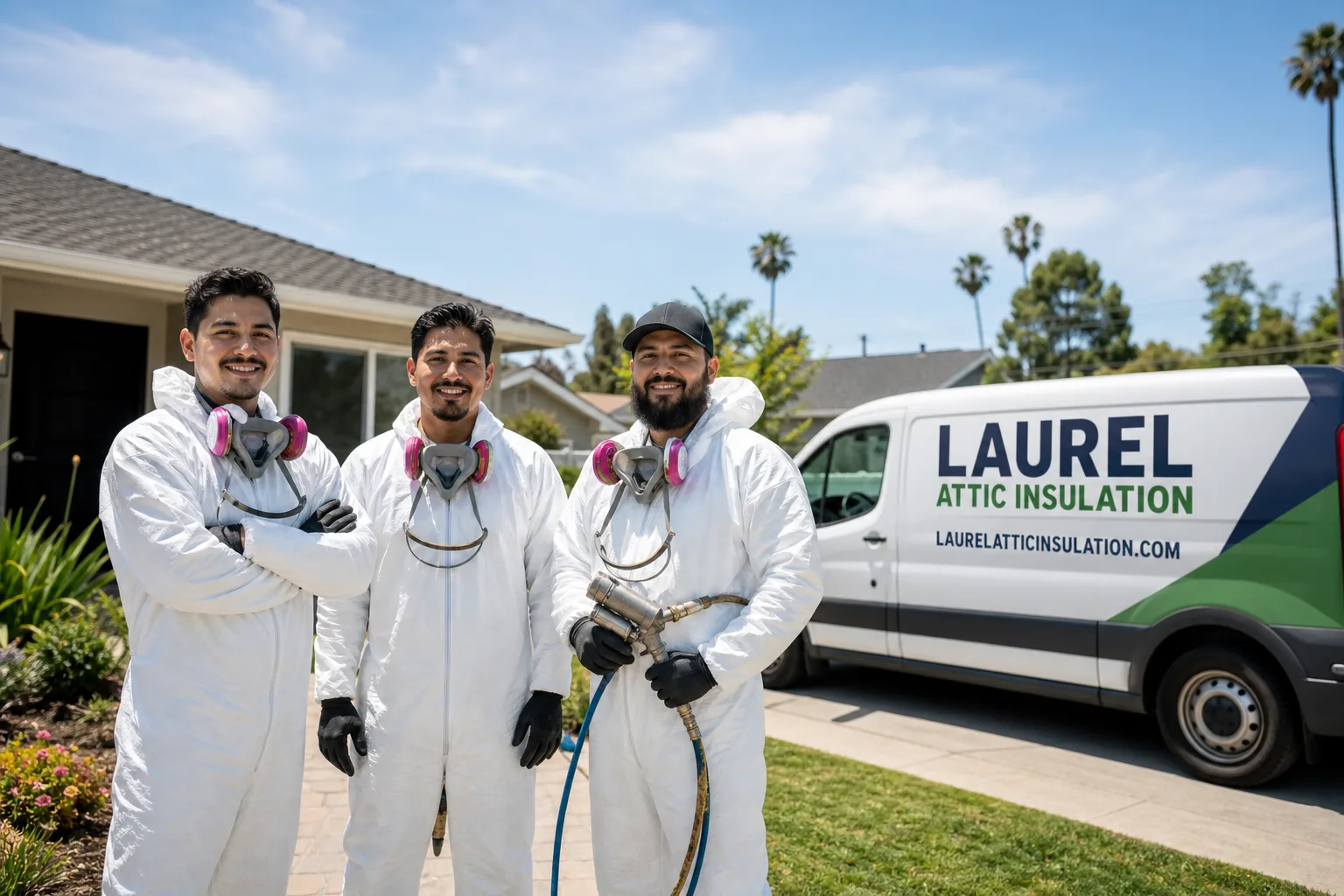
Chase Whitaker leads our crew, and he’s spent enough time in Castro Valley attics to know exactly what the marine layer does to a vented attic by 3pm. Homeowners here don’t call because insulation is a nice upgrade. They call because a specific room is failing, and they want someone who’ll answer the phone and show up. Our technicians arrive in uniform at a live, trackable time, not a four-hour window you have to block off.
We’re part of the Relay Home Co. family, founded in 2003, which means every Castro Valley job includes the Relay Visibility Guarantee: a written price before work starts, photo updates while we’re in your attic, and an invoice you can pay from a link. The 365-Day Done Right Promise backs the workmanship in writing for a full year. If something isn’t right, we come back and fix it. No charge, no argument, no second-guessing.
Homeowners in Castro Valley keep our number because the process feels like booking a rideshare: you tap, you see your technician’s live arrival time, and you get before and after photos of the actual work. No phone tag. No vague “sometime Tuesday.” Just a straight answer and a straight price.
Crawl Space Spray Foam Insulation in Castro Valley
Crawl Space Spray Foam Insulation in Castro Valley is a different animal than it is in drier parts of the Bay Area, because so many homes here sit on 1950s slab-and-pier foundations that pull moisture up from fog-damp soil. When a Castro Valley homeowner calls about cold floors or a musty smell rising through the floorboards, the fix usually starts with sealing the crawl space, not just spraying foam and walking away. We specify closed-cell for most crawl spaces here, because the marine layer that rolls over Lake Chabot every summer evening pushes enough humidity into open-cell foam to make it wick and sag. Closed-cell holds its structure and doubles as a vapor barrier when applied to the ground-facing side.
Sealing and Ground Preparation First
We don’t spray over damp earth. In Castro Valley crawl spaces, we seal the ground plane first, then apply closed-cell to the rim joists and foundation walls. If you’ve had standing water under the house after a heavy winter, we’ll address drainage before any foam goes in. The foam is only as good as what it’s bonded to.
Rim Joist Spray Foam for Pier-and-Beam Homes
Rim joists on Castro Valley’s older pier-and-beam homes are usually uninsulated and leaky. Closed-cell spray foam around the rim joist band stops the stack effect that pulls cold air in from under the house. Most rim joist jobs in Castro Valley run $900 to $2,200 depending on the linear footage and access.
Garage Spray Foam Insulation in Castro Valley
Garage Spray Foam Insulation in Castro Valley usually targets wood-framed garage ceilings and kneewall cavities, especially on attached garages where a bedroom or bonus room sits directly above. The failure pattern we see most often here is an unsealed garage ceiling that acts as a bypass, letting hot afternoon air pour into the house wall cavity even when the rest of the attic is insulated. Spray foam stops that bypass because it air-seals and insulates in one pass. On a 400-square-foot garage ceiling in Castro Valley, expect to pay between $1,400 and $2,800 for closed-cell.
Ceiling Spray Foam for Above-Garage Rooms
If the room above your garage runs 8 to 12 degrees hotter than the rest of the house every summer afternoon, that’s a garage ceiling problem, not an AC problem. We’ll spray the ceiling cavity and the kneewalls where they meet the house, closing the bypass. Homeowners on Seven Hills and Palomares Hills deal with this exact condition because their garages catch late afternoon sun.
Garage Wall and Rim Areas
Most Castro Valley garages weren’t built with any insulation in the wall cavities. Open-cell spray foam works well for garage walls that are fully enclosed, and it’s a practical way to turn a garage into a workshop or gym without tearing out drywall. Open-cell garage wall projects typically run $1,100 to $2,400.
Trusted Brands We Service in Castro Valley
We install and service spray foam from manufacturers we trust, including Icynene and Demilec for foam systems, and Owens Corning and Johns Manville for the batt and blown-in work that often pairs with a spray foam retrofit. The material gets matched to your Castro Valley home’s specific condition: closed-cell for crawl spaces and roof decks, open-cell for interior walls and garage cavities. We stock the parts and material our techs need locally, which means less waiting when a Castro Valley job needs a fast turnaround. If you have existing Owens Corning or Johns Manville batts already in place, we can tell you within minutes whether spray foam can seal over them or whether they need to come out first.
Common Spray Foam Insulation Problems We See in Castro Valley Homes
- Compressed batt insulation in vented attics. Decades of cable, HVAC, and recessed-light work in Castro Valley’s 1950s and 60s ranchers have shoved fiberglass batts to the sides of the joists, leaving bare gaps. Spray foam has to air-seal those gaps before any blown-in material goes back on top, or the hot spots stay.
- Open-cell foam that wicked moisture in fog-exposed crawl spaces. Under Castro Valley’s marine-layer fog cycle, open-cell sprayed directly onto damp conditions absorbs water and loses its R-value. Closed-cell is the correct spec here, and the ground needs sealing first.
- Unsealed garage ceilings and kneewalls. Many attached garages in Castro Valley were framed in the 50s and 60s with no air barrier at the house wall, so spray foam that stops at the living-space wall leaves a bypass that lets hot air pour around the foam. The garage side has to be included in the scope.
- Roof deck spray foam over old shingle decks in hillside homes. Homes up off Redwood Road and Palomares Road with conditioned attic conversions often need roof deck foam specified carefully, because unvented roofs in Castro Valley’s temperature swings can trap moisture if the assembly isn’t right. We check the existing membrane and ventilation before recommending closed-cell on the deck.
Pricing for Spray Foam Insulation in Castro Valley, CA
Here’s what we actually quote for Castro Valley work. Crawl space spray foam with closed-cell and ground sealing runs $2,100 to $5,600 depending on square footage and how much rim joist area needs coverage. Garage ceiling spray foam runs $1,400 to $2,800 for a typical single-car, $2,300 to $4,400 for a double. Full attic air-seal plus spray foam on the attic floor runs $2,800 to $6,400 on the 1,100 to 1,600-square-foot ranchers common here. Attic jobs that include removing old batts first add $600 to $1,200. Every estimate is written, itemized, and in your hand before we open a can. Call (361) 315-4177 for a free estimate with no door-step surprise.
We Also Serve Cities Near Castro Valley
Our crews run daily through Castro Valley and cover the surrounding communities where the same vented-rancher and crawl-space patterns show up. We regularly take calls from San Lorenzo and San Leandro on the flat side, Union City to the south, and Dublin over the grade. If you’re in any of those spots, give us a call and we’ll put you on the schedule. For the full breakdown of what our Spray Foam Insulation team offers, that page covers the service line.
Serving Castro Valley, CA - Our Local Coverage Area
We’re based in the Castro Valley area and know this community well. Use the map below to see our service coverage - if you’re nearby, we can almost certainly help.
FAQs About Spray Foam Insulation in Castro Valley
Yes, and in fact the vented attic is where spray foam does its best work in Castro Valley, because the foam air-seals the attic floor against the convective hot spots that batt insulation can’t stop. The fix works with the vented design rather than fighting it. Call (361) 315-4177 and we’ll tell you within the first few minutes on the phone whether your attic is a good spray foam candidate.
Closed-cell is the right spec in Castro Valley because the marine layer pushes enough moisture into crawl spaces that open-cell foam wicks and sags, losing its R-value and bonding poorly. Closed-cell stays rigid and adds a vapor barrier. If you’re not sure which you have under your house, we’ll check it for free.
Same day is common for Castro Valley calls, especially when the problem is an attic hot spot or a crawl space moisture issue that’s actively affecting the house. Our dispatch is coordinated from the San Francisco Bay Area office, and our techs run Castro Valley routes daily. Call (361) 315-4177 and we’ll give you a live arrival window, not a four-hour range.
Yes, because the garage ceiling bypass we see across Castro Valley’s attached-garage ranchers is exactly the kind of problem spray foam solves in one pass. On a standard single-car garage ceiling, you’re looking at $1,400 to $2,800, and the improvement in the room above is usually measurable the same week. A free estimate tells you the exact number for your garage.
Sometimes yes, sometimes no. If the existing batts are dry and in decent shape, we can often air-seal the attic floor with spray foam and re-set the batts on top. If they’re compressed, dirty, or rodent-damaged, they need to come out first. We’ll tell you which camp your attic falls into when we walk it. Call (361) 315-4177 for a free on-site look.
Written by Chase Whitaker, Owner at Laurel Attic Insulation, serving Castro Valley and the surrounding Bay Area communities.