
Spray Foam Insulation: Repair or Replace? How Los Angeles Homeowners Decide
Here’s the short version: if spray foam has failed, you’re almost always better off replacing it. The reason isn’t the foam itself. It’s that spray foam is the only insulation that bonds permanently to the surface it’s applied to, so when it pulls away or turns crumbly, it’s usually telling you something about what’s underneath. A patch job on failing foam typically leaves an air gap that performs worse than having no foam at all. If you want a straight answer for your specific attic, call (361) 314-0118 and we’ll tell you what we’d do if it were our house.
In Los Angeles, where attics routinely hit 140 degrees in August, a failed spray foam installation isn’t just an efficiency problem. It’s a moisture problem waiting to happen. We’ll break down exactly how to tell the difference between a repairable section and a full redo.
Key Takeaways
- Spray foam fails in three specific ways: delamination, off-ratio mixing, and UV degradation. Each has a different fix.
- Delaminated foam creates an air gap that traps condensation against your roof decking. Patching it seals nothing.
- Repair only makes sense for open-cell foam damaged by a single, identified roof leak, where less than 15% of total coverage is affected and the decking is dry and sound.
- Full replacement in Los Angeles runs $1.50 to $2.50 per square foot just for removal, plus inspection and reinstallation.
- Any replacement quote should include a blower door test. If a contractor skips it, they’re guessing at your air seal.
What Makes Spray Foam Different From Other Insulation
Fiberglass batts sit in place. Blown-in cellulose settles. Spray foam is different because it adheres. When we apply closed-cell or open-cell foam to your attic deck, it chemically bonds to the wood. That bond is what makes spray foam the best air-sealing insulation on the market. R-value, that’s the number measuring how well insulation slows heat from moving through your ceiling, only tells part of the story. Spray foam’s real advantage is stopping air movement entirely.
But the bond cuts both ways. If the foam fails, it rarely fails in isolation. It pulls away because the substrate moved, or it never cured properly in the first place. Understanding that distinction is what separates a repair that lasts from one that buys you six months.
The Three Ways Spray Foam Fails in Los Angeles
1. Delamination and Shrinkage
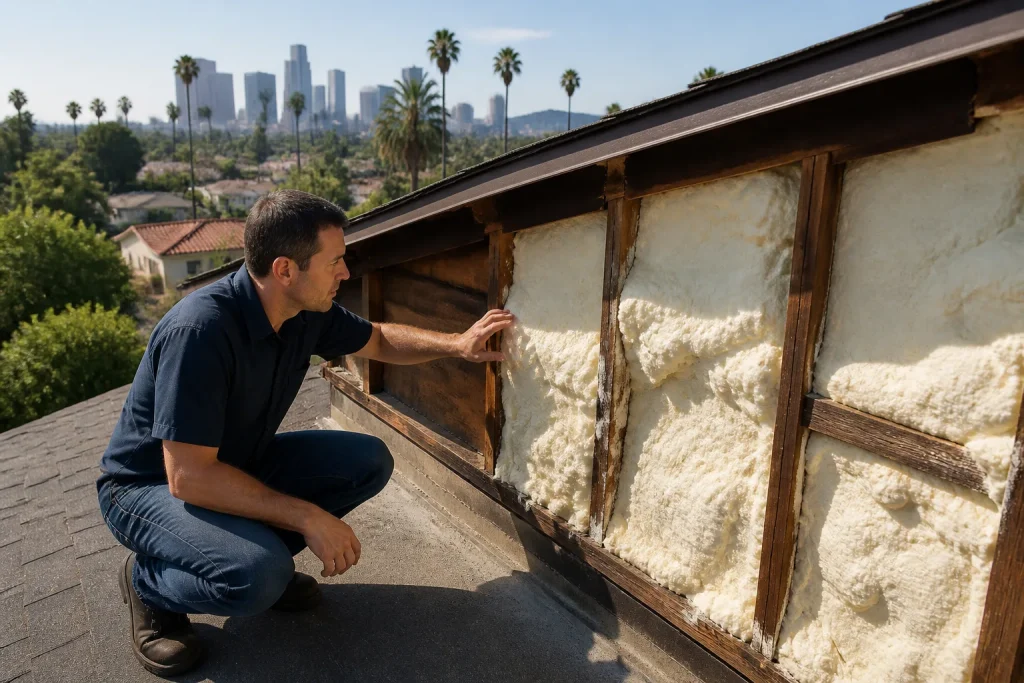
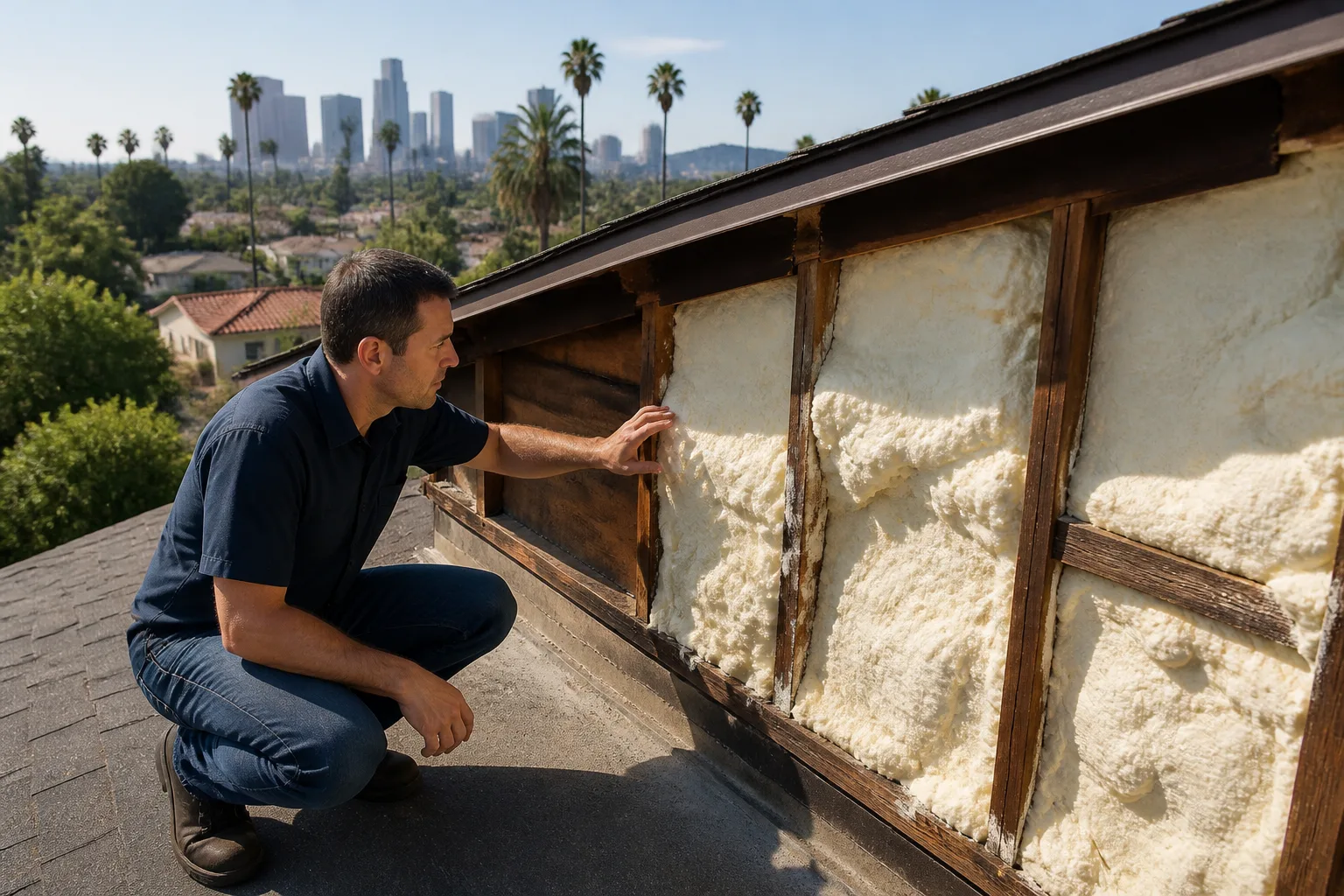
Delamination means the foam has separated from the decking. You’ll see gaps where foam meets wood, or you’ll hear a hollow sound if you tap on it. Shrinkage is related but different: the foam contracts, leaving cracks at seams and edges. In Los Angeles, our hot, dry summers accelerate this. The attic deck expands and contracts through daily temperature swings of 40 to 60 degrees, and eventually the foam can’t keep up.
Delaminated spray foam cannot be patched effectively. Once a gap forms between foam and deck, air moves through it. Worse, moisture condenses there. A technician could inject new foam into the gap, but it won’t bond to the old foam’s cured surface. You end up with foam next to foam, not foam bonded to deck. The air gap persists. In our experience, a delaminated section is a replacement job, not a repair job.
2. Off-Ratio Mixing During Installation
Spray foam is created on site by mixing two chemical components, typically an isocyanate and a polyol resin. When the mixing ratio is off, the foam never cures correctly. It stays soft, crumbly, or shrinks weeks after installation. This is an installation defect, not a material failure.
We see this in Los Angeles more often than we’d like, usually from jobs done fast with poorly calibrated equipment. Foam from brands like Demilec or Icynene doesn’t fail this way when applied correctly. The problem is almost always the application, not the product.
3. UV Degradation in Exposed Applications
Spray foam degrades when exposed to sunlight. UV rays break down the foam’s cellular structure, turning it yellow and chalky over time. In most attics, this isn’t a concern because the foam sits under the roofline. But in Los Angeles homes with exposed applications like rim joists in crawl spaces near vents, soffit edges, or unshaded exterior walls, UV exposure is a real failure mode. Yellowed, dusty foam loses both R-value and its air-sealing ability.
How to Check Your Foam Yourself: The Crumble, Color, and Smell Tests
Before you call anyone, do a basic inspection. These three checks will give you a good sense of what you’re dealing with.
- The crumble test: Press your thumb into the foam. Properly cured closed-cell foam is hard. Open-cell foam has some give but springs back. If the foam crumbles, flakes, or feels like stale bread, the mix ratio was off during installation, or the foam has degraded. Off-ratio foam cannot be repaired.
- The color check: Healthy foam is cream or off-white. Yellowed foam, especially on surfaces that get any light, indicates UV exposure or chemical imbalance. If the yellowing is widespread, you’re looking at replacement. If it’s limited to a small, well-defined area near a light source, go to the next test.
- The smell test: Cured spray foam should have no lingering odor. If you notice a fishy or chemical smell, especially on hot Los Angeles days when the attic heats up, that points to an isocyanate imbalance. Off-gassing from improperly mixed foam is an air quality concern, not just an efficiency problem. This is worth a professional evaluation. If you can smell it in the living space, we’d recommend addressing it sooner rather than later.
One caveat: if any of these tests point to off-ratio foam, have a professional handle removal. Cutting into uncured foam can release particles you don’t want to breathe. A respirator and proper containment matter here.
When Repair Makes Sense: The Under-15% Rule
There is one genuinely cost-effective repair scenario, and we want to be honest about it because not every problem requires a full redo. If you have open-cell spray foam and a single roof leak created a clearly defined damaged section, repair might work. The conditions:
- The leak source is identified and fixed. Not “probably fixed.” Fixed.
- The damaged area is under 15% of the total foam coverage.
- The decking underneath is dry, solid, and shows no rot or mold.
- The surrounding foam is fully intact and properly bonded.
In that case, the damaged section can be cut out cleanly, the deck inspected, and new open-cell foam applied to match. The key is that the new foam bonds to bare wood, not old foam. That’s a real repair. It costs less than full replacement, and if you’re in Los Angeles, it’s usually doable in a single visit.
When to call a pro instead of tackling this yourself: if you see mold on the decking, if the damaged area is larger than a small section, or if you’re unsure whether the leak is truly fixed. Spray foam removal creates dust, and working in a 130-degree Los Angeles attic in July is not a casual weekend project. We’ve pulled foam out of attics in neighborhoods like Sherman Oaks and Silver Lake where homeowners waited too long on a small leak and ended up with a much bigger decking repair. The foam was fine. The wood underneath was not.
What Full Replacement Actually Involves in Los Angeles
If your foam has failed by delamination or off-ratio mixing, full replacement is the honest answer. Here’s what that looks like step by step, and what it costs.
Removal comes first. Spray foam doesn’t vacuum out like loose-fill insulation. It has to be scraped, cut, and sometimes ground off the decking. In Los Angeles, removal alone typically runs $1.50 to $2.50 per square foot, depending on foam type, thickness, and attic access. That’s just the demo. Expect the full replacement to include:
- Substrate inspection: Once the old foam is gone, we inspect every inch of decking. In Los Angeles, where termite activity and dry rot are common, this step matters. Replacing foam over damaged decking just hides the problem.
- Decking repair if needed: If the substrate inspection turns up rot or termite damage, that gets addressed before new foam goes in. Some insulation contractors won’t touch this. Laurel Attic Insulation does, because sealing a damaged deck serves nobody.
- New foam application: The replacement foam should be matched to the job. Open-cell for most attic applications, closed-cell where moisture resistance or higher R-value per inch is needed. We use materials from manufacturers like Icynene, Demilec, and CertainTeed, matched to the specific application rather than whatever is on hand.
- A blower door test: This is the step most Los Angeles homeowners never hear about, and it’s the one we insist on. A blower door test depressurizes the house and measures actual air leakage. It confirms the new foam achieved a real air seal. If a contractor quotes spray foam replacement without including a blower door test, ask why. You’re paying for air sealing, not just insulation.
Related services in Los Angeles: if your spray foam inspection turns up evidence that an earlier insulation job was never properly addressed, our Insulation Removal in Los Angeles service handles the safe removal of failed foam, including containment and cleanup. And for a full breakdown of what spray foam installation should look like when it’s done right, see our Spray Foam Insulation in Los Angeles page.
Why We Put the Price in Writing Before We Start
By now you’ve probably noticed that spray foam replacement involves several moving parts: removal, inspection, possible decking repairs, new foam, and verification testing. That’s exactly why a vague verbal estimate doesn’t work in Los Angeles. The house in Encino isn’t the same as the house in Echo Park. Deck conditions differ. Foam thickness differs. Access differs.
At Laurel Attic Insulation, part of the Relay Home Co. family, every job starts with a written price before any work begins. Not a range talked through on the phone. A written number. Our technicians arrive at a live, trackable time, not a four-hour window. You get before-and-after photos of the work, a digital invoice you can pay from a link, and a written guarantee covering the repair. If it’s not done right within 365 days, we make it right. If the repair fails, the second visit is free. That’s not a marketing angle. If you’d like to talk through what you’re seeing in your attic, call (361) 314-0118. A live person answers, any hour.
The Bottom Line
Spray foam is the best air-sealing insulation available when it’s installed correctly and the deck underneath is sound. When it fails, the failure almost always points to something structural or installation-related that a patch can’t address. Delaminated foam leaves an air gap. Off-ratio foam never cured. UV-degraded foam has lost its integrity. Each points to replacement, unless you’re looking at a small, clearly defined section of open-cell foam damaged by a single fixed leak.
The smart move in Los Angeles is to have a professional who does this daily take a look. We’ll tell you honestly whether repair is viable or whether you’re throwing money at a problem that’ll be back next summer. Laurel Attic Insulation offers free estimates on spray foam inspection and replacement throughout Los Angeles, and everything we quote is in writing before work starts. Call (361) 314-0118.
Frequently Asked Questions
In most cases, replacement is cheaper in the long run. A small, contained repair of open-cell foam damaged by a single roof leak can be cost-effective, usually a few hundred dollars in Los Angeles. But delaminated or off-ratio foam can’t be reliably patched. You’d pay for a repair that fails within a season, then pay for replacement anyway. Call (361) 314-0118 for an honest assessment, the estimate is free.
Removal alone in Los Angeles typically runs $1.50 to $2.50 per square foot. Full replacement with inspection, new foam application, and a blower door test will run higher depending on attic size, foam type, and decking condition. A written quote based on your actual attic is the only real number. Call (361) 314-0118 and we’ll give you that before any work starts.
Do the three checks: press the foam (it shouldn’t crumble), look at the color (cream, not yellowed), and smell for chemical odors on hot days. If any of those fail, or if you see gaps between foam and decking, poor installation or degradation is likely. Off-ratio foam is an installation defect and requires replacement, not repair.
Yes. Spray foam can be scraped, cut, or ground off the decking, and new foam can be applied once the substrate is inspected and sound. Removal in Los Angeles typically costs $1.50 to $2.50 per square foot, and any quality replacement job should conclude with a blower door test to confirm the new air seal. If you’re weighing removal, see our Laurel Attic Insulation home services or call (361) 314-0118.
Los Angeles falls in climate zone 3, where building codes recommend attic insulation of R-30 to R-38. Spray foam achieves that with less thickness than fiberglass because its air-sealing performance adds effective R-value beyond the stated number. For a full explanation of what’s right for your home’s construction, see our Attic Insulation in Los Angeles guide.
Written by the team at Laurel Attic Insulation.
Need Insulation Help?
Call Laurel Attic Insulation - licensed & insured, here with fast after-hours help in Los Angeles.
(361) 314-0118