
Icynene Attic Insulation in Los Angeles: A Homeowner’s Guide
Icynene open-cell spray foam is the most misunderstood attic insulation product in Los Angeles. Plenty of homeowners assume it’s the premium upgrade that makes every attic bulletproof, while others write it off as wall-only material. Here’s the truth in two sentences: Icynene open-cell foam, sprayed to the underside of your roof deck, converts a vented attic into an unvented conditioned attic, and that matters because it pulls your HVAC ductwork inside your home’s thermal envelope. For a specific attic profile that’s extremely common in Southern California, it’s the single best insulation decision you can make. If you’d rather skip the reading and get a straight answer for your house, call (361) 314-0118 and we’ll walk you through it.
Key takeaways:
- Icynene open-cell foam at 5.5 inches (R-20) runs $2.50 to $3.50 per square foot installed in Los Angeles.
- The biggest savings often come from duct conditioning, not the insulation value itself.
- Open-cell’s vapor permeability is a feature in LA’s climate zone, not a flaw.
- Manufacturer certification matters for warranty coverage, and photo documentation supports claims.
What Icynene Actually Does Differently in an LA Attic
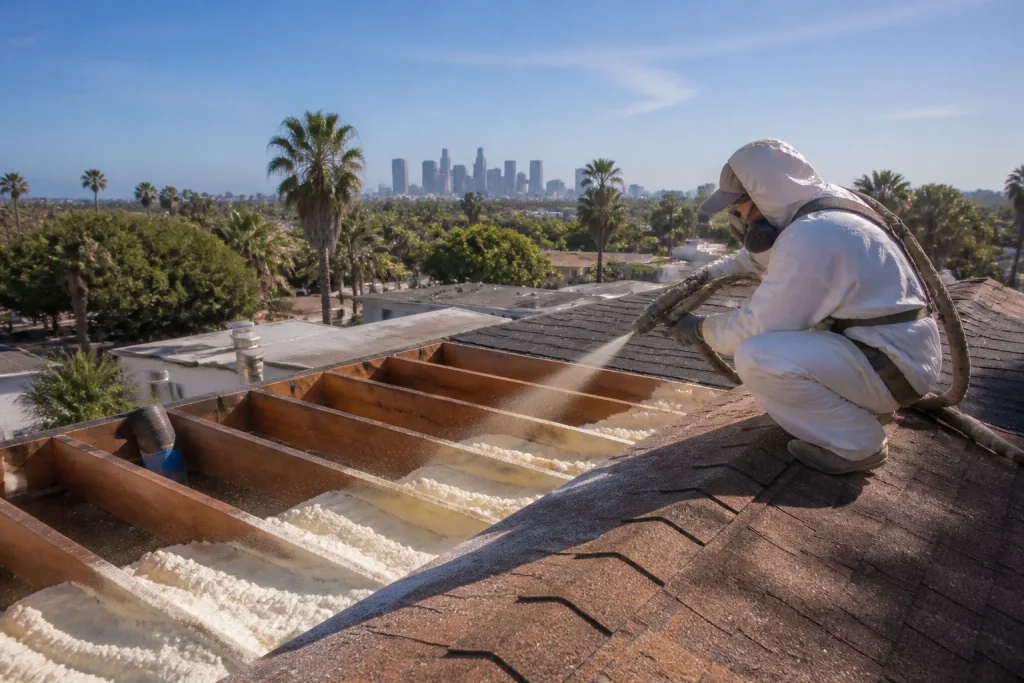
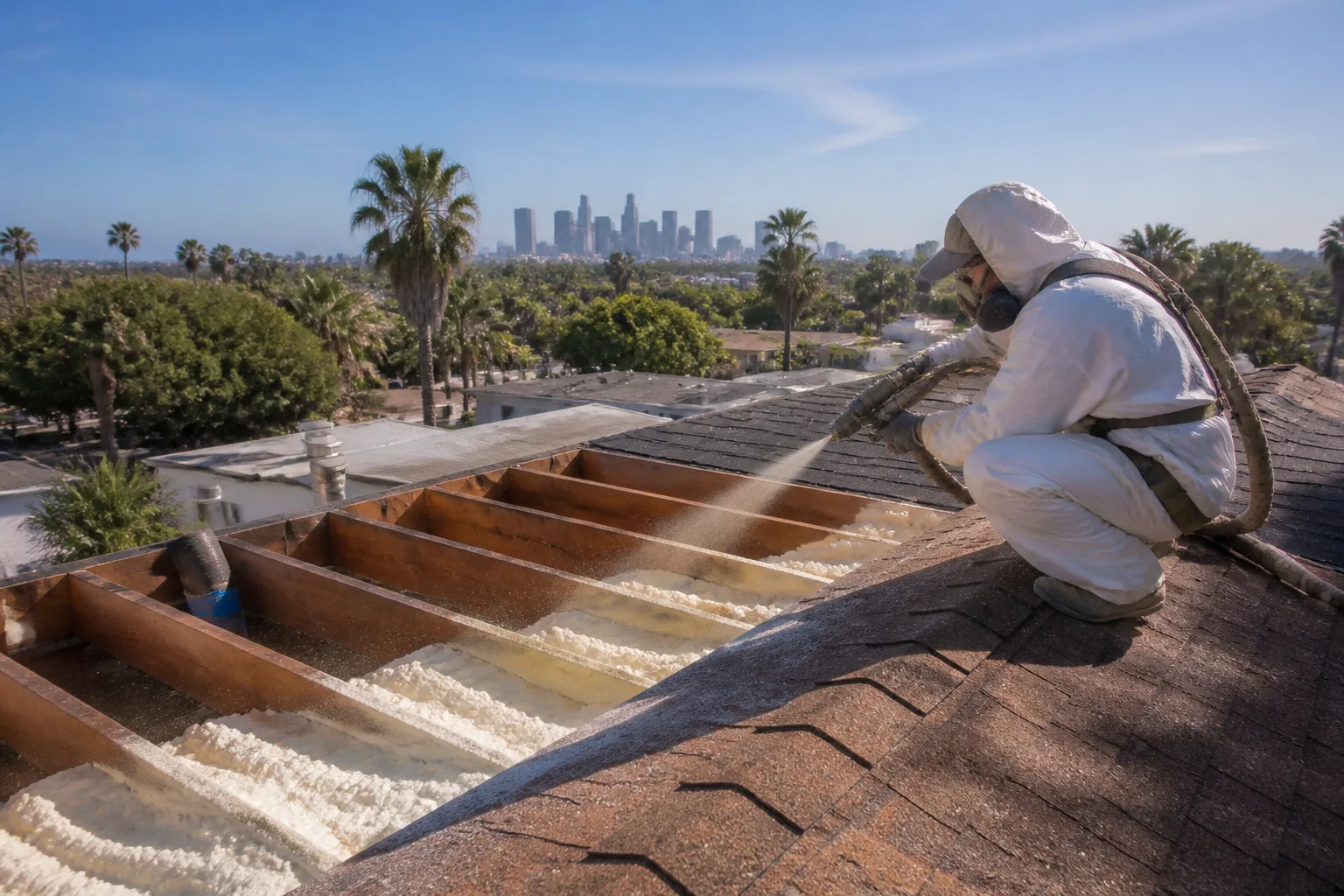
Most attics in Los Angeles are insulated at the floor. Batts or blown-in fiberglass sit on top of the ceiling drywall, the attic stays hot, and your HVAC ducts bake in 130-degree air all summer. Spray foam flips the equation. Instead of insulating the attic floor, we spray Icynene open-cell foam directly onto the underside of the roof deck, sealing the roofline itself.
The result is what building scientists call an unvented attic assembly. Your attic stops being an oven and becomes a semi-conditioned buffer space. The temperature up there tracks much closer to your living space, which means the air traveling through your ducts isn’t losing a huge share of its cooling before it reaches your vents. The Department of Energy has documented duct losses of 20 to 30 percent in unconditioned attics. In a Los Angeles summer, that’s real money leaving your house before the air ever touches your skin.
What’s also true: this approach does not work the same way with fiberglass batts at the roofline. Those need ventilation to dry out. Foam seals air and manages moisture differently, which is why the unvented approach works with spray foam and fails with almost everything else.
Where Icynene Specifically Wins in Los Angeles Homes
We don’t recommend Icynene for every house. We recommend it for specific situations, and those situations show up a lot in Los Angeles.
- HVAC air handlers in the attic. If your furnace or air handler lives up in the attic, you’re paying to cool ductwork that sits in a hotbox. Icynene at the roofline changes that math entirely. This is the single most common reason LA homeowners see dramatic energy savings after a spray foam job.
- Exposed-rafter cathedral ceilings. Many older homes in neighborhoods like West Adams, Silver Lake, and Highland Park have vaulted ceilings with no attic cavity at all. In those houses, the only practical place to put insulation is inside the rafter bays. Icynene sprayed between the rafters is often the cleanest, highest-performing option.
- Older homes where proper soffit-to-ridge ventilation is structurally impractical. Some roofs in Los Angeles were framed without adequate vent channels, and retrofitting them means cutting into structure that isn’t worth disturbing. Foam lets you skip ventilation entirely, because the assembly is designed to work without it.
If you’re not sure which category your house falls into, the honest move is to have someone look. We include that assessment in every estimate we do. You can also learn more about the broader range of attic insulation options in Los Angeles to see how Icynene compares to batts and blown-in.
How Much Does Icynene Attic Insulation Cost in Los Angeles?
Open-cell Icynene at the standard 5.5-inch depth, which gets you R-20, runs $2.50 to $3.50 per square foot installed in Los Angeles. That’s the honest range we quote, and it includes material, labor, and our written price before anything starts.
| Project Size (attic floor area) | Typical Range at R-20 |
|---|---|
| 800 sq ft (small bungalow) | $2,000 – $2,800 |
| 1,200 sq ft (standard ranch) | $3,000 – $4,200 |
| 1,800 sq ft (larger two-story footprint) | $4,500 – $6,300 |
A few things affect the final number. Roof complexity matters: a hip roof with lots of angles takes more time than a simple gable. Access matters too. If the attic is tight or the roof is steep, labor hours climb. And if you need more than 5.5 inches for code or comfort reasons, the price scales proportionally. For comparison, this sits above fiberglass batts and blown-in on upfront cost, but the payback calculation changes when you factor in duct conditioning savings and the elimination of attic air leakage. When you’re already running a second AC unit to keep a second floor cool in August, the foam often pays for itself faster than the numbers initially suggest.
One thing we insist on: you get a written price before work begins. No door-step surprises. That’s how we operate on every job, whether it’s Icynene or any other spray foam project in Los Angeles.
Why Open-Cell Foam’s Vapor Permeability Is a Feature in LA’s Climate
R-value is the number that measures how well insulation slows heat from moving through your ceiling. Higher means better resistance. But spray foam has another property that matters just as much in Los Angeles: vapor permeability.
Open-cell Icynene is vapor permeable. That means moisture can pass through it. Closed-cell foam, by contrast, acts as a vapor barrier. In a humid climate like Houston or Miami, closed-cell’s barrier properties protect the roof deck from moisture-laden outdoor air. But in Los Angeles, our climate is dry for most of the year, and our biggest moisture source is often the house itself: showers, cooking, laundry, and people breathing. If you seal the roof with closed-cell, you trap that indoor moisture inside the assembly, and over time it can condense on the underside of the roof sheathing.
Open-cell lets the assembly dry inward, which is the direction moisture wants to move in our climate. It’s a small technical detail, but it matters for the long-term health of your roof deck and for the material life. We’ve seen open-cell jobs in LA that are 15 years old and still performing with zero structural issues. We’ve also seen closed-cell jobs in older homes where trapped moisture created rot nobody discovered until the roof was torn off. A good installer should be able to explain this tradeoff in plain language. If your contractor can’t explain why they chose open-cell versus closed-cell, call someone else.
The Manufacturer Certification Question Nobody Asks
Icynene is a brand name with a manufacturer-controlled installer network. To install Icynene foam and offer the manufacturer’s warranty, a contractor has to go through Icynene’s training program and maintain certification. That certification matters for two reasons.
First, the material warranty on Icynene foam depends on the installer being certified at the time of application. If an uncertified contractor sprays Icynene, the manufacturer can deny warranty claims. Second, the application quality matters hugely for how the foam performs. Foam that’s applied at the wrong temperature, wrong thickness, or with bad mixing ratios can shrink, crumble, or fail to cure properly. A certified installer has passed training on those specifics.
This is also why photo documentation matters. We take before-and-after photos of every job, including the foam in place at the correct depth before it’s covered. If you ever need to file a warranty claim three or ten years down the road, you’ll have proof of what was installed. That documentation is part of our standard process on every Icynene and spray foam job we do in Los Angeles. If the warranty issue surfaces, you’ll be glad the evidence exists. We learned this the hard way once on a job over in Atwater Village, where a homeowner had lost all records from a previous contractor and had no way to prove what was below the drywall. We now document everything, every time.
What to Watch For When Comparing Contractors
If you’re getting multiple quotes for Icynene in Los Angeles, here’s what separates a real professional from someone who watched a training video and bought a rig.
- Certification proof. Ask to see the Icynene manufacturer certification. It’s not a secret document. A certified installer will show it to you.
- Depth commitment in writing. Your contract should state the exact inch depth and R-value to be applied, not just “spray foam.” R-20 means 5.5 inches of open-cell Icynene, and that number should be in writing.
- Documentation policy. Will you receive photos of the installed foam? If the answer is no, that’s a red flag. Photo proof protects your warranty.
- Scope clarity. Which areas get sprayed, which areas don’t, and what prep work is included? Air sealing around gaps and penetrations should be part of the job.
We’ve pulled apart enough botched foam jobs in Los Angeles to know that the expensive mistake isn’t the foam itself. It’s hiring someone who doesn’t document, doesn’t certify, and doesn’t stand behind the work. If any of this feels like homework you’d rather skip, call us at (361) 314-0118 and we’ll give you a straight answer with numbers attached.
The Bottom Line
Icynene open-cell spray foam is not the right product for every attic in Los Angeles. But for homes with attic-mounted HVAC equipment, vaulted or cathedral ceilings, or ventilation problems that would require structural work to fix, it’s often the best solution available. The cost of $2.50 to $3.50 per square foot at R-20 sounds high compared to fiberglass, but the real value is in moving your ductwork inside the thermal envelope and eliminating air leakage at the roofline. That’s the part most comparison shopping misses.
If you’re in Los Angeles and want an honest assessment of whether Icynene fits your home, Laurel Attic Insulation offers free estimates. Call (361) 314-0118 and you’ll get a written price before anything starts, live arrival tracking on the day of service, and photo proof of the job from start to finish. If we don’t think Icynene is right for your house, we’ll tell you that too. We’d rather install the right material once than the wrong material twice. If your attic needs existing material removed first, we handle insulation removal in Los Angeles as part of the full job.
Frequently Asked Questions
For homes with attic-mounted HVAC equipment, exposed-rafter ceilings, or ventilation retrofits that aren’t practical, yes. The energy savings from moving ductwork inside the thermal envelope often exceed the savings from the insulation value alone. For a standard vented attic with floor insulation and ducts in good condition, a less expensive option may serve you better. Call (361) 314-0118 for an honest read on your specific house.
Open-cell Icynene foam is designed to last the life of the home. It does not settle or sag like blown-in fiberglass, and it doesn’t lose loft like batts. The material itself carries a manufacturer warranty when installed by a certified contractor, and we back our workmanship with a written guarantee on every job.
If you’re spraying the roof deck, old floor insulation may remain in place but should be evaluated first. In some cases, old or contaminated insulation should come out before foam work begins, especially if there’s been rodent activity or moisture damage. We’ll tell you whether removal is necessary during the estimate, and we handle insulation removal when it is.
For a vented attic with floor insulation, code in Southern California generally calls for R-30 to R-38. For an unvented attic with open-cell Icynene at the roof deck, R-20 at 5.5 inches is the standard, and it performs differently because the attic space itself becomes part of the conditioned envelope. The right number depends on your roof assembly, not a one-size-fits-all chart. Laurel Attic Insulation home estimates include the exact depth and R-value in writing.
Written by the team at Laurel Attic Insulation.
Need Insulation Help?
Call Laurel Attic Insulation - licensed & insured, here with fast after-hours help in Los Angeles.
(361) 314-0118