
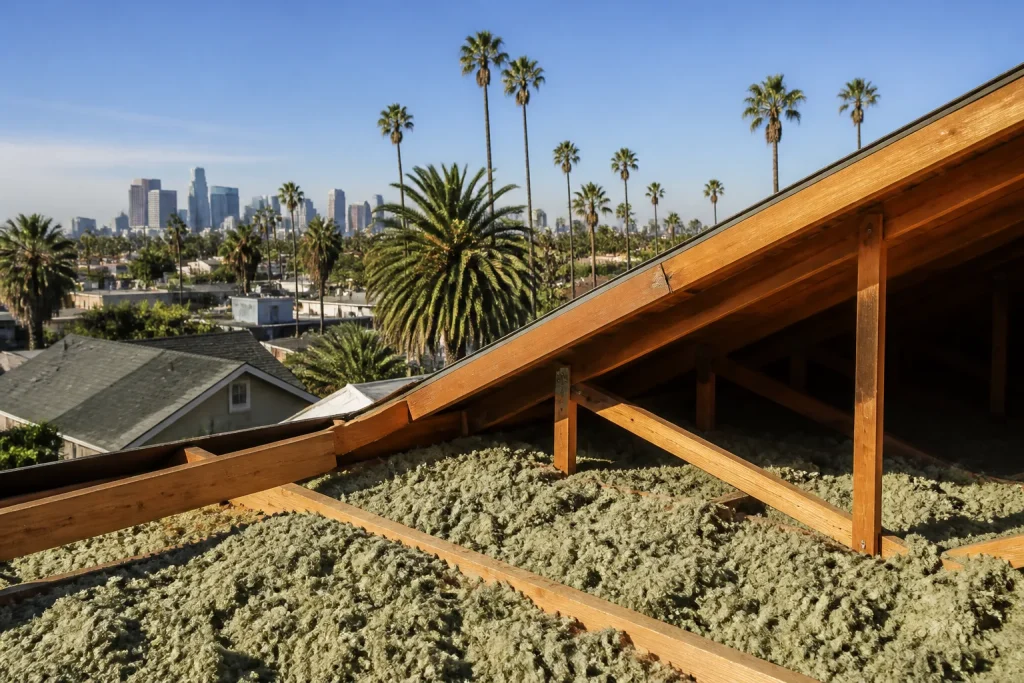
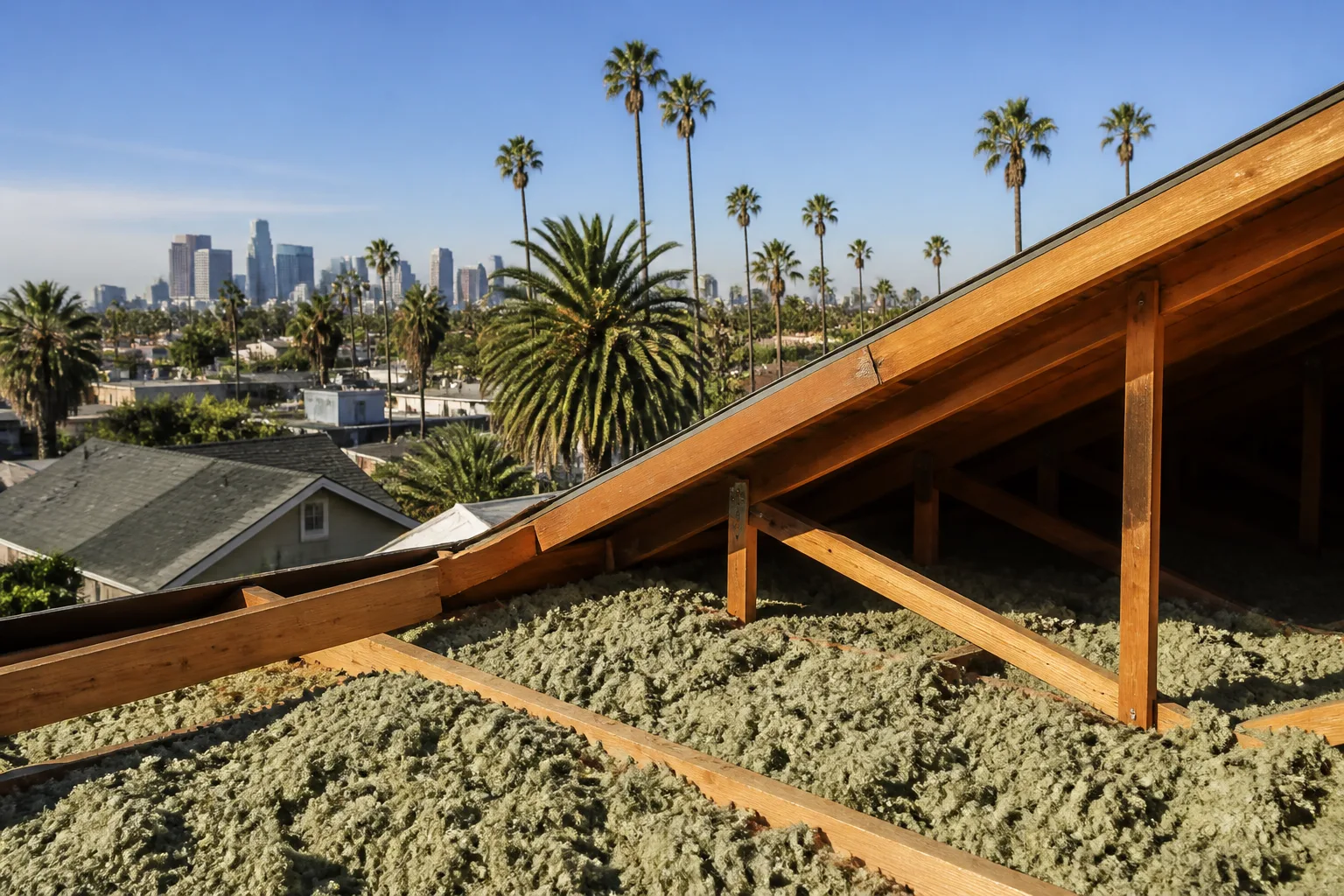
GreenFiber Attic Insulation in Los Angeles: A Homeowner’s Guide
GreenFiber blown-in cellulose insulation costs roughly 25 – 35% less installed than comparable fiberglass batts and delivers a higher settled R-value per inch, yet it’s the brand you’ll almost never see featured in a contractor’s pitch deck. Why? Because it’s made from recycled newsprint, and that simple fact makes some homeowners nervous and some contractors lazy. Here’s the truth: in Los Angeles, GreenFiber is one of the smartest insulation decisions you can make, provided your attic ventilation is doing its job during marine layer season. If you’d rather skip the research and just get a written price, call (361) 314-0118 and we’ll handle the rest.
What GreenFiber Actually Is (And Why It Costs Less)
GreenFiber is a cellulose insulation product, which means it starts its life as recycled newspaper and cardboard treated with borate compounds for fire resistance and pest deterrence. The material gets shredded into a fine, fluffy consistency and then blown into your attic with specialized equipment. Because the raw material is recycled paper rather than manufactured glass fibers, the production cost is lower, and that savings shows up on your invoice.
In Los Angeles, where attic spaces regularly hit 140°F in August, the performance difference matters more than the price difference. Cellulose has a settled R-value of about R-3.2 to R-3.8 per inch, which edges out standard fiberglass batts at R-2.9 to R-3.1 per inch. What that means in plain English: a 10-inch layer of GreenFiber gives you roughly R-34 to R-38 of thermal resistance, while the same depth of fiberglass might only get you R-30 to R-32. R-value measures how well insulation slows heat from moving through your ceiling, and in a city where summer cooling bills routinely hit $300-plus per month, that difference shows up on your LADWP bill.
The brand is manufactured by GreenFiber LLC, and it’s one of eight material lines we work with at Laurel Attic Insulation. We don’t stock eight brands because it looks good on a website. We stock eight brands because a 1930s Spanish Revival in Echo Park has different attic realities than a 1990s tract home in Porter Ranch, and the material should match the house, not whatever happens to be on hand.
Settled R-Value vs. Initial R-Value: The Number Nobody Explains
When a contractor quotes you “R-38 blown-in insulation,” they’re almost certainly quoting the initial installed R-value, not the settled R-value. All blown-in insulation settles over time. The question is how much. This is where GreenFiber has a mechanical advantage that most guides completely miss.
GreenFiber is installed using a dense-pack or stabilized method, depending on the attic configuration. Standard loose-fill cellulose is blown in at a density of roughly 1.5 to 2 pounds per cubic foot and will settle about 15 – 20% over its first year. That means an initial R-38 install could settle to R-31 or R-32 within twelve months if the installer didn’t account for settling. GreenFiber’s spec sheets explicitly instruct installers to “fluff” the material to a target depth that anticipates settling, so the settled R-value is the number printed on the bag. Other brands expect the installer to do that math themselves, and in our experience in Los Angeles, most don’t.
Dense-pack, by contrast, is installed at 3 to 3.5 pounds per cubic foot. At that density, settling is effectively zero, which means the R-value you pay for is the R-value you keep for 20-plus years. Dense-pack also creates an air seal that loose-fill can’t match, and in a Los Angeles attic, that air seal is doing a lot of quiet work keeping conditioned air inside your living space rather than escaping through every recessed light housing and plumbing chase.
How to verify your installer did dense-pack correctly: ask them what pounds per cubic foot they’re targeting. If they look at you blankly, find another installer. If they say 3.0 to 3.5 pcf, they know what they’re doing. That single question will separate the professionals from the pickup-truck-and-a-rented-blower crowd faster than anything else.
The Moisture Question: Cellulose and LA’s Coastal Humidity
This is the objection every skeptical homeowner raises, and it deserves a straight answer. The concern goes like this: cellulose is made from paper, paper absorbs water, water causes mold, therefore cellulose causes mold. The concern is understandable. The conclusion is wrong.
Here’s what the data actually shows. Modern cellulose insulation is treated with borate compounds, primarily boric acid and sodium borate, which do two things: they make the material Class 1 fire rated (the same rating as fiberglass), and they actively resist mold and fungal growth. The borate treatment doesn’t just sit on the surface of the fibers. It’s absorbed into the cellulose itself, which means the material has a built-in resistance to the exact failure mode people worry about.
The real variable in Los Angeles isn’t the material. It’s the ventilation. During marine layer season, from roughly May through July, coastal-adjacent neighborhoods like Westchester, Playa del Rey, and San Pedro get morning humidity levels that can sit at 80% or higher for hours at a time. If your attic isn’t ventilated properly, that humid air has nowhere to go. It condenses on the underside of your roof deck, drips onto whatever insulation is below it, and creates exactly the soggy mess people fear. That happens with fiberglass too, by the way. The material isn’t the problem. The airflow is.
Before any insulation goes in, we check ridge vents, soffit vents, gable vents, and any powered attic fans. If the ventilation is inadequate, the best insulation in the world won’t save you. If it’s adequate, GreenFiber performs beautifully in LA’s climate. We’ve pulled failed fiberglass out of attics in Mar Vista and Culver City where the insulation was fine and the ventilation was garbage. The material took the blame. It rarely deserves it.
Real Cost Comparison: GreenFiber vs. Owens Corning Fiberglass for a 1,500 Sq Ft Los Angeles Attic
Let’s talk actual dollars, because vague pricing is how contractors keep you in the dark. For a standard 1,500-square-foot attic in Los Angeles, assuming roughly R-38 of coverage:
- GreenFiber blown-in cellulose: $1,100 – $1,800 installed, depending on access, existing insulation removal, and whether we’re doing loose-fill or dense-pack.
- Owens Corning blown-in fiberglass: $1,500 – $2,500 installed for the same R-value target.
- Owens Corning fiberglass batts (R-38): $1,800 – $2,800 installed, and that’s assuming the attic framing is standard 16-inch or 24-inch on-center spacing.
The price gap exists because cellulose is cheaper to manufacture and faster to install. A two-person crew can dense-pack a 1,500-square-foot attic with GreenFiber in about four to five hours. Batts take longer because every cavity has to be cut and fitted individually, and blown fiberglass requires more material by volume to hit the same R-value.
On the performance side, GreenFiber’s settled R-value per inch beats blown fiberglass by roughly 10 – 15%, and its air-sealing properties are measurably better. Fiberglass is an air filter, not an air barrier. Cellulose is dense enough to actually slow air movement. In a Los Angeles attic, where conditioned-air leakage can account for 30% of your cooling load, that’s not a minor detail.
One note on R-value targeting: we quote every job with a written price before any work starts, so the number on your bid is the number you pay. No door-step adjustments, no “we found some extra square footage” phone calls. That’s the Laurel Attic Insulation standard, and it applies to every material we install.
California Title 24 Compliance: What You Need to Know
California’s building energy code, Title 24, sets minimum insulation requirements for residential attics. In Los Angeles, which sits in Climate Zone 6 or 9 depending on your exact location (San Fernando Valley and Inland areas are Zone 9; coastal areas are Zone 6), the prescriptive requirement for attic insulation is typically R-30 for existing homes and R-38 or R-49 for new construction and major remodels, depending on the climate zone and project scope.
GreenFiber’s product lines, including GreenFiber Sanctuary and GreenFiber Insulmax, meet or exceed Title 24 requirements when installed to the specified depth and density. The material carries a Class 1 fire rating, which is the same classification as fiberglass and rock wool. What that means in plain terms: if you’re pulling permits for a remodel in Los Angeles and your plans call for R-38 attic insulation, GreenFiber can be specified without any special variance or engineer’s note.
The compliance detail worth knowing: Title 24 cares about settled R-value, not initial R-value. If your installer blows in R-38 of loose-fill fiberglass and it settles to R-31 over the first year, your house is technically out of compliance. GreenFiber’s dense-pack method avoids that problem entirely because settled R-value equals installed R-value. For a Los Angeles homeowner, that’s the kind of detail that shows up on a home inspection when you sell.
If you’re not sure what R-value your attic currently has, we’ll check it during the free estimate. A quick ruler measurement tells us the existing depth, and a visual inspection tells us whether that old insulation is even doing its job anymore.
How Dense-Pack Actually Works (And How to Verify It Was Done Right)
Dense-pack is the installation method that makes GreenFiber perform the way the spec sheet promises. Here’s the mechanics: loose cellulose fibers are fed into a blower machine outside the house, travel through a 3-inch hose up into the attic, and get blown into the floor cavities at high pressure. The key phrase is “at high pressure.” Loose-fill installation dribbles the material in at low pressure, which leaves air gaps and allows settling. Dense-pack forces it in at 3.0 to 3.5 pounds per cubic foot, which creates a compacted, stable insulation layer.
The verification part matters because no homeowner is climbing into a 140-degree attic to check the installer’s work in August. Here are the three checks we recommend:
- Ask for the pcf number. Any installer who knows dense-pack will tell you their target density without hesitation. If they can’t, they’re not doing dense-pack.
- Look for uniform depth markers. Professional installers mark target depth on the trusses or use a depth gauge. The material should sit level across the entire attic floor, including the edges near the eaves.
- Request photo documentation. You should get before, during, and after photos. The Relay Standard we operate under includes photo proof of every job precisely because attics are invisible workspaces.
A properly dense-packed GreenFiber attic should feel firm underfoot, almost like walking on a firm mattress. If the material is fluffy and you sink into it, you got loose-fill, not dense-pack. Both can work, but the R-value retention is very different over a 10-year Los Angeles weather cycle.
When to Call a Pro
Some attic projects are genuinely DIY-able. Replacing weatherstripping on an attic hatch is easy. Adding a radiant barrier to the underside of rafters is doable with patience and a staple gun. But blown-in insulation, whether GreenFiber or anything else, is not a Home Depot weekend project. The blower machines are heavy and finicky, the installation technique actually determines whether the R-value performs, and walking through an unfinished attic without stepping through the ceiling is a skill you learn by doing it wrong once. Also, attics in Los Angeles hit 140°F in summer. That’s heat exhaustion territory, not a pleasant Saturday.
If you want the job done right and verified with photos, call us at (361) 314-0118 for a free estimate. We’ll come out, inspect the attic, answer the pcf question honestly, and give you a written price before anything starts. Related services in Los Angeles: Attic Insulation in Los Angeles and Spray Foam Insulation in Los Angeles.
The Bottom Line
GreenFiber is a genuinely superior product for LA attics when installed correctly: lower cost per R-value unit, higher settled R-value per inch, better air-sealing properties, and full Title 24 compliance. The moisture concern is real but manageable, and it has more to do with your attic ventilation than your insulation material. The single most important factor is installation quality, specifically whether the installer is doing true dense-pack at 3.0 to 3.5 pounds per cubic foot. Ask that question, and you’ll separate the professionals from the guys with a rental blower and a prayer.
If you’re in Los Angeles and want a no-pressure assessment of your attic, Laurel Attic Insulation offers free estimates with a written price before any work begins. Call (361) 314-0118 and we’ll handle the rest. We pulled a green fiberglass bat out of a garage attic in Silver Lake last week that was so old it had turned brown. Your attic probably isn’t that bad, but we’re happy to check.
Frequently Asked Questions
Yes. GreenFiber is treated with borate compounds that are non-toxic to humans and pets and are the same materials used in many household cleaning products. The borate treatment also makes the material fire-resistant and pest-deterrent. Once installed in the attic, it’s completely contained in a space your family never enters.
For a typical 1,500-square-foot Los Angeles attic at R-38, GreenFiber blown-in insulation runs $1,100 – $1,800 installed. Dense-pack runs slightly higher due to the additional labor. The price depends on attic access, existing insulation removal, and whether air sealing is included. Call (361) 314-0118 for an exact quote. Estimates are free.
Standard loose-fill cellulose settles 15 – 20% in the first year. GreenFiber’s dense-pack method, installed at 3.0 to 3.5 pounds per cubic foot, eliminates settling almost entirely, so the R-value you buy is the R-value you keep. If your installer can’t tell you their target density, they’re not doing dense-pack.
Yes, in most cases. Cellulose can be blown directly over existing fiberglass or rock wool as long as the existing material is dry, mold-free, and not compressed. However, if your existing insulation has been damaged by rodents, water, or decades of LA heat cycling, removal is the better path. We offer Insulation Removal in Los Angeles as part of a complete attic upgrade. We’ll assess the existing material during the free estimate and give you an honest recommendation.
Written by Laurel Attic Insulation at Laurel Attic Insulation home, serving Los Angeles.
Need Insulation Help?
Call Laurel Attic Insulation - licensed & insured, here with fast after-hours help in Los Angeles.
(361) 314-0118