
Demilec Attic Insulation in Los Angeles: A Homeowner’s Guide
Demilec attic insulation in Los Angeles typically costs $2,800 to $6,500 for a standard 1,200 sq ft attic when you’re using closed-cell Heatlok spray foam, or $1,800 to $3,800 for open-cell Sealection. It’s one of the few insulation systems genuinely built for what LA attics actually go through: 150°F afternoon heat in July followed by a 40-degree temperature swing by midnight. Most fiberglass batts were never designed for that kind of daily stress. Demilec’s formulas were.
If you’d rather skip the research and just get a straight answer on what your attic needs, call Laurel Attic Insulation at (361) 314-0118. We’ll give you a written price before anything starts, and you’ll never sit around wondering when we’ll show up.
Why Demilec Matters More in Los Angeles Than Most Homeowners Realize
Your attic in Sherman Oaks hits 150°F in July. In December, it drops into the 40s at night. That’s a 100-degree swing inside one calendar year, and your insulation sits in the middle of it the whole time. Traditional fiberglass batts sag, compress, and lose effectiveness under that kind of thermal cycling. Air leaks through gaps that batts simply can’t seal.
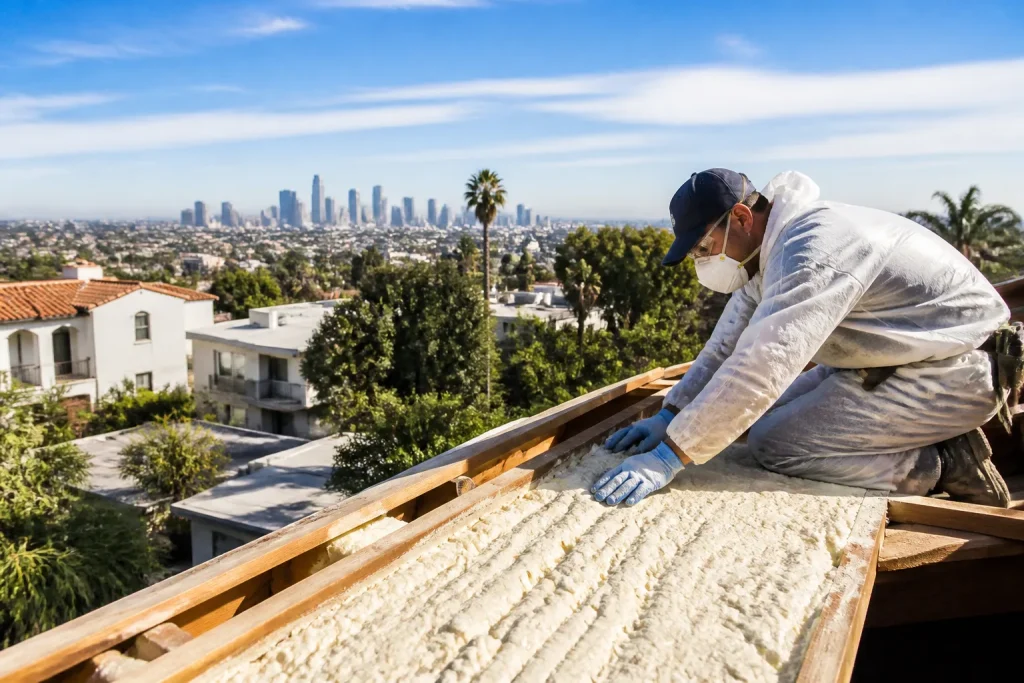
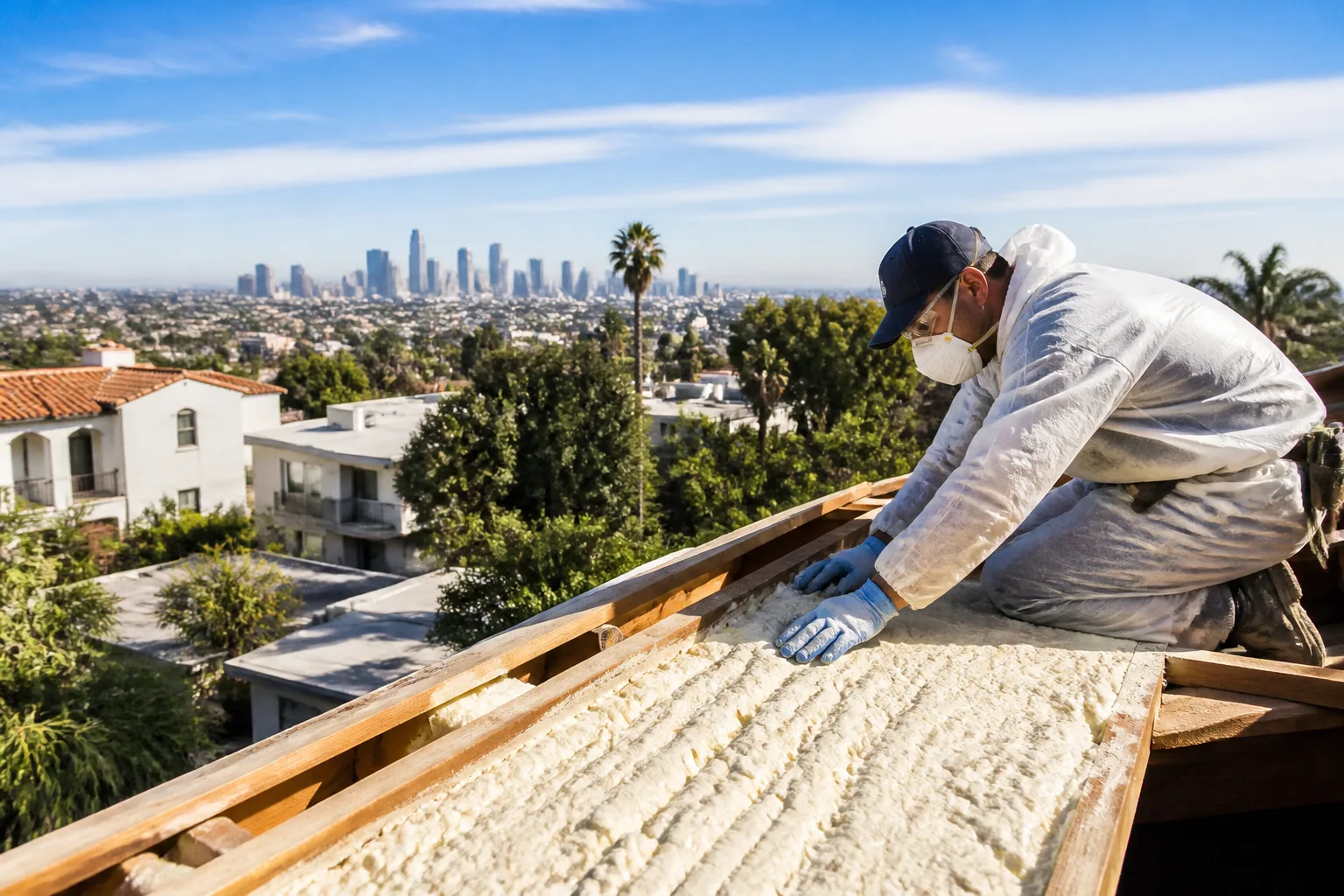
Demilec’s closed-cell polyurethane spray foam, Heatlok HFO, creates an air seal and an insulation layer in one pass. It’s not just stuffing material into a cavity; it’s bonding to the roof deck and wall framing to stop air movement entirely. In Los Angeles, where air leakage is often a bigger comfort problem than raw R-value, that matters. We’ve pulled batt insulation out of attics in Pasadena and Eagle Rock that looked like damp sponges after five years of coastal-influenced humidity swings. Demilec foam doesn’t sag. It doesn’t shift. It stays where you spray it.
Demilec sits alongside Icynene, Rockwool, and CertainTeed in the materials we offer at Laurel Attic Insulation home, and for a specific set of LA attic conditions, Demilec is often the one we recommend first.
Demilec’s Two Product Lines: Heatlok HFO and Sealection 500
Demilec makes two spray foam products that matter for Los Angeles attics, and they serve different purposes. Knowing which one fits your situation saves you from paying for more than you need.
Heatlok HFO: Closed-Cell, Maximum Seal, Higher Price
Heatlok HFO is a closed-cell spray foam. That means the foam cells are packed together tight, forming a rigid, dense layer that blocks both air and moisture. It delivers roughly R-7 per inch, so a 2-inch application gives you about R-14 plus a full air seal. It also acts as a vapor barrier at that thickness.
This is the product for attics where:
- The roof deck is exposed and you want to convert the attic into conditioned space
- You have ductwork running through the attic and want to stop thermal loss
- You’re in a hillside home, like parts of Silver Lake or Mount Washington, where moisture intrusion from the wall assembly is a real concern
- You want structural reinforcement (closed-cell foam adds shear strength to wall and roof assemblies)
Sealection 500: Open-Cell, Softer, Air-Seal Focused
Sealection 500 is open-cell foam. The cells aren’t fully closed, so the material is softer, expands more, and delivers about R-3.8 per inch. It’s less expensive per board foot, but it doesn’t stop moisture vapor the way closed-cell does.
This is the right pick for attics where:
- The primary goal is air sealing and sound dampening, not maximum R-value per inch
- You have a vented attic and are insulating the attic floor, not the roofline
- Your budget is tighter but you still want a continuous air barrier
- You’re soundproofing between floors and the attic
In Los Angeles, we’ve found Sealection 500 is often the smarter choice for older homes in neighborhoods like Mid-City or West Adams where the attic isn’t living space and the real problem is drafty air leakage, not thin insulation. Heatlok HFO earns its price tag when the attic is part of the conditioned envelope.
What Demilec Actually Costs in Los Angeles
Spray foam gets expensive fast, so let’s talk real numbers. These are installed costs for Los Angeles and the San Fernando Valley, including labor, equipment setup, and materials, based on what we quote and what we’ve seen in the market.
| Attic Scenario | Product | Typical 1,200 sq ft Cost |
|---|---|---|
| Attic floor, vented attic | Sealection 500 (open-cell, ~10″) | $1,800 – $3,800 |
| Roofline, unvented/conditioned attic | Heatlok HFO (closed-cell, ~3″) | $2,800 – $6,500 |
| Roofline with flash-and-batt hybrid | Heatlok HFO (2″) + fiberglass or Rockwool batt layer | $2,200 – $5,200 |
| Attic floor with air sealing package | Sealection 500 (seal rim joists + floor) | $2,400 – $4,800 |
Per-board-foot pricing in LA typically runs $0.55 to $1.10 for open-cell and $1.15 to $2.10 for closed-cell, installed. The spread depends on access, prep work, existing insulation removal, and whether you’re in a single-story Ranch in Van Nuys or a three-story hillside build with tight clearance.
One thing we always tell homeowners in Los Angeles: if a quote comes in meaningfully below these ranges for closed-cell foam, ask hard questions about foam thickness and coverage. Spray foam is expensive because the chemistry is expensive. Shortcutting shows up as thin spots, a cheap open-cell where closed-cell was specified, or worse, poor mixing that leaves the foam soft and off-gassing.
California Title 24 and Demilec: What Actually Applies
California’s Title 24 building energy efficiency standards don’t care what brand of insulation you use. They care about two things: R-value and air leakage. Demilec’s product specs map to Title 24 requirements in ways that make compliance documentation straightforward, which is something a lot of insulation contractors in Los Angeles don’t bother explaining.
Title 24 requires attic insulation to hit specific R-values depending on your climate zone. Most of Los Angeles falls in zones 6 through 9, which call for R-30 to R-38 in vented attics and R-22 to R-30 for unvented roof assemblies. Heatlok HFO at 3.5 inches delivers R-25, which meets the unvented assembly floor for most LA climate zones. Sealection 500 at 10 inches delivers R-38, which meets vented attic requirements.
The air leakage piece is where Demilec genuinely outperforms. Title 24’s performance approach lets you trade measured air sealing for R-value, and a properly sprayed Demilec job will out-seal any batt installation. If you’re renovating with permits in Los Angeles, your energy consultant or HERS rater will test for envelope leakage. Closed-cell foam on the roofline is the fastest path to passing a blower door test in an older LA home.
For most homeowners, the takeaway is this: Demilec isn’t a “Title 24 product” in some special registered sense. It’s a product that makes Title 24 easier to meet because it solves the air leakage problem that fiberglass leaves on the table.
When Demilec Closed-Cell Is Overkill, and the Hybrid Alternative
Closed-cell spray foam is the most expensive insulation per square foot you can put in an attic. And in a lot of Los Angeles homes, you don’t need it on the roofline at all. Here’s the scenario we see constantly: a 1940s or 1950s home in Burbank, Glendale, or the Valley with a vented attic and a conventional roof. No one’s living up there. The ducts run through the space, but the roofline has soffit and ridge vents doing exactly what they were designed to do.
In that situation, spraying Heatlok HFO across the roof deck is paying for a product you don’t need. A flash-and-batt hybrid saves real money. That’s 2 inches of closed-cell Demilec on the roofline to create an air and moisture barrier, followed by a layer of Rockwool or fiberglass batt over it to hit your total R-value target. You get the air sealing benefit of foam at roughly 60% of the full-foam cost.
The other overkill scenario is a flat-roof home in Los Angeles where the ceiling cavity is shallow and inaccessible. We’ve seen quotes for full foam encapsulation on homes where the real problem was simply old, compressed fiberglass on the attic floor. Sometimes the fix is Insulation Removal in Los Angeles plus a proper blown-in material, not a five-figure foam job.
We tell people this because we’d rather you spend $3,000 on the right solution than $7,000 on the wrong one. That’s how we’d want to be treated if the roles were reversed.
What a Proper Demilec Install Looks Like – And How to Spot a Rushed Job
Spray foam is a chemical reaction, not a carpentry project. The quality of a Demilec installation in your Los Angeles attic comes down to three things: mixing, temperature, and coverage depth. Here’s what we check on every job, and what you should look for if you’re comparing contractors.
Mixing ratios. Demilec foam comes as two liquid components, an A-side and a B-side. They must mix at a precise 1:1 ratio at the spray gun. If the mix is off, the foam won’t cure properly. It’ll feel spongy, it’ll smell off, and it won’t hit its rated R-value. A proper rig has heated hoses and digital proportioning. A cheap rig guesses, and guessing ruins foam.
Temperature conditions. Demilec foam needs substrate temperatures between 60°F and 120°F to cure correctly. That’s rarely a problem in a Los Angeles attic in summer, but in winter, or on a shaded hillside in December, a contractor should be using a substrate heater or waiting for the right conditions. If someone shows up to spray on a cold January morning and doesn’t check the deck temperature, that’s a red flag.
Cure time and re-entry. Closed-cell Heatlok HFO is typically safe for re-entry after 2 hours. Open-cell Sealection 500 takes about 8 to 12 hours. A contractor who tells you to sleep in the house the same night as an open-cell spray is telling you to sleep in off-gassing foam. Don’t.
One time we were called out to a home in Eagle Rock where a previous contractor had sprayed Heatlok in a single pass that measured 1.5 inches in some spots and 4 inches in others. The homeowner was told it was “within tolerance.” It wasn’t. Inconsistent depth means inconsistent R-value, which means you paid for a number you didn’t get. We documented every inch of that attic with photos, tore out the bad foam, and re-sprayed it right. That’s the standard, and it should be yours too.
The Bottom Line
Demilec spray foam is one of the best insulation materials available for Los Angeles attics, specifically because it’s engineered for the temperature swings and air leakage patterns that define our climate. But “best material” doesn’t mean “always the right choice.” Open-cell Sealection 500 is the value pick for vented attics. Closed-cell Heatlok HFO earns its cost on the roofline of conditioned attics and hillside homes. And a flash-and-batt hybrid using Heatlok plus Rockwool or fiberglass is often the smartest money you can spend in a conventional LA home.
If you’re in Los Angeles and want a straight answer, Laurel Attic Insulation offers free estimates with a written price before any work starts. Call (361) 314-0118.
Related Services in Los Angeles
If you’re evaluating Demilec for your attic, these services might be part of the same project:
- Attic Insulation in Los Angeles – our full attic insulation service, including Demilec, Rockwool, and blown-in options
- Spray Foam Insulation in Los Angeles – if you want to compare Demilec against Icynene and other foam systems
What happens when you call
- 1
A real person answersNo phone trees - you reach a local pro.
- 2
You get an upfront price rangeHonest numbers before anyone is dispatched.
- 3
A background-checked tech heads outLicensed & insured, dispatched right away.
- 4
You approve before work beginsNothing starts until you say go.
Frequently Asked Questions
Demilec attic insulation in Los Angeles typically costs $1,800 to $6,500 depending on product type and attic size. Open-cell Sealection 500 on a vented attic floor runs $1,800 to $3,800 for a typical 1,200 sq ft attic. Closed-cell Heatlok HFO on the roofline runs $2,800 to $6,500. Get a written quote before any work starts. Call (361) 314-0118 for a free estimate.
Yes, once it’s fully cured. Closed-cell Heatlok HFO is re-entry safe in about 2 hours. Open-cell Sealection 500 takes 8 to 12 hours. During spraying, the home should be vacated and the installer should be wearing proper respiratory protection. A contractor who tells you to stay in the house during spraying is not following basic safety protocol.
No. Spray foam needs direct contact with the surface it’s sealing, whether that’s the roofline or the attic floor. Old fiberglass, cellulose, or deteriorated foam has to come out first. In Los Angeles, a lot of homes have 60-year-old insulation that’s compacted and dusty, and removing it before spraying is the correct sequence.
Demilec polyurethane foam, when installed correctly, is chemically stable and doesn’t sag, settle, or lose R-value the way fiberglass can. Realistically, a proper Demilec install should last 30+ years in an LA attic. The failure points we see are installation errors, not material degradation: poor mixing, inconsistent depth, or spraying over moisture.
Written by the team at Laurel Attic Insulation.
Need Insulation Help?
Call Laurel Attic Insulation - licensed & insured, here with fast after-hours help in Los Angeles.
(361) 314-0118