
CertainTeed Attic Insulation in Los Angeles: A Homeowner’s Guide
CertainTeed attic insulation solves two problems that show up constantly in Los Angeles homes built between 1945 and 1975: non-standard 24-inch on-center joist spacing and indoor air quality issues from decades of old adhesives, finishes, and trapped VOCs. Their AirRenew and Sant-R-Batt lines are the only mainstream batt products engineered to tackle both at once. If you’d rather not spend your weekend crawling through fiberglass, call Laurel Attic Insulation at (361) 315-4177 for a free estimate.
Most homeowners default to whatever insulation brand they see first at the big box store. We get it. You have a hot upstairs, a cold downstairs, and an energy bill that makes you wince every August. But CertainTeed earns a closer look for a specific reason: LA’s older housing stock was built differently than what most insulation manufacturers design for. We’ll break down what actually matters, what’s marketing fluff, and where this brand genuinely outperforms the alternatives.
What CertainTeed Insulation Actually Does Differently
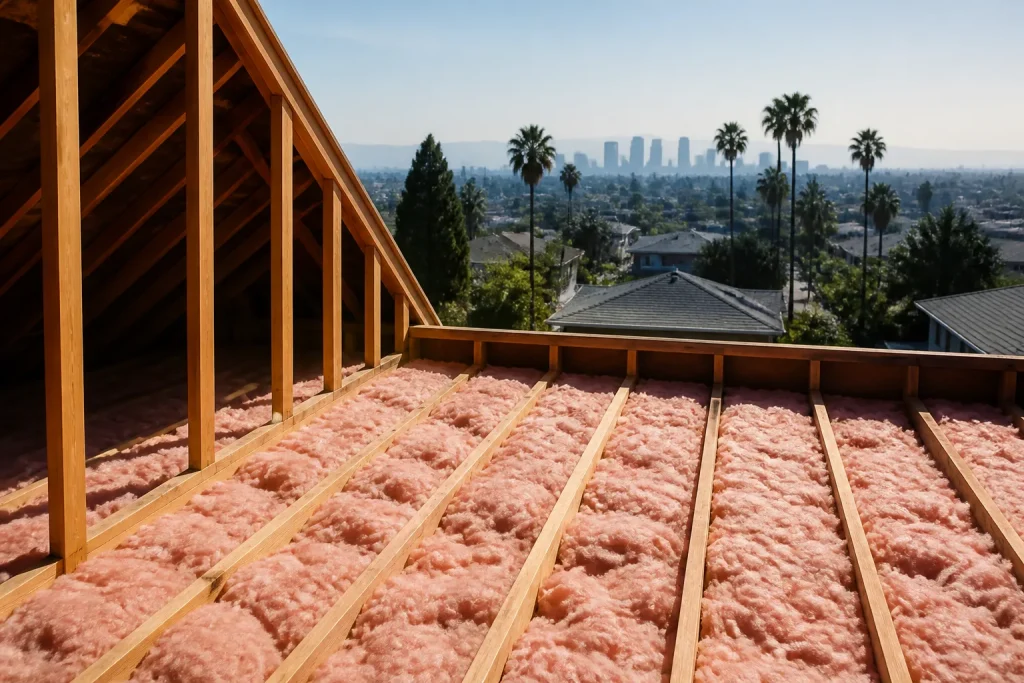
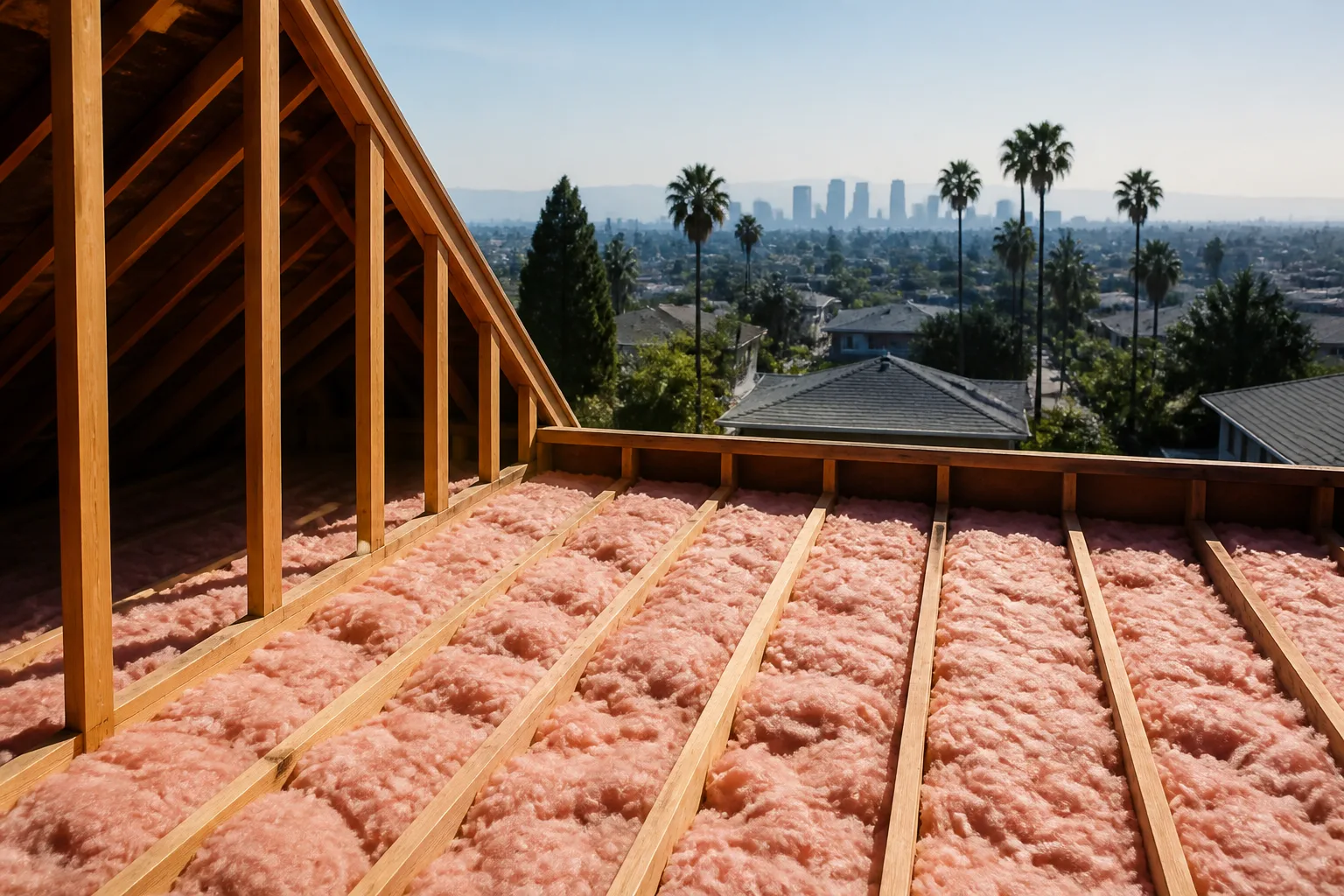
CertainTeed has been manufacturing building materials since 1904, and their insulation division makes two products that matter for Los Angeles attics: CertainTeed AirRenew and CertainTeed Sant-R-Batt. Both are fiberglass batt insulation, meaning they come in pre-cut rectangular sections that fit between joists. The difference is in what they’re engineered to do beyond basic thermal resistance.
AirRenew is the product that gets our attention. According to CertainTeed’s own spec sheet, the batt contains a formaldehyde-absorbing technology that captures volatile organic compounds from the surrounding air. In plain English: it’s designed to pull formaldehyde and other VOCs out of your home’s air and trap them in the insulation. The captured compounds won’t re-release back into your living space. CertainTeed claims the capability lasts for the lifetime of the product as long as the batts remain dry and intact.
Now, here’s what we tell our Los Angeles customers in the field. Homes built in the 1940s, 1950s, and 1960s used adhesives, lacquers, and engineered woods that off-gas for decades. That’s not a scare tactic. That’s building science. An attic with AirRenew gives you a passive air-quality assist that standard fiberglass simply doesn’t provide. It’s not a substitute for ventilation or source removal, but it’s a meaningful layer for older LA homes.
Sant-R-Batt, by contrast, is CertainTeed’s workhorse thermal batt. We’ll get into how it performs compared to Owens Corning and Rockwool below.
Why Non-Standard Joist Spacing Changes the Whole Equation
Here’s the thing most insulation guides skip: homes in Los Angeles built before roughly 1970 frequently used 24-inch on-center joist spacing instead of today’s standard 16-inch. The distinction matters enormously when you’re choosing between batt and blown-in insulation.
Standard fiberglass batts are manufactured for 16-inch or 24-inch cavities. If your home has 24-inch spacing and you buy batts sized for 16-inch, you’ll leave gaps at every joist. Those gaps become thermal bypasses, which is the technical term for “your expensive conditioned air leaking straight through your ceiling.” Conversely, if you have 16-inch joists and force 24-inch batts in, compression destroys the R-value. Compressed fiberglass insulates worse, not better, because it’s the trapped air pockets that do the insulating work.
CertainTeed Sant-R-Batt and AirRenew both come in custom widths that fit 24-inch on-center framing without modification. This sounds minor. It isn’t. In neighborhoods like West Adams, Echo Park, and the older sections of the San Fernando Valley, we consistently see pre-1970s construction with exactly this spacing. If you have a Spanish revival or California bungalow from this era, blown-in insulation can work, but batts sized for your actual framing give you more predictable coverage, especially in attics with awkward geometry, roof pitch changes, or areas you plan to use for storage.
If you’re not sure what spacing your home has, that’s exactly the kind of thing our team checks during a free estimate. Call (361) 315-4177 and we’ll take a look.
How CertainTeed Stacks Up Against Owens Corning and Rockwool
Let’s talk numbers. R-value measures how well insulation slows heat from moving through your ceiling. Higher is better. At the same installed thickness, here’s how the three main brands compare for batt products:
- CertainTeed Sant-R-Batt: approximately R-3.7 per inch at standard density
- Owens Corning EcoTouch: approximately R-3.7 per inch at standard density
- Rockwool Comfortbatt: approximately R-4.2 per inch at standard density
Rockwool wins on pure thermal performance per inch because stone wool is denser than fiberglass. But density has tradeoffs. Rockwool costs more per square foot, is heavier to work with, and offers no VOC-capturing capability. Owens Corning EcoTouch performs essentially identically to Sant-R-Batt on thermal resistance. The deciding factor between those two often comes down to the air-quality angle and product availability through certified installers in the Los Angeles market.
For Los Angeles climate zones, the Department of Energy recommends attic insulation between R-30 and R-60 depending on whether your home is in a coastal zone (milder winters, marine layer influence) or inland (hotter summers, bigger temperature swings). If you’re aiming for R-38, which is a common sweet spot, you’re looking at roughly 10 to 11 inches of either CertainTeed or Owens Corning fiberglass batt.
Here’s what we’ve seen in practice across Los Angeles attics: the thermal difference between these three brands at the same R-value is negligible. You’ll feel the same summer comfort. What changes your actual experience is installation quality. Gaps, compression, and missed spots will erase any theoretical brand advantage faster than you can say “August electric bill.”
The ClimaPlus Claim: What the Spec Sheet Says vs. What LA’s Marine Layer Actually Does
CertainTeed markets ClimaPlus as a moisture-and-mold-resistant facing on their batt products. The spec sheet says it resists moisture absorption and won’t support mold growth. That’s accurate, but it’s not magic, and it’s worth understanding what it means for your specific Los Angeles neighborhood.
If you live within a few miles of the coast, places like Venice, Playa del Rey, San Pedro, or Long Beach, your attic sees regular marine layer fog and higher ambient humidity than homes in Pasadena or Studio City. Here’s what we’ve observed after years of attic work in those coastal zones: ClimaPlus does help with surface moisture resistance, but it can’t overcome an attic with inadequate ventilation. If your attic has blocked soffit vents, no ridge vents, or bathroom fans exhausting directly into the attic space, water vapor will condense regardless of what brand of insulation you install.
We pulled a batt out of a garage conversion in Mar Vista last year where the homeowner had installed CertainTeed themselves five years earlier. The top face was fine. The underside, sitting against a poorly vented roof deck, was waterlogged. The ClimaPlus facing did what it could, but the underlying moisture problem was bigger than any batt can solve.
The takeaway: ClimaPlus is a worthwhile feature for coastal Los Angeles homes, but it’s a supplement to proper attic ventilation, not a substitute. If you’re not sure whether your attic vents correctly, that’s part of what we evaluate during a free insulation assessment.
What CertainTeed’s Lifetime Limited Warranty Actually Covers
CertainTeed’s warranty language is a genuine factor in the buying decision, and this is one area where buying through a certified installer changes your coverage. Here’s the plain-language breakdown:
What’s covered: The lifetime limited warranty covers the thermal performance of the insulation for as long as you own the home. If the batts fail to perform at the labeled R-value due to a manufacturing defect, CertainTeed will replace the product. The warranty transfers if you sell your home.
What voids it: This is the part most people don’t read. The warranty excludes damage from water intrusion, improper installation, compression, or any modification to the product after installation. If you squash the batts to make them fit, if a roof leak soaks them, if a rodent nests in them, you’re outside coverage. If you buy CertainTeed from a box store and install it yourself, CertainTeed’s warranty covers the product only. Labor to remove and replace defective insulation is on you.
Why buying through a certified installer changes terms: CertainTeed’s best warranty terms apply when the product is installed by a contractor who participates in their certified installer program. The workmanship component, meaning the actual installation labor, gets covered separately. At Laurel Attic Insulation, our own 365-Day Done Right Promise runs independently of CertainTeed’s product warranty. That means if something’s not right within a year, we make it right, in writing, on every job. If a repair fails, you get a free second visit. No charge, no argument.
That’s the combination that actually protects you: the manufacturer’s product warranty plus the installer’s workmanship coverage. One without the other leaves gaps.
When CertainTeed Makes Sense for Your LA Home (And When It Doesn’t)
Here’s the honest version. CertainTeed is not the right call for every Los Angeles attic. Here’s our decision framework based on real jobs across the city:
CertainTeed AirRenew is a strong choice if:
- Your home was built between 1945 and 1975 and you suspect old adhesives, flooring, or finishes are still off-gassing
- You have family members with chemical sensitivities or respiratory conditions
- You want the passive air-quality benefit without changing your daily habits
CertainTeed Sant-R-Batt is a strong choice if:
- Your attic has 24-inch on-center joist spacing and batts sized for 16-inch cavities won’t work
- You want fiberglass batt at a price point comparable to Owens Corning
- You’re in a coastal Los Angeles zone and the ClimaPlus moisture resistance adds value
CertainTeed is probably not the right call if:
- You’re building a new home and want the highest R-value per inch (look at Rockwool or closed-cell spray foam instead)
- Your attic has complex geometry, lots of penetrations, or hard-to-reach corners where blown-in insulation performs better for coverage
- You’re on an extremely tight budget and your attic is a simple, open rectangle (in that case, standard blown-in fiberglass like Knauf or Johns Manville may be more economical)
If you’re weighing batt versus blown-in for an older Los Angeles home, our attic insulation service page walks through the tradeoffs in more detail. And if the job calls for spray foam instead, we offer spray foam insulation in Los Angeles using Icynene and Demilec products. Sometimes the old insulation has to come out before anything new goes in, and our insulation removal service handles that too.
When to Call a Pro
Installing batt insulation in an attic is one of those projects that looks straightforward on YouTube and turns difficult fast once you’re up there. Attic temperatures in Los Angeles hit 120 to 130 degrees in summer. The spaces are tight. Wires, junction boxes, recessed lights, and HVAC runs all need to be worked around carefully. And here’s the safety part we don’t skip: if your attic has vermiculite insulation from before 1990, it may contain asbestos. Do not disturb it. A professional assessment is the only safe move.
Even setting safety aside, a bad insulation job costs you money. Gaps around electrical boxes. Compression at the eaves. Missing the far corners. We’ve fixed enough DIY jobs to know that the materials are only half the result. The other half is consistent, airtight installation. Our crews are background-checked, uniformed, and show up at a live, trackable time through the Relay Visibility Guarantee. You get a written price before anything starts, before-and-after photos, and pay from a digital link when the job’s done.
The Bottom Line
CertainTeed attic insulation earns its place in the conversation for a specific slice of the Los Angeles housing stock: older homes with non-standard framing and indoor air quality concerns. AirRenew’s VOC-capturing capability is real and differentiated. Sant-R-Batt performs on par with Owens Corning EcoTouch at the same R-value and thickness. ClimaPlus is useful for coastal moisture resistance provided your attic ventilation is sound. The lifetime limited warranty is solid when you buy through a certified installer and pair it with a workmanship guarantee.
But the brand is not the whole story. Installation quality determines whether you actually get the performance you paid for. If you’re in Los Angeles and want a free estimate on CertainTeed insulation, or any of the alternatives, call Laurel Attic Insulation at (361) 315-4177. We’re part of the Relay Home Co. family, founded in 2003, and we’ve been in enough LA attics to tell you exactly what your home needs, in writing, before you spend a dollar. You can also visit the Laurel Attic Insulation home page to learn more about how we work.
Frequently Asked Questions
For a typical 1,200 to 1,500 square foot attic, CertainTeed batt insulation in Los Angeles generally runs $1,200 to $2,800 depending on the R-value you need, ceiling height access, and whether old insulation has to be removed first. AirRenew runs slightly higher than Sant-R-Batt due to the air-quality technology. The exact number depends on your attic. Call (361) 315-4177 for a written, no-hassle price before any work starts.
At the same R-value and thickness, CertainTeed Sant-R-Batt and Owens Corning EcoTouch perform essentially identically for thermal resistance. CertainTeed separates itself with AirRenew’s formaldehyde-absorbing capability and the ClimaPlus moisture-resistant facing. Owens Corning is equally reputable and widely available. The better choice for your home depends on whether air quality and moisture resistance matter more than price. In our Los Angeles attic work, both brands install well when the installer knows what they’re doing.
Yes. CertainTeed manufactures Sant-R-Batt and AirRenew in widths specifically sized for 24-inch on-center framing, which is common in Los Angeles homes built before 1970. This is a key advantage over some competitor batts that only come in 16-inch widths. Proper fitment matters because compressed or gapped insulation loses a significant portion of its R-value.
No. CertainTeed’s lifetime limited warranty covers the product itself, not the labor to remove and replace defective insulation. Labor coverage comes from your installer’s workmanship warranty. At Laurel Attic Insulation, our 365-Day Done Right Promise covers workmanship for a full year, and if a repair fails, we return for a free second visit. That’s in writing on every job.
Written by Chase Whitaker, Owner at Laurel Attic Insulation, serving Los Angeles since 2003.
Need Insulation Help?
Call Laurel Attic Insulation - licensed & insured, here with fast after-hours help in Los Angeles.
(361) 315-4177