
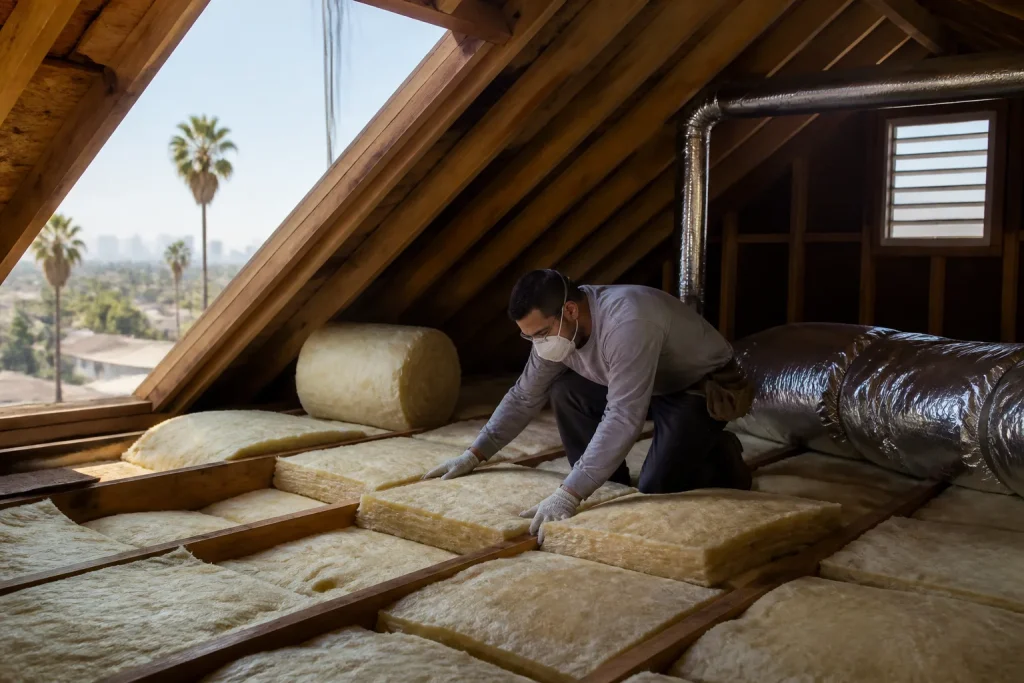
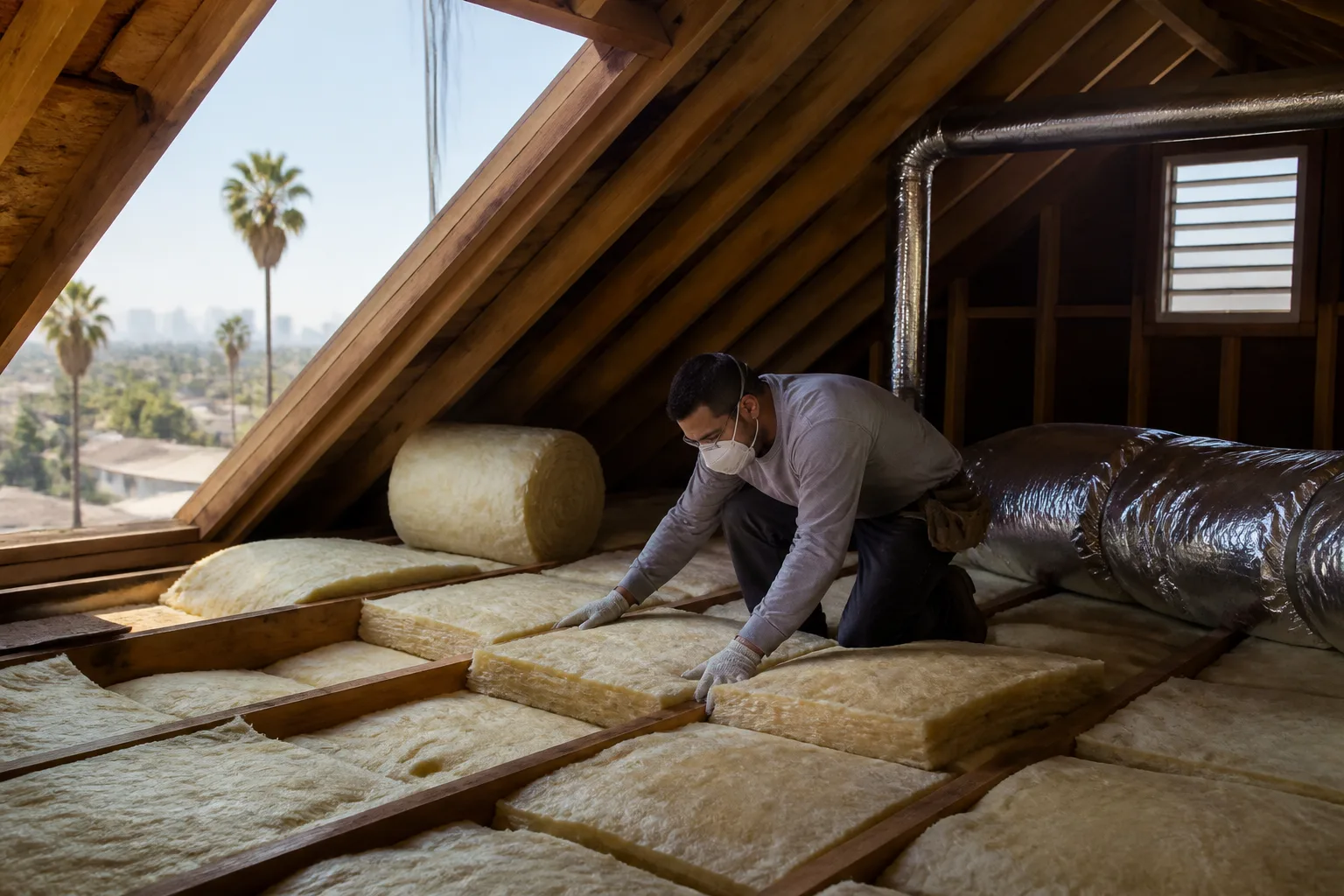
Attic Insulation What It Really Costs: What Los Angeles Homeowners Pay in 2026
Most Los Angeles homeowners pay between $4,500 and $7,500 for attic insulation in 2026, with the most common project being removal of old material plus new blown-in fiberglass to R-38 in a 1,500 sq ft attic. The wide range comes down to which of five distinct scopes of work you’re actually being quoted. If you’d rather skip the research and get a straight answer for your specific attic, call (361) 314-0118 for a free estimate.
Here’s the thing most insulation articles won’t tell you: the $1,200 quote and the $4,800 quote for the same 1,500 sq ft LA attic can both be legitimate. One is batt-over-existing. The other is full removal plus blown-in to Title 24 compliance. The homeowner who doesn’t know to ask which one they’re getting is the one who ends up surprised when the crew arrives and the work doesn’t match what they thought they bought.
The Five Scopes of Work Behind Every LA Attic Insulation Quote
“Attic insulation” is not one thing. It’s five different jobs wearing the same name, and in Los Angeles, the spread between the cheapest and most expensive version is $2,000 to $4,000 on the same house. Here’s what each scope actually involves, with 2026 LA market pricing per square foot.
- Batt over existing (R-11 to R-19 topper): $0.75 – $1.25/sq ft. This is the $1,200 quote. The crew lays new fiberglass batts over whatever is already up there. It adds some R-value, but the old material stays in place, and no air sealing is done. For a 1,500 sq ft attic, expect $1,100 to $1,900. This is a legitimate option if your existing insulation is dry, clean, and just thin.
- Full blown-in on a bare attic: $1.50 – $2.50/sq ft. This assumes the attic is already empty or nearly empty. The crew blows loose-fill fiberglass or cellulose to the target depth. On a 1,500 sq ft attic, that’s $2,250 to $3,750. This is the cleanest install when no removal is needed.
- Removal plus replacement: $3.00 – $5.00/sq ft all-in. The old material comes out, the attic gets a clean slate, and new blown-in insulation goes in to current code minimums. On that same 1,500 sq ft attic, you’re looking at $4,500 to $7,500. This is the most common project we do in Los Angeles, because most homes built before 2000 have either rodent-damaged insulation, dust-caked fiberglass, or a thin layer of R-19 that never met modern requirements.
- Spray foam complete attic encapsulation: $3.50 – $7.00/sq ft. Closed-cell or open-cell foam applied to the roofline, turning the attic into conditioned space. This is the most expensive option at $5,250 to $10,500 for 1,500 sq ft, and it changes the thermal envelope of the house. It’s also the only option that air-seals and insulates in a single step. Spray foam in Los Angeles makes the most sense when you’re converting an attic or storing temperature-sensitive items up there.
- Air sealing plus insulation combined: add $0.50 – $1.50/sq ft to any base scope. This is a line item, not a standalone project. It means the crew caulks and foams every penetration (recessed lights, plumbing vents, top plates, the attic hatch) before adding insulation. On a 1,500 sq ft attic, air sealing adds $750 to $2,250 depending on how leaky the house is.
The next time you get a quote, ask which of these five scopes you’re being priced for. Write it down. Then ask the next contractor the same question. You’ll start seeing why the numbers are all over the place.
What a 1,500 sq ft LA Attic Actually Costs in 2026
Let’s anchor this in one real number. The most common project we quote in Los Angeles is full removal of old material plus blown-in fiberglass to R-38, with air sealing. That job lands between $4,500 and $7,500 installed on a typical 1,500 sq ft attic.
Why the $3,000 swing inside that range? Three things move the price in LA more than anything else:
- Access difficulty. If your attic hatch is in a hallway closet and you can barely get a ladder in, the crew works slower. If your roof pitch is tight and the eaves are shallow, getting material to the far corners takes real effort. Homes in older neighborhoods like West Adams and Echo Park often have attics that fight the installer every step.
- Existing material depth. A 2-inch layer of R-19 fiberglass removes fast. Ten inches of compressed, dusty insulation from 1973 takes three times as long to bag and haul out. Some LA attics we’ve opened have had 14 inches of material because a previous owner just kept adding layers. Removal on those is a full day by itself.
- Contamination status. This is the big one in Los Angeles. Rat droppings, squirrel nests, raccoon activity. If the existing insulation is contaminated, removal requires protective gear, sanitizing, and sometimes duct replacement. That pushes the job toward the top of the range and sometimes beyond it. No contractor can quote this accurately without looking in the attic first, and anyone who promises a fixed number sight unseen is guessing.
Your actual price depends on what’s up there right now. That’s why a written price before work starts should follow an actual attic inspection, not a Google Maps photo.
Which Line Items Are Worth It (and Which Are Not)
Once you know the scope, the next question is which extras the contractor proposes. Some are worth every dollar in LA’s climate. Some have payback periods longer than you’ll own the house.
Air sealing: always worth it
Air sealing is the line item you should never decline. Here’s the reason: insulation slows heat moving through your ceiling, but air moves heat through gaps, and in a typical LA attic, those gaps add up to the equivalent of leaving a window cracked open all summer. Recessed lights, the attic hatch, plumbing penetrations, electrical chases. Sealing all of them before adding insulation means your new R-38 actually performs like R-38, not R-28. It should be in every quote, not presented as an upsell. If a contractor doesn’t mention air sealing, that’s a red flag.
Radiant barrier: depends on your zone
Radiant barrier is a reflective foil installed under the roof deck to bounce radiant heat before it reaches your insulation. In Los Angeles, it adds value in Climate Zones 10 and 13 (think the San Fernando Valley, Santa Clarita, and the inland valleys) where summer attic temperatures regularly hit 150°F. In Zone 9 (coastal areas like Santa Monica, Venice, and Palms), the attic rarely gets hot enough for the barrier to pay for itself. If you’re in the Valley, it can cut cooling costs meaningfully. If you’re within a few miles of the ocean, skip it.
Premium batt upgrades from R-38 to R-49: usually not the best buy
California code in most of LA requires R-38 in attics. Some contractors will offer to “upgrade” you to R-49, which means adding a few more inches of blown-in material. The problem is that R-38 to R-49 in LA’s mild climate has a 12 to 18 year payback, because the incremental energy savings are small once you’re already at code minimum. That’s money better spent on air sealing or on upgrading your insulation from fiberglass to a higher-performing material. If your contractor leads with the R-49 pitch, ask them to show you the energy model. Not the brochure, the model.
Why Title 24 Changes What You Can and Cannot Reinstall
Here’s a fact most LA homeowners learn the hard way: if you pull a building permit for attic insulation replacement in Los Angeles County, the new insulation must meet current Title 24 energy code minimums. You cannot legally reinstall R-19 in an attic that code says needs R-38.
This is why those ultra-low quotes exist. A contractor who quotes $1,200 for “new attic insulation” on a house that currently has R-19 is either planning to skip the permit entirely, or planning to install batt-over-existing and call it a day. The first is a code violation. The second is a different scope than what you think you’re buying.
In our experience, about half the LA attics we inspect have insulation that was never close to code even when it was new. If your house was built before 1978, there’s a good chance your attic has R-11 or R-19 and nothing else. You’re not “upgrading” by adding to it. You’re bringing it to legal minimum for the first time in the house’s life.
When you get a quote, ask: “Does this scope include bringing the attic to current Title 24 minimums?” If the answer is anything but an immediate yes, get it in writing or get another quote.
The Three Numbers Every LA Homeowner Should Have in Writing
Comparing insulation quotes by headline price is how people get burned. Two contractors can quote $4,800 and $3,200 for the “same” attic, and the lower one is actually worse value because it’s a thinner scope. Here are the three numbers that make comparison apples to apples. Get all three in writing before signing anything.
- Total installed R-value at completion. Not the R-value of the material alone. The installed number. If one quote ends at R-38 and another ends at R-30, that’s a real performance difference worth hundreds of dollars a year in an LA attic that hits 140°F in August.
- The brand and product name of the material. Ask for the exact product. Not “blown-in fiberglass.” The actual product, like Knauf Jet Stream Ultra, or Rockwool Loose Fill, or CertainTeed InsulSafe. Product-level specificity tells you the contractor has actually planned the job, and it gives you something to verify when the technician shows up. If they won’t name the product before you sign, that’s a contractor planning to use whatever is on hand.
- The warranty terms on both material and labor. Material warranties come from the manufacturer and vary by product. Labor warranty is on the contractor. Ask what happens if the insulation settles, if a section is missed, or if you find a gap six months later. A real answer includes a specific timeframe and a specific remedy. At Laurel Attic Insulation, we put it on every job: a Done Right Promise in writing, and a free second visit if the work isn’t right. Ask other contractors if they’ll do the same.
Compare those three numbers, not the price on top of the page. The price follows from the scope. The scope follows from those three lines.
When to Call a Pro in Los Angeles
Attic insulation is not inherently dangerous work, but it is miserable work, and getting it wrong is expensive in a way that shows up on your summer electric bill. If your attic has any of the following, call a professional: rodent activity (droppings, nesting, chewed wiring), mold or water stains from roof leaks, pre-1978 fiberglass that crumbles when you touch it, vermiculite (a pre-1990 loose-fill that can contain asbestos), or an attic you can’t stand upright in.
We pulled one out of an attic in Eagle Rock last month where the homeowner had spent two weekends trying to remove 60-year-old fiberglass with a dust mask and a shop vac. The material had been soaking up leak moisture for years and compressed into a dense mat. He got maybe a quarter of it out before the dust made the rest of the house unlivable. Sometimes the smart move is knowing when a job is beyond a weekend warrior.
If you’re in Los Angeles and want to know what’s really in your attic, start with attic insulation in Los Angeles. If the existing material needs to come out first, that’s insulation removal in Los Angeles.
What Laurel Attic Insulation Does Differently
We’re part of the Relay Home Co. family, and we built our process around the thing LA homeowners resent most about contractors: not knowing what’s happening. Every job includes the Relay Visibility Guarantee: a written price before work starts, live technician tracking so you know when the truck actually arrives, before-and-after photos so you can see the work was done, and a digital invoice you can pay from your phone. Our technicians are background-checked and uniformed. They’re not a crew of the day.
We install from eight manufacturer brands – including Knauf, Rockwool, CertainTeed, and Icynene – and we match the material to the job rather than the job to whatever is left in the truck. The Done Right Promise is on every quote in writing: if it’s not done right, we make it right, and if the work fails within the year, the second visit is free. No charge, no argument. A live person answers our phone 24/7, because a homeowner at 9 PM with an insulation emergency shouldn’t get a voicemail.
Laurel stays green all year, and your home’s comfort should too. That’s the idea behind the name.
The Bottom Line
Attic insulation in Los Angeles costs anywhere from $1,100 for a batt topper to $10,500 for full spray foam encapsulation on a 1,500 sq ft attic. The range exists because “attic insulation” is five different jobs, not one. The most common project – removal plus blown-in fiberglass to R-38 with air sealing – runs $4,500 to $7,500. Before you sign anything, get three numbers in writing: total installed R-value, the exact product being installed, and the labor warranty terms. Air sealing is always worth the line item. Radiant barrier makes sense in the Valley, rarely at the coast. R-49 upgrades over R-38 usually have a payback longer than your time in the house.
If you’re in Los Angeles and need help figuring out which scope your attic actually needs, Laurel Attic Insulation offers free estimates. Call (361) 314-0118 and we’ll send someone to look at what’s really up there.
Frequently Asked Questions
Most Los Angeles homeowners pay $4,500 to $7,500 for full removal and replacement in a 1,500 sq ft attic, while smaller scopes like batt-over-existing run $1,100 to $1,900. Your price depends on the scope of work, access, existing material depth, and whether contamination is present. Call (361) 314-0118 for an exact quote – estimates are free.
If your existing insulation is dry, clean, and just thin, adding batt over it ($1,100-$1,900) is cheaper than removal and replacement. If it’s contaminated, compressed, or under code minimum R-38, replacement is the better long-term investment, because building a topper over failed material leaves the original problem in place. A free attic inspection tells you which situation you have.
Yes, most batt-over-existing and simple blown-in jobs finish in a single day. Removal plus replacement on a contaminated attic can take two days. We schedule with live technician tracking, so you know when the crew arrives. Call (361) 314-0118 and a live person will help you book.
Title 24 energy code requires R-38 in most Los Angeles climate zones. If your attic has R-19 or less, you cannot legally reinstall at that level with a permit. Any contractor who quotes a job without mentioning Title 24 compliance is either planning to skip the permit or hoping you won’t notice.
Written by the team at Laurel Attic Insulation.
Need Insulation Help?
Call Laurel Attic Insulation - licensed & insured, here with fast after-hours help in Los Angeles.
(361) 314-0118