
Attic Insulation: Repair or Replace? How Los Angeles Homeowners Decide
For most Los Angeles homes, if your attic insulation is damaged in less than 20% of the total area, came from a single identifiable leak, and still measures at least R-30, you can repair it. If it’s settled below R-19, has rodent contamination, or predates 1985, replace it. The decision comes down to three measurable inputs, not a contractor’s opinion. If you’d rather skip the math and get a straight answer, call Laurel Attic Insulation home at (361) 314-0118.
Here’s the uncomfortable truth most LA homeowners don’t realize: the person telling you whether to repair or replace your attic insulation often has a financial stake in the answer. A full replacement pays more than a patch job. That’s not a conspiracy, it’s arithmetic. This guide walks you through the exact formula we use when giving estimates, so you can run the numbers yourself before anyone steps foot in your attic.
The Three-Input Formula: How to Calculate Repair vs. Replace
A contractor who profits more from full replacement than from a repair has no financial incentive to give you unbiased advice. Here’s how to run the numbers yourself before you call anyone.
Three factors determine whether your Los Angeles attic insulation needs a patch or a full redo. None of them are subjective. Here’s the formula:
- Current R-value: What’s actually up there now, measured, not guessed.
- Damage percentage: How much of the attic floor has wet, compressed, or contaminated insulation.
- Cost delta: The real price difference between repairing the damaged section and replacing everything, including LA rebates that only apply to full replacement.
Let’s break each one down so you can check your own attic this weekend.
Input 1: Your Current R-Value vs. California’s Minimum
R-value, that’s the number that measures how well insulation slows heat from moving through your ceiling. Higher number, better performance. California’s Title 24 building code requires R-38 for most Los Angeles climate zones, which translates to roughly 10 to 14 inches of blown-in fiberglass or cellulose, or about 10 to 12 inches of batt insulation, depending on the material.
Here’s the problem: insulation settles. Blown-in fiberglass can lose up to 20% of its loft over 15 to 20 years. Cellulose settles faster, especially if it got damp at some point. A 1990s LA home that started with R-38 might be sitting at R-22 today without the homeowner ever knowing.
How to check your R-value without hiring anyone:
- Grab a ruler and a flashlight.
- Open your attic hatch and look at the insulation depth in several spots, not just one.
- Measure the depth in inches.
- Multiply: fiberglass batts give roughly R-3.2 per inch. Blown fiberglass gives about R-2.5 per inch. Blown cellulose gives about R-3.4 per inch.
If your blown-in fiberglass measures 8 inches, you’re at approximately R-20. That’s half of what Title 24 requires. In a Los Angeles summer, that’s the difference between a second floor that stays comfortable and one that hits 85 degrees by 3 p.m.
In our experience, homes in older LA neighborhoods like West Adams, Highland Park, and the Valley’s postwar tracts frequently measure R-13 to R-19. Those were code-compliant when installed in the 1960s and 70s. They’re nowhere close today.
When Partial Repair Is Legitimate
Partial repair makes sense in one specific scenario: spot damage under 20% of the attic floor from a single leak source, with no mold and no pest activity. If a roof vent failed, a pipe boot cracked, or a single section of flashing gave out and soaked a 6-by-8-foot area of blown-in insulation, you don’t need to replace the whole attic. You need to fix the leak, remove the wet insulation, treat the affected decking if needed, and blow new material into that section to match the surrounding R-value.
Here’s what that typically costs in Los Angeles: removing and replacing 100 to 200 square feet of blown-in insulation runs $400 to $800, assuming the decking underneath is sound. Compare that to a full attic replacement for a 1,200-square-foot LA home, which runs $1,500 to $3,000 before rebates. The repair is clearly cheaper, and it’s the right call.
But the key phrase is “single leak source.” Water travels. If you see water staining across multiple rafter bays or the insulation is damp in disconnected sections, that’s not spot damage. That’s a pattern. And patterns mean replacement.
Red Flags That Kill the Repair Option
- Mold on the insulation or decking: You can’t spot-treat mold in blown-in insulation. Remove it all, sanitize, and start fresh.
- Pest droppings or nesting: Rodent contamination in one corner almost always means they’ve been through the whole attic. Insulation is one big filter. Replace it.
- Compression from foot traffic: If an HVAC tech or cable installer trampled sections flat, those spots lost their R-value permanently. Squished fiberglass doesn’t bounce back.
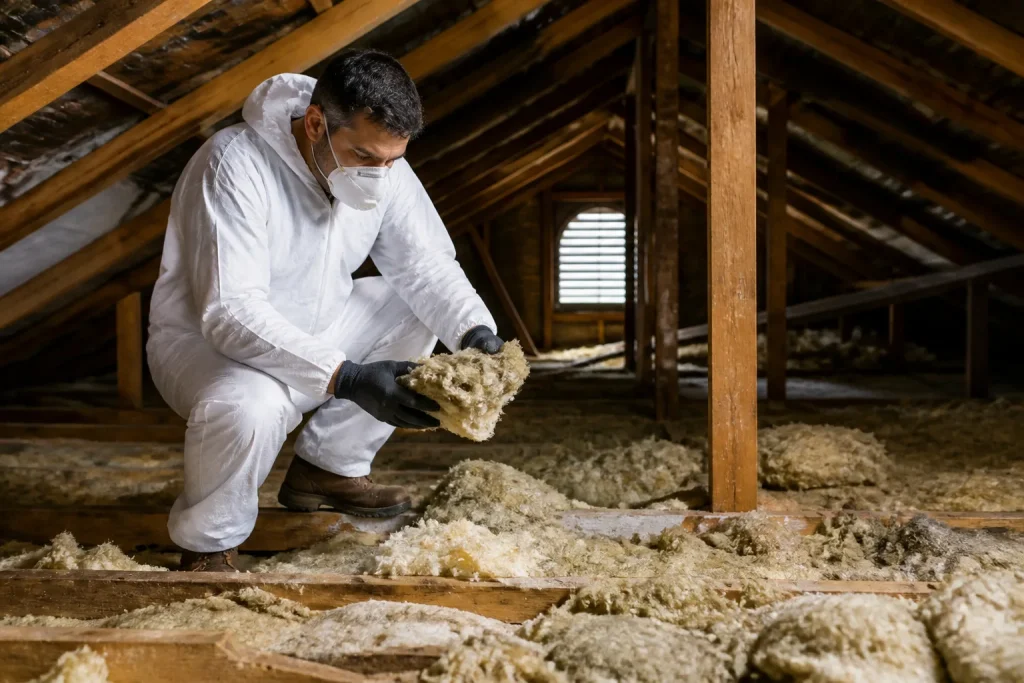
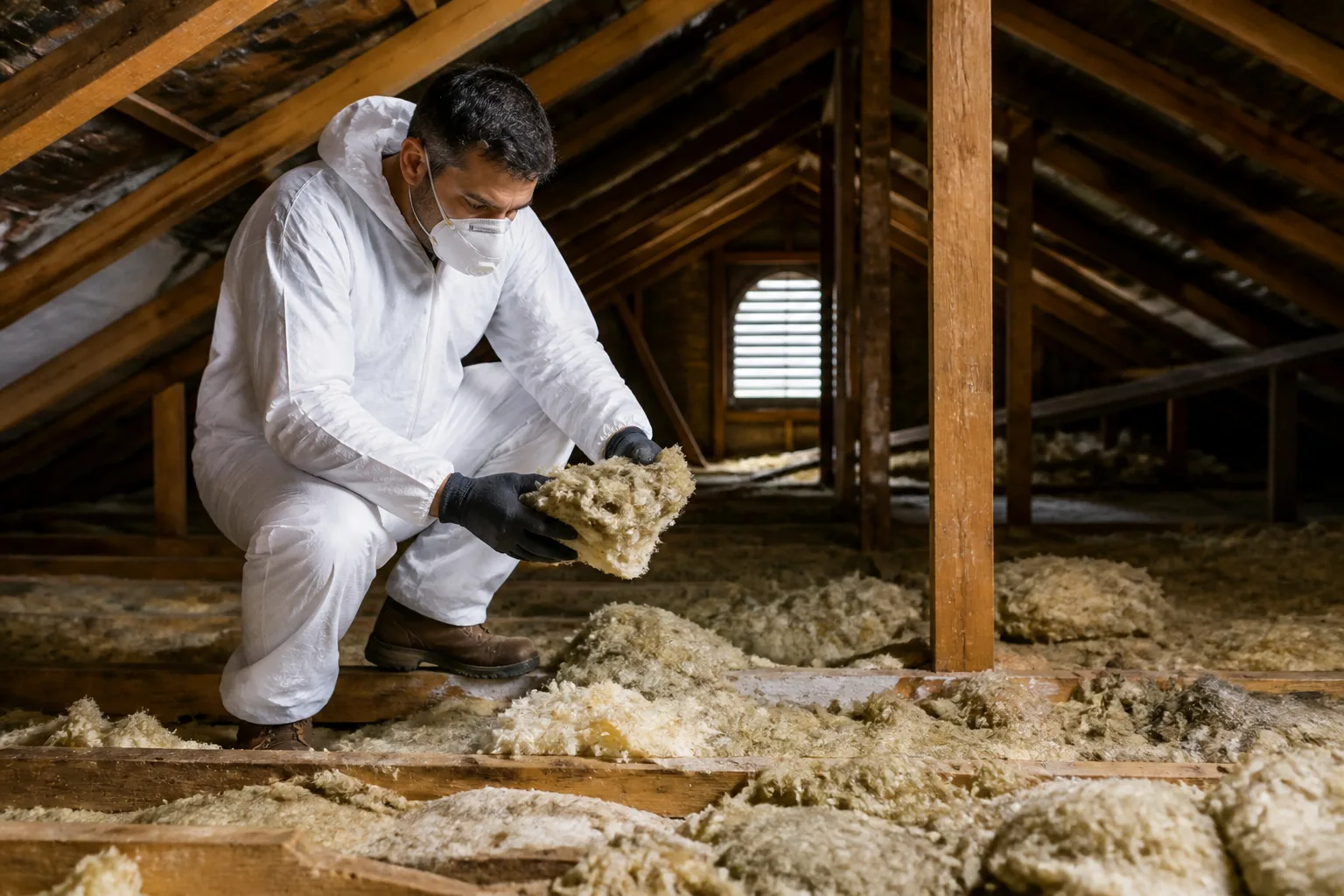
- Insulation installed before 1985: This era can include vermiculite (which may contain asbestos) or early fiberglass with formaldehyde binders. If your LA home has original insulation from this period, don’t patch it. Have it tested and removed properly.
When Full Replacement Is the Only Real Answer
Three situations leave no room for debate. Here they are, plain:
- Settled blown-in below R-19. If you measured and your attic is at R-19 or lower across most of its area, you’re not repairing. You’re rebuilding. Adding new insulation on top of badly settled material just creates uneven coverage and hides the problem. Remove and replace.
- Any confirmed rodent contamination. Rat and mouse droppings in insulation aren’t a localized issue. Rodents tunnel through blown-in material and nest in batts. What they don’t directly soil, they still contaminate with urine and dander. This is a health issue, not a comfort issue. Full removal and replacement, plus sealing entry points, is the only correct fix. We handle this through our Insulation Removal in Los Angeles service.
- Pre-1985 insulation. Some vermiculite insulation from the Libby, Montana mine was contaminated with asbestos. It was installed in LA homes from the 1940s through the 1980s. You cannot visually confirm whether yours contains asbestos. If your attic has pebble-like, gray-brown insulation, don’t disturb it. Call a professional for testing and removal.
Full replacement in Los Angeles for a typical 1,200 to 1,500-square-foot attic runs $1,500 to $3,000, depending on material choice and access. That’s not pocket change. But here’s the part most contractors won’t tell you: LA utility rebates can knock that down substantially.
Why LA Rebates Often Make Full Replacement Cheaper Net-of-Rebate
SoCalGas and SCE both run energy-efficiency rebate programs that pay homeowners for attic insulation upgrades. The catch: these programs require meeting minimum R-value thresholds, typically bringing the attic up to R-38 from a substantially lower starting point. A partial repair of 100 square feet won’t qualify. A full replacement that raises your entire attic from R-13 to R-38 can earn rebates of several hundred dollars.
Let’s run a real Los Angeles scenario. Say your 1,300-square-foot home in Encino has settled R-16 blown fiberglass. You need 30% replaced due to a roof leak, which quotes at $900. Full replacement quotes at $2,400. But the full replacement qualifies for a $500 SoCalGas rebate, bringing your net cost to $1,900. The repair plus partial coverage leaves you at R-16 in the untouched sections and R-38 in the repaired section, which means uneven thermal performance. The replacement gets your entire attic to R-38 for $1,000 more than the patch. Over a decade of LA summers, that $1,000 pays for itself in AC savings and comfort.
That’s the math most homeowners never see, because the contractor quoting the repair has no reason to explain it.
How to Get an Honest Assessment
You have three options. First, do the DIY measurements I described above. Second, get three quotes and compare them against the formula, not against each other. If one contractor says “repair” and two say “replace,” don’t count votes. Look at the measured R-value and the damage percentage.
Third, call someone who puts their recommendation in writing with the reasoning attached. We document every assessment with photos and measurements, because our Attic Insulation in Los Angeles estimates include a written price before any work starts. No verbal “trust me” pricing. You see the numbers, the photos, and the math.
One quick job story: a homeowner in Mar Vista called us about a damp spot in her hallway ceiling. She figured a patch job, maybe $600. We pulled open the hatch and found blown-in cellulose that had been soaking in roof-leak moisture for months. The visible damp spot was 2 feet wide. The contaminated insulation stretched 14 feet. Repair wouldn’t have touched 70% of the problem. She appreciated that we showed her the photos rather than just quoting the bigger job. That’s how it should work.
When to Call a Pro
Call a professional if your attic shows any of these: visible mold, animal droppings, pre-1985 insulation that looks like loose pebbles, or measured insulation depth under 8 inches. These aren’t DIY situations. Disturbing old insulation can release fibers you don’t want to breathe, and rodent contamination requires proper protective equipment and disposal protocols.
We work with Owens Corning, Johns Manville, and GreenFiber materials, matched to what your specific attic actually needs rather than whatever is on hand. If you’re considering a different insulation type entirely, like closed-cell foam for a conditioned attic, that’s covered under our Spray Foam Insulation in Los Angeles service.
The Bottom Line
Repair your attic insulation if the damage is under 20% of total area, came from a single identifiable leak, and your overall R-value still measures at least R-30. Replace it if you’re below R-19, have any rodent contamination, or the insulation predates 1985. Run the rebate math before deciding, because in Los Angeles a full replacement often nets out only slightly more expensive than a patch, while delivering dramatically better performance.
If you’re in Los Angeles and want a straight answer with the measurements to back it up, Laurel Attic Insulation offers free estimates. We’ll show you exactly what’s in your attic, what it measures, and what each option costs in writing. Call (361) 314-0118.
Frequently Asked Questions
Spot repairs for water-damaged blown-in insulation in Los Angeles typically run $400 to $800 for areas under 200 square feet. Larger repairs that require decking treatment or mold remediation can push costs to $1,200 or more. Call (361) 314-0118 for an exact quote based on your attic’s square footage and condition.
Sometimes, but only if the existing insulation is dry, uncontaminated, and not compressed. Adding new material over settled insulation masks the problem rather than fixing it, and it won’t qualify for utility rebates. If your existing insulation is clean and you just need a higher R-value, topping off can work. If it’s wet, moldy, or pest-contaminated, remove it first.
The only way to know is laboratory testing. Vermiculite insulation installed before 1990 may contain asbestos, but visual inspection cannot confirm it. If you see pebble-like gray-brown insulation in your Los Angeles attic, stop, keep the hatch closed, and call a professional for testing before anyone disturbs it.
Yes. SoCalGas and SCE both offer energy-efficiency rebates for attic insulation upgrades that meet minimum R-value thresholds. Full replacements that bring an attic to R-38 usually qualify, while partial repairs typically don’t. Rebate amounts vary by program year, so call (361) 314-0118 and we’ll check current programs for your address.
Written by the team at Laurel Attic Insulation.
Need Insulation Help?
Call Laurel Attic Insulation - licensed & insured, here with fast after-hours help in Los Angeles.
(361) 314-0118