
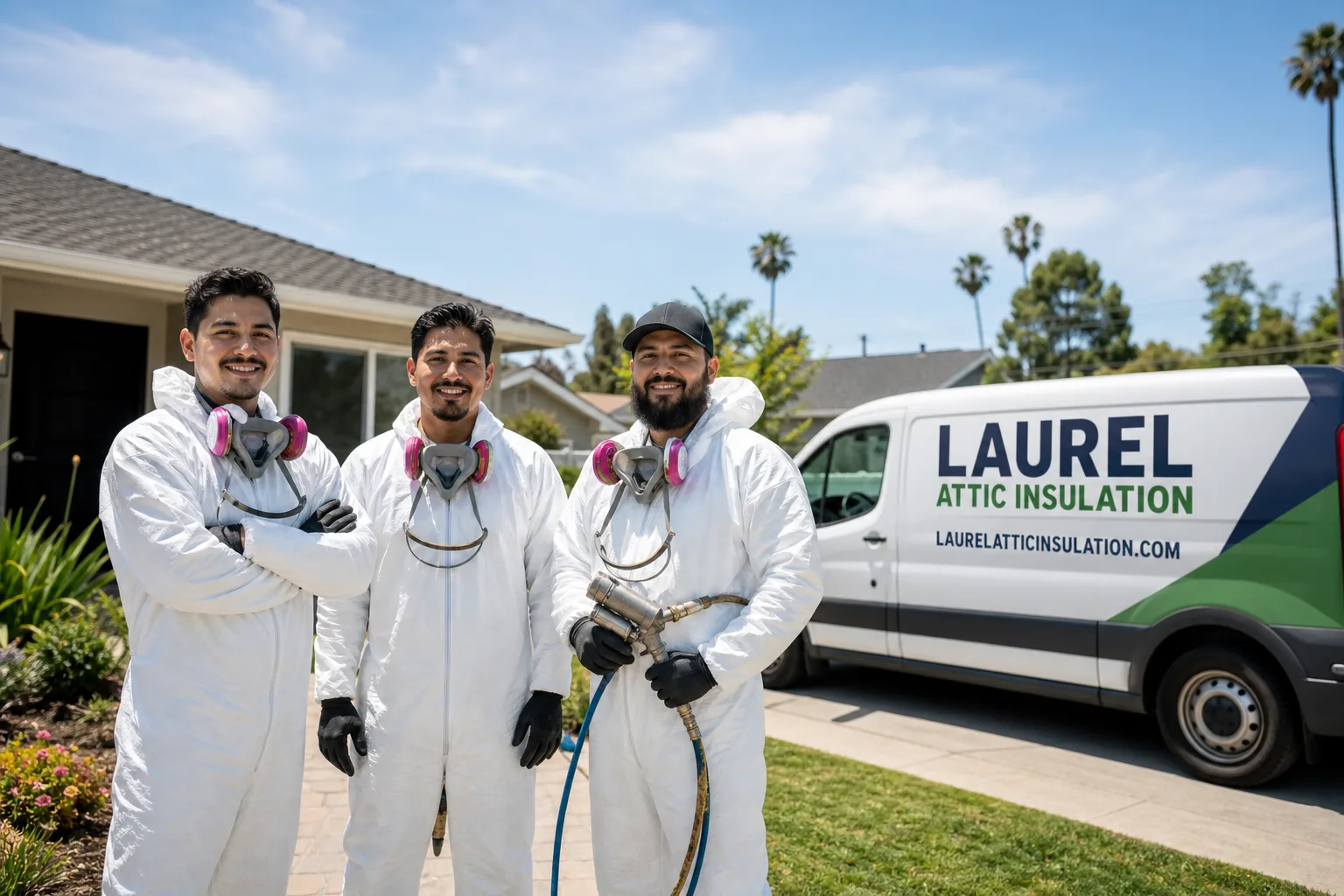
Fast, Reliable Attic Insulation Across West Carson
Attic insulation in West Carson runs into one problem more than any other: moisture. Our crews are in West Carson weekly, and most calls start the same way. A homeowner notices a warm ceiling, a spiking August bill, or damp spots around ceiling vents. Up in the attic we find sagging batts with failing kraft-paper facing, blocked soffit vents, or no ridge vent at all. West Carson sits in the South Bay’s coastal-influence band, and that marine air changes how insulation fails here. We get to West Carson jobs same-day in most cases. Call (361) 315-4177 for a free estimate, and we’ll tell you exactly what’s happening up there.
Key Takeaways:
- Most West Carson attic problems come from marine moisture, not heat alone
- Typical blown-in attic insulation jobs in West Carson run $900 – $2,400 depending on square footage and R-value
- Ventilation correction usually happens before new insulation in 1950s – 60s tract homes
- Every job includes a written price before work starts, a written guarantee, and a free second visit if the repair fails
Why Laurel Attic Insulation Is West Carson’s Preferred Attic Insulation Company
Laurel Attic Insulation is part of the Relay Home Co. family, founded in 2003, and we built our West Carson reputation on showing up when we say we will. Homeowners here tell us the same story: a contractor gives a four-hour window, doesn’t show, doesn’t answer. That’s not how we operate. You book, you get a live arrival time with technician tracking, and a written price lands in your hand before anything starts. No door-step surprises. No vague estimates.
Our techs are background-checked and uniformed, and they know West Carson’s housing stock. When a homeowner on 223rd Street tells us their 1963 single-story has a warm hallway ceiling, we already have a strong idea what’s in the attic before we climb up. That local familiarity means faster diagnosis and fewer return trips. We answer the phone 24/7 with a live person, never a voicemail queue. West Carson customers get the same thing every Laurel customer gets: the 365-Day Done Right Promise in writing, and a free second visit if something isn’t right. That’s not marketing language. It’s the guarantee on every invoice.
Attic Ventilation in West Carson
Attic Ventilation in West Carson is the first thing we check on nearly every job, because the coastal air that rolls through the South Bay keeps attic moisture high and dew points swing overnight. A correctly vented attic pulls outside air in through the soffits and pushes warm, damp air out through ridge or gable vents. When that loop breaks, moisture hangs in the attic. Batts soak it up. Kraft-paper facing peels. Mold develops. In West Carson’s 1950s and 1960s tract homes, original venting is often minimal: a few metal soffit vents, no ridge vent, and sometimes no exhaust path at all. That worked when homes were leakier and attics were not used for storage. It does not work today.
For a typical West Carson single-story, correcting ventilation before adding new insulation runs $400 – $900 depending on access and how much retrofitting is needed. The job involves clearing blocked soffits, adding baffles where needed, and often cutting in a ridge vent or box vents. It’s not glamorous work. It’s also the difference between insulation that lasts 15 years and insulation that fails in three.
Blocked Soffit Vents and Coastal Moisture
Original soffit vents in West Carson tract homes get blocked surprisingly often. Homeowners add plywood storage decks in the attic, or someone blows in cellulose that drifts over the intake vents. We’ve seen vents packed solid with old fiberglass, too. When the intake side of the ventilation loop dies, the attic stops breathing. The result is higher humidity, damp insulation, and condensation that drips on furnace flues in winter.
Ridge Venting for 2×4 Rafter Construction
Almost all the West Carson homes we insulate have 2×4 rafters, not 2×6 or truss framing. That shallow rafter bay doesn’t leave much room for both insulation and airflow. Adding a ridge vent with proper baffled soffit intake gives those tight attic spaces a real shot at drying out. It’s a small structural change that changes how every other material in the attic performs.
Radiant Barrier in West Carson
Radiant Barrier in West Carson matters more than most people expect, even with the coastal overcast. Those low-pitch asphalt shingle roofs on 1960s tract homes absorb radiation all summer, and the underlayment radiates that heat straight down into the living space. Even after you replace your batts, the ceiling stays hot because the roof deck is still dumping heat into the attic air. A radiant barrier stapled to the rafters reflects that radiant heat back before it reaches the insulation below.
For a West Carson attic, adding a radiant barrier typically runs $1,200 – $2,500 depending on attic square footage and roof complexity. We use perforated radiant barrier material that allows water vapor to pass through, which matters in West Carson’s marine air. The wrong material traps moisture against the roof deck and causes sheathing rot in coastal climates. We’ve replaced barriers installed incorrectly by other contractors for exactly that reason.
Low-Pitch Rafter Heat Gain
West Carson homes often have shallow roof pitches, which means the roof deck sits close to the ceiling. That short distance gives radiant heat a fast path into the house. In August, an unvented West Carson attic can hit 140°F, and that heat radiates down through the insulation whether it’s R-11 or R-30. Radiant barrier stops the radiation at the source.
Shingle Underlayment as a Hidden Heat Source
The asphalt underlayment on these older shingle roofs acts like a heat battery. It absorbs sun all day and releases it all evening. West Carson homeowners notice this as a home that won’t cool down until well after sunset. Radiant barrier breaks that release cycle. It works especially well when paired with proper venting from the previous section: vents remove convected heat, the barrier blocks radiated heat, and you get a much cooler attic overall.
Trusted Brands We Service in West Carson
We install and service insulation from brands West Carson homeowners actually trust: Owens Corning, Johns Manville, Knauf, Rockwool, CertainTeed, and more. We stock the materials that match this specific climate, not whatever happens to be on the truck. If your existing attic has Johns Manville kraft-faced batts from the 1960s and we’re doing a top-up, we’ll be honest about whether those batts are worth keeping. If they’re damp or sagging, they’re not. For West Carson’s moisture-prone attics, we often recommend Rockwool or fiberglass blown-in over kraft-faced batts because paper facing absorbs coastal humidity and fails faster. We can get any of these materials into West Carson quickly, and we keep common sizes locally so we’re not delaying your job waiting on a distributor.
Common Attic Insulation Problems We See in West Carson Homes
- Kraft-paper facing failure from coastal moisture. The marine air that drifts through West Carson hangs in attics with minimal venting. Paper facing on 1960s batts soaks it up, sags off the rafters, and leaves gaps that look insulated from below but barely perform.
- Blocked or missing soffit vents. West Carson tract homes from the 1950s and 1960s never had much venting to begin with. Decades of storage decks and blown-in cellulose later, the intake side is often completely gone. That kills the whole ventilation loop.
- Packed or collapsed R-11 batts in 2×4 rafter bays. Original batt insulation in these homes was usually R-11, and after 50 or 60 years it’s compressed, dusty, and performing at a fraction of its rating. In shallow 2×4 bays, even a small amount of compression chokes airflow.
- No radiant barrier under low-pitch roofs. Without a radiant barrier, those shallow West Carson attics radiate shingle heat straight down into the living space. Homeowners notice warm ceilings even after new batts go in, because radiation is a different heat path than conduction.
Pricing for Attic Insulation in West Carson, CA
Here’s what attic insulation actually costs in West Carson. Blown-in attic insulation for a typical 1,000 – 1,400 sq ft single-story runs $900 – $1,800. Top-up jobs where existing insulation is dry and sound run $500 – $1,000. Full replacement including removal of old damp batts runs $1,500 – $2,400. Attic baffles and ventilation prep fall between $400 – $900, and radiant barrier adds $1,200 – $2,500. Your total depends on square footage, access, and whether your existing insulation is wet or moldy. We deliver a written price before any work starts, so you’ll see exactly what you’re paying. Call (361) 315-4177 and we’ll get a tech to your West Carson home for a free estimate, usually same day.
We Also Serve Cities Near West Carson
Beyond our work in West Carson, we regularly help homeowners throughout Southern California. If you’re in Los Angeles, San Diego, San Jose, or San Francisco, our Attic Insulation team can get you the same written pricing, live technician tracking, and 365-day guarantee. Call (361) 315-4177 to schedule.
Serving West Carson, CA - Our Local Coverage Area
We’re based in the West Carson area and know this community well. Use the map below to see our service coverage - if you’re nearby, we can almost certainly help.
FAQs About Attic Insulation in West Carson
West Carson sits in the South Bay’s coastal-influence band, where marine air and overnight dew point swings push attic humidity higher than inland neighborhoods like Gardena or Torrance proper. The moisture isn’t coming from rain; it’s condensing out of the air itself. When warm daytime attic air cools at night, the moisture in it condenses on rafters, insulation facing, and furnace flues. In an attic with blocked or missing ventilation, that condensation has nowhere to go. The fix is correcting the ventilation loop before adding insulation. Call (361) 315-4177 for an exact assessment of your West Carson attic.
In most cases, yes. West Carson’s 1950s and 1960s tract homes were built with minimal original venting, and much of it has been blocked over the years by storage decks or blown-in insulation. Adding new insulation on top of a dead ventilation loop traps more moisture in the attic and accelerates batts failing. We typically clear and baffle soffits and add ridge or box vents before any new insulation goes in. It extends the life of your insulation and keeps your attic dry. We’ll give you a written price for the venting work before we touch anything.
The honest answer depends on what’s up there. If the kraft-paper facing is damp, peeling, or sagging, the batts are done. Re-stapling them doesn’t fix the moisture problem and the insulation value is already compromised. If the batts are dry and still holding their shape, a top-up with blown-in fiberglass can make sense and saves money. For most West Carson homes with original 1960s batts, we find moisture damage and recommend full removal and replacement. We’ll show you photos from your own attic so you can see exactly what we’re seeing before you decide.
Yes, even with the marine layer. West Carson attics still see direct sun on clear afternoons, and those low-pitch asphalt shingle roofs heat up fast. Radiant barrier stops the roof deck from radiating that heat down into your living space. It works alongside insulation, not instead of it. In West Carson specifically, you want perforated radiant barrier so moisture can pass through instead of getting trapped against the roof sheathing. The result is a noticeably cooler ceiling in summer plus reduced winter condensation.
We’re in West Carson weekly, and we can reach most jobs same-day or next-day. Scheduling is coordinated from the brand’s Los Angeles office, but our crews serve West Carson locally, so we’re not driving across the county to get to you. Call (361) 315-4177, get a live person 24/7, and we’ll give you an arrival time you can track. Estimates are free, and the written price comes before any work starts.
Written by Chase Whitaker, Owner at Laurel Attic Insulation, serving West Carson with attic insulation, ventilation, and radiant barrier work.