
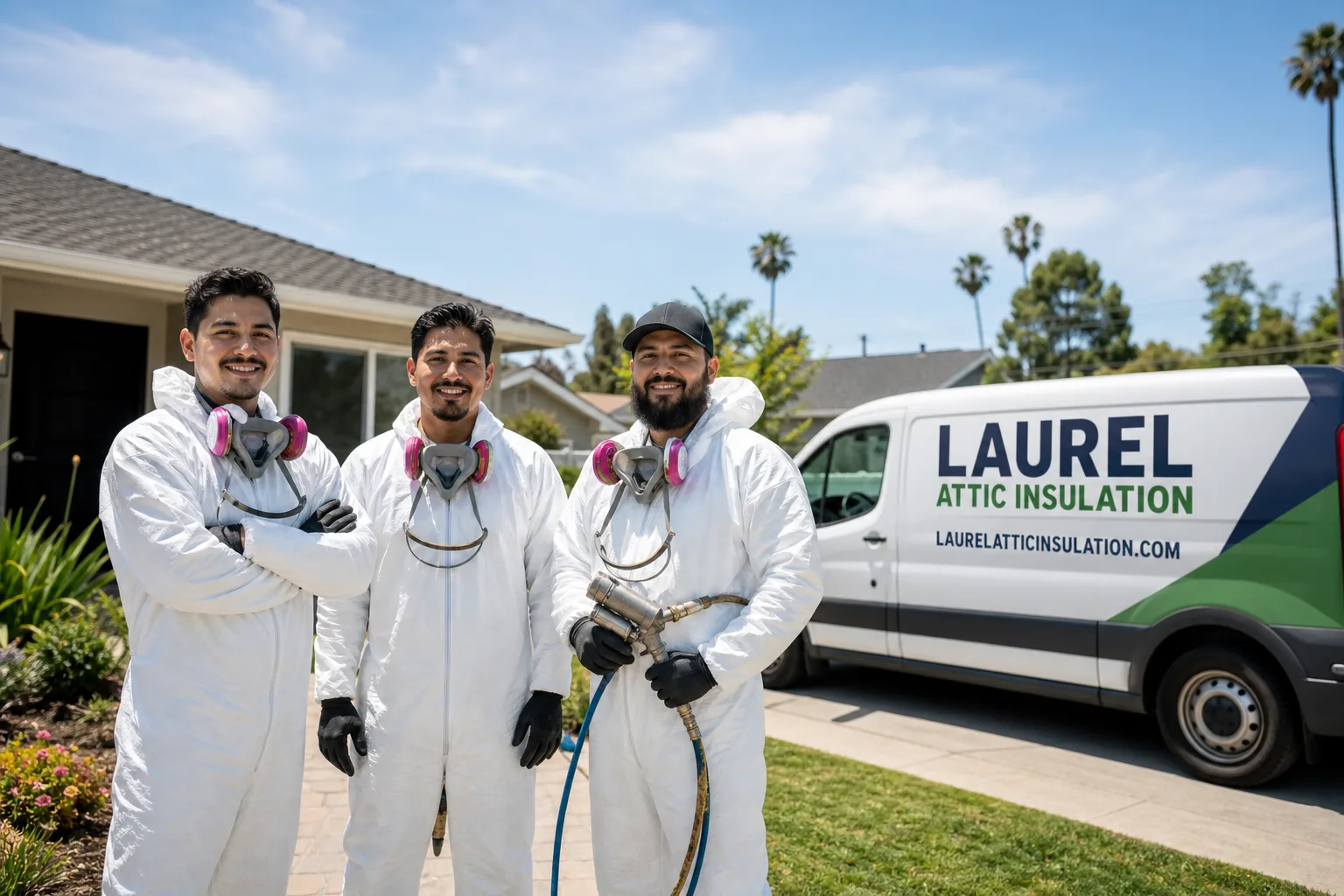
Fast, Reliable Attic Insulation Across Seal Beach
Attic insulation replacement in Seal Beach typically costs between $1,450 and $3,600 depending on square footage, existing insulation condition, and the material you choose. Most jobs take one day, and our crews are in Seal Beach every week, from the Hill down to Old Town and College Park East. If your attic has been cooking your second floor all summer, or your energy bill keeps climbing, the fix is probably sitting right above your ceiling. We’re Laurel Attic Insulation, part of the Relay Home Co. family, and we’ve been insulating attics since 2003. Call (361) 315-4177 and we’ll give you a written price before any work starts.
Why Laurel Attic Insulation Is Seal Beach’s Preferred Attic Insulation Company
Seal Beach homeowners call us because we show up when we say we will, and we work like we’re going to see you at the pier on Saturday. Our crews know the houses here, not just the map. The 1950s and 60s tract homes near McGaugh Elementary and Surfside have different attic realities than the newer builds off Lampson Avenue or up in the Hill. Some have original rock wool blown in, some have fiberglass batts that have been compressed flat, and a lot have nothing more than dust and heat. We see it all, and we price each job based on what’s actually in your attic, not a one-size-fits-all number.
Every Laurel job includes the Relay Visibility Guarantee: a live arrival time on your phone, photo proof of the work before we leave, and a written price delivered before anything starts. No vague windows. No door-step add-ons. Our technicians are background-checked, uniformed, and they’ll walk you through exactly what they found up there. If anything isn’t right within 365 days, we come back and make it right, free of charge. That’s the Done Right Promise, and it’s in writing on every single job. Call (361) 315-4177 and you can schedule in about the time it takes to walk from Main Street to the beach.
Attic Insulation Removal in Seal Beach
Insulation Removal in Seal Beach is the first step on a lot of jobs, and for good reason. That old layer of fiberglass or rock wool up there has been quietly absorbing coastal moisture and salt residue for decades. In a climate like this, old insulation doesn’t just underperform, it holds humidity against your ceiling joists and can trap the salt that drifts in through worn vent screens. Removing it lets us start clean: inspect the top plates, check the baffles, and see exactly what your ventilation is actually doing.
You need removal when the existing insulation is water-stained, rodent-affected, compressed to half its original depth, or simply so old that its R-value has crumbled. We vacuum it out with commercial equipment, bag it, and haul it away same day. Our Attic Insulation team handles removal as a standalone service or as the first phase of a full re-insulation. Most removals in Seal Beach run $1,100 to $2,800 depending on attic size and how much material is up there.
What We Find During Removal
Salt-corroded vent hardware. Loose thermal bypasses around can lights and plumbing chases. Rodent entry points hidden under batts. We document everything with photos and show you before we insulate.
When Removal Is Non-Negotiable
If the old insulation is wet, moldy, or has been soaked by a roof leak near the coast, adding new material on top just seals the problem in. Removal is the only honest fix in those attics.
Blown In Insulation in Seal Beach
Blown In Insulation is the workhorse of Seal Beach attic jobs. We use an industrial blower to distribute loose-fill fiberglass (often Owens Corning or Johns Manville) to a uniform depth across the attic floor. It fills odd angles, tight eaves, and irregular joist bays, places batts never sit flat. For a 1,200 square foot attic, blown-in installation in Seal Beach typically lands between $1,900 and $3,200 depending on the target R-value and whether we’re starting from bare drywall or topping up.
We choose manufacturers by the job. GreenFiber cellulose works well in coastal attics where breathability matters, but blown fiberglass is the more common pick here because it won’t settle as dramatically even with the humidity swings we get off the Pacific. Whatever material we spec, we blow to a consistent depth and air-seal the top plates and penetrations while the attic is open.
Air-Sealing Before We Blow
In coastal Seal Beach, open top plates and unsealed can-light boxes are escape hatches for conditioned air. Sealing them before blowing in new material makes the new insulation actually do its job. This is the step most contractors skip.
Depth Markers and R-Value Targets
We set depth markers every 10 feet so the final install is even. For most Seal Beach homes, we target R-38 to R-49, which translates to roughly 12 to 16 inches of blown material, depending on the product.
Trusted Brands We Service in Seal Beach
We stock and install from Owens Corning, Johns Manville, Knauf, and GreenFiber, and we match the material to your attic, not to whatever is on the truck that morning. That matters in Seal Beach, where the marine air exposes weak products fast. A cheap batt that would be fine in an inland attic can sag, tear, and lose its loft in a coastal vent path within a couple of years. We’d rather see you spend once. That’s the principle Laurel was named for: laurel stays green all year, and your home’s comfort should too. We keep the common material types and depths ready for quick deployment to Seal Beach, so most jobs book within a few days of calling (361) 315-4177.
Common Attic Insulation Problems We See in Seal Beach Homes
- Salt-corroded gable and roof vents: The marine air off the Pacific doesn’t just rust patio furniture. It seizes vent pivots and eats fasteners, so vents that should be exhausting humid air stop moving. That trapped moisture then degrades your insulation from above. We inspect this first on nearly every Seal Beach job.
- Compressed loose-fill from coastal humidity cycles: Damp, dry, damp, dry, all year. That cycle, combined with wind-driven salt fog, packs loose-fill insulation down until its effective R-value is a fraction of what the bag said. A 12-inch attic that should be R-38 might be performing at R-19 by the time we see it.
- Failed air-sealing around top plates and penetrations: Older Seal Beach attics were rarely sealed to modern standards, and the salt air accelerates the drying and cracking of whatever old caulk or foam was used. The result is a direct air leak from your living room into your attic.
- Rodent damage near beachside landscaping: Rats and mice love the same bougainvillea and dense landscaping Seal Beach homeowners love. Once they get into an attic, they tunnel through batts, soak insulation, and leave waste that makes removal the only safe option. We find this a lot in the Hill and the older neighborhoods around Main Street.
Pricing for Attic Insulation in Seal Beach, CA
Here’s what you can expect to pay in Seal Beach. Attic insulation removal runs $1,100 to $2,800. Blown-in installation runs $1,900 to $3,200 for a typical 1,200 square foot attic. A full replacement, which means removal plus new blown-in or batt insulation plus air-sealing, typically lands between $3,000 and $5,600 depending on your attic size, access difficulty, and whether you need new baffles or ventilation hardware. Batts run a bit lower on the material side but take longer to install properly. The best way to know your exact number is to call (361) 315-4177. We’ll set a time, get up into the attic, and give you a written price you can think about, no obligation.
We Also Serve Cities Near Seal Beach
Our crews cover Seal Beach and the surrounding communities every week. If you’re in Los Alamitos, Cypress, Hawaiian Gardens, or Westminster, you get the same visit-a-real-attic, upfront-pricing approach. This page is all about Attic Insulation in Seal Beach, but our service area runs right up to your neighborhood too. Call (361) 315-4177 and tell us where you are.
Serving Seal Beach, CA - Our Local Coverage Area
We’re based in the Seal Beach area and know this community well. Use the map below to see our service coverage - if you’re nearby, we can almost certainly help.
FAQs About Attic Insulation in Seal Beach
Yes, and it affects the vents before the insulation. In Seal Beach, the salt-laden marine air carried in off the Pacific doesn’t just rust anything ferrous, it quietly shortens the service life of standard attic ventilation hardware. The gable and roof vents that are supposed to keep a coastal attic dry are often the first components to seize, stick, or fail. Once the vents stop working, humidity sits in the attic and degrades whatever insulation is up there. That’s why an attic preservation job here so often begins with a ventilation hardware inspection before a single batt is touched. Call (361) 315-4177 and we’ll walk you through what to look for.
Every 18 to 24 months is right for a coastal home like ours. Vent pivots, screens, and fasteners corrode faster here than they would ten miles inland. A quick visual check of the gable and roof vents, plus a look at the baffles, takes less than 30 minutes. If you’re hearing a grinding or squeaking from the vents on windy days, that’s salt-air friction on a corroded pivot. Let us inspect it while we’re up there. Estimates are free.
Blown-in fiberglass from Owens Corning or Johns Manville works well because it resists the moisture-driven settling we see in Seal Beach. GreenFiber cellulose is a solid choice when you want higher recycled content and don’t mind a slightly different density profile. Batts are perfectly fine too, as long as the air-sealing underneath is done right. The material matters less than the air-sealing and the ventilation hardware, honestly.
Sometimes. If the old insulation is dry, uncompressed, and not water-stained, a top-up can work. Find the top plates and air-seal first, then blow new material over the old to reach your target R-value. But if there’s any sign of moisture, salt residue, rodent activity, or mold, adding on top is just burying a problem. Our Attic Insulation crews do a moisture check before any top-up. If it fails, we’ll recommend removal instead.
Because in Seal Beach, the vents fail first. On a job in the Hill, we opened up an attic and found the roof vents had corroded pivots and one gable vent screen falling apart, classic salt-air casualties that were quietly cutting airflow. We fitted corrosion-resistant replacements, then blew in Owens Corning fiberglass to a uniform depth and air-sealed the top plates while we were up there. The homeowner noticed the house held a steadier temperature the next week, and the vents were working as intended again. If we’d skipped the vent check and just blown in new insulation, the attic would have stayed damp and the new material would have been compromised within a couple of years. That’s the inspection-first approach.
If your attic is hot, cold, damp, or just costing you money every month, call (361) 315-4177. We’ll answer. We’re in Seal Beach every week. And we’ll show you exactly what’s up there before you spend a dollar.
Written by Chase Whitaker, Owner at Laurel Attic Insulation, serving Seal Beach since 2003.