
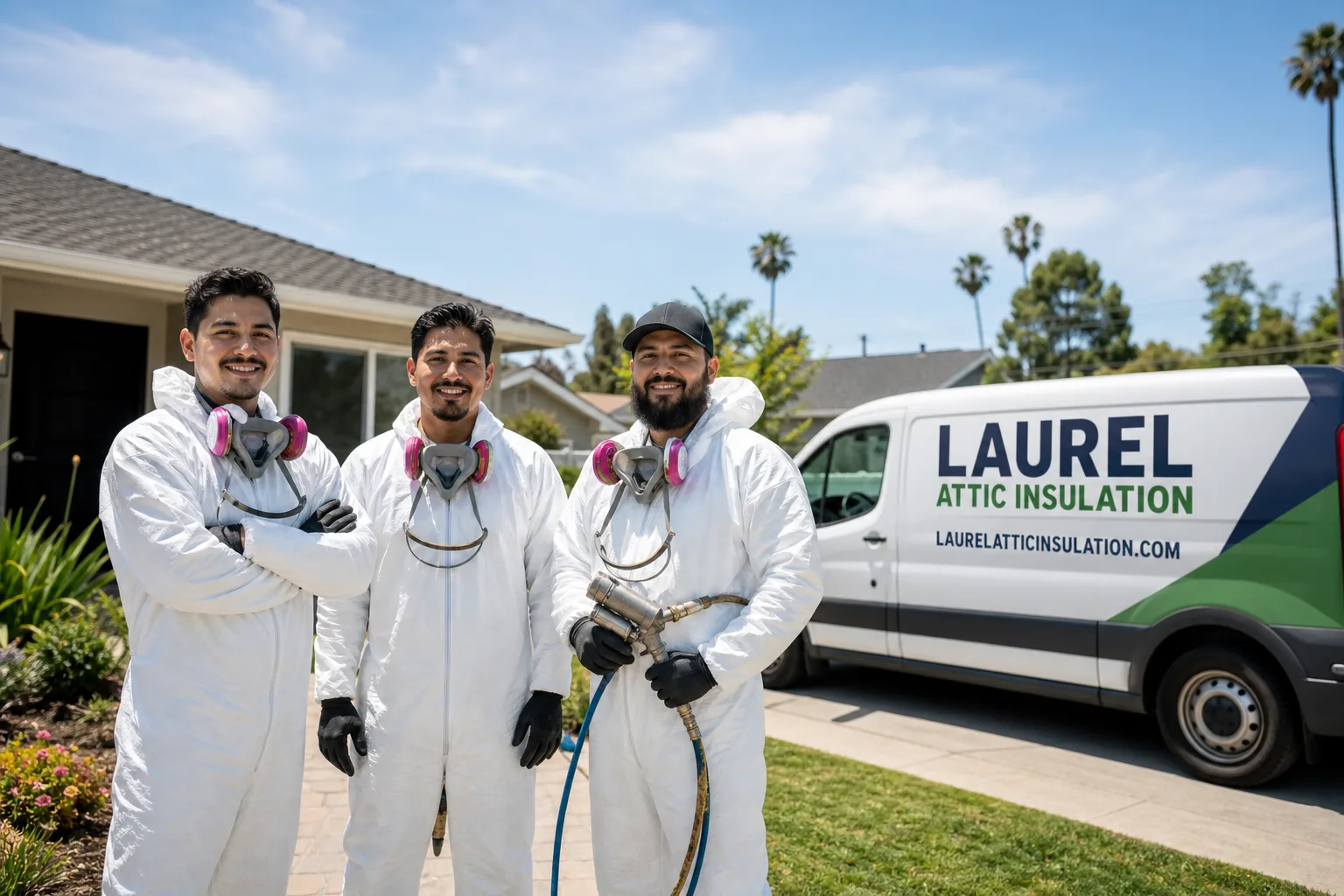
Fast, Reliable Attic Insulation Across Alum Rock
Attic insulation in Alum Rock usually means one of two calls: either you’ve felt the back bedrooms heat up past 4 p.m. every summer, or you’ve spotted a cold spot in the ceiling and want it fixed before the next utility bill. We get it. Laurel Attic Insulation runs local crews into Alum Rock neighborhoods throughout the week, and we schedule by live arrival time, not a four-hour window. If you’re in Alum Rock and want a written price before any work starts, call (361) 315-4177. We’ll walk the attic, show you what’s actually going on up there, and give you a number that won’t change at the door.
Why Laurel Attic Insulation Is Alum Rock’s Preferred Attic Insulation Company
Most insulation companies in the Bay Area treat Alum Rock as a drive-through. We don’t. The housing stock here is specific – ranch and bungalow attics from the 1950s and 60s, tight eave lines, and a lot of roof decks with barely any venting. That changes how insulation should be done. Our crews know the difference between a house off Alum Rock Avenue with gable louvers and a house in the East Foothills with zero soffit intake, because we’ve worked both. We show up with the right material for the job, not whatever fiberglass roll happens to be on the truck.
Chase Whitaker leads our team, and he’s built the business around one rule: put everything in writing. The Attic Insulation work we do in Alum Rock comes with a written price before work begins, a written guarantee on the repair, and live technician tracking so you know when we’ll arrive. If the repair fails within 365 days, we come back. No charge, no argument. That’s the Relay Visibility Guarantee, and it’s included on every job. Alum Rock homeowners book on their phones, and they should be able to see exactly what’s happening with their attic the same way.
Attic Ventilation in Alum Rock
Attic ventilation in Alum Rock is the quiet problem behind a lot of insulation failures. Many of the ranch homes built here in the 1950s and 60s went up with a single small gable louver and no soffit vents at all. That means there’s no path for air to move through the attic. Heat stacks against the roof deck in summer. Moisture condenses on the sheathing in winter. New insulation won’t fix that by itself – in fact, it can make the moisture problem worse if the attic can’t breathe. Most Alum Rock ventilation jobs run $400 – $1,200, depending on whether we’re adding intake vents, a ridge vent, or both.
Adding Intake and Exhaust Where There Was None
On a 1950s ranch off Mt. Hamilton Road near Alum Rock Park, our crew found the original kraft-faced batts collapsed to R-8 and mold staining the north sheathing. The only exhaust was a single small gable louver. We pulled the failed batts, baffled the eave line, added a ridge vent and intake vents, then blew in Owens Corning L77 fiberglass to R-38 with a radiant barrier stapled under the rafters facing the hot afternoon sun. The homeowner called two weeks later to say the back bedrooms finally held temperature past 4 p.m. That’s the difference ventilation makes.
When a Ranch Needs Baffles Before Insulation
Baffles are thin channels that keep blown insulation from blocking the eave line where air enters. If your Alum Rock home has no soffit vents, we can’t just blow in insulation and call it done – the air path has to exist first. This is why some Alum Rock quotes come back higher than a neighbor’s: the venting work is part of the job. We’ll show you photos of the eave before and after so you can see exactly what was fixed.
Radiant Barrier in Alum Rock
A radiant barrier in Alum Rock is one of the best dollar-for-dollar upgrades for homes on the east-facing hillsides, where the afternoon sun beats on the roof from about 1 p.m. until sunset. The barrier is a foil-faced layer stapled under the rafters that reflects radiant heat back out of the attic instead of letting it radiate down into the living space. In Alum Rock’s summer heat, that can drop attic temperatures by 20 to 30 degrees on the hottest days. Radiant barrier installation typically runs $900 – $2,100 for an average Alum Rock attic, and it pairs well with blown insulation.
Why the East Foothills Homes Benefit Most
Homes up along the East Foothills above Alum Rock Avenue catch full afternoon sun with very little tree cover. The roof deck absorbs that heat and radiates it downward. Insulation slows conductive heat, but radiant heat passes right through standard fiberglass. A radiant barrier addresses that second path directly. If your Alum Rock home has a west- or south-facing roof plane, the barrier pays for itself faster than almost any other attic upgrade.
Stapling Under the Rafters vs. Laying on the Floor
We install radiant barriers under the rafters, facing the air space, not laid flat on top of the insulation. That orientation keeps the reflective surface clean and working. Laid on the floor, the barrier gets dusty and loses most of its reflectivity. It also traps moisture in some Alum Rock attics where humidity gets high. Under the rafters is the right way, and we’ll tell you if your attic can take it before we quote the job.
Trusted Brands We Service in Alum Rock
We match material to the attic, not to what’s left in the truck. For Alum Rock homes, that usually means Owens Corning blown fiberglass, Johns Manville batts for tight eave lines, and Knauf for specific R-value targets in shallow cavities. We keep local stock for fast turnaround on Alum Rock jobs, so a top-up or replacement doesn’t mean waiting two weeks for a special order. If your attic needs Rockwool for fire resistance or sound control, we’ll bring it. You get the right brand for your roof assembly, and we’ll explain why in plain language before any staple is set.
Common Attic Insulation Problems We See in Alum Rock Homes
- Collapsed kraft-faced batts from the 1950s-60s. Original batts in East Foothills ranches sag and fall away from the joists, leaving the outer edge of the attic bare and the ceiling hot. We see this on nearly every original attic in Alum Rock.
- No soffit intake and a single gable louver. No path for air to move means heat and moisture condense on the roof deck in winter and cook the attic in summer. This is the root cause of mold staining on north sheathing in older Alum Rock homes.
- DIY big-box batts laid flat over old wiring and recessed cans. These block eave airflow and fail inspection, often compressing the very insulation the homeowner paid for. If you’ve got rolls from a Saturday project up there, we’ll assess whether they can be reused or need to come out.
- Attic insulation crushed by storage or past trades work. Insulation works by trapping air. Compressed insulation loses most of its R-value. If you’ve stored boxes up there or an electrician moved batts around, you may be running at a fraction of what you think.
Pricing for Attic Insulation in Alum Rock, CA
A typical blown-in attic insulation job in Alum Rock runs $900 – $2,400 depending on square footage and the R-value you’re targeting. Batt insulation for smaller or shallow attics usually falls between $1,000 and $2,800. An attic top-up, where we add insulation on top of what’s already there, is typically $600 – $1,400. Replacement jobs, where old insulation comes out first, run higher: $1,800 – $4,200 is common for Alum Rock homes with failed 1950s-60s batts and ventilation work thrown in. Radiant barrier tends to add $900 – $2,100. We give you a written price before any work starts, and that number is what you pay. Call (361) 315-4177 for a free estimate.
We Also Serve Cities Near Alum Rock
Laurel Attic Insulation runs crews beyond Alum Rock into Los Angeles, San Diego, San Jose, and San Francisco. If you’re in a neighboring city and need attic insulation, the same written-price guarantee and live arrival tracking applies. Dispatch and scheduling are coordinated from our San Francisco Bay Area office, and local crews serve Alum Rock directly.
Serving Alum Rock, CA - Our Local Coverage Area
We’re based in the Alum Rock area and know this community well. Use the map below to see our service coverage - if you’re nearby, we can almost certainly help.
FAQs About Attic Insulation in Alum Rock
Yes, but venting has to come first. A ranch without soffit intake can’t move air through the attic, and adding insulation to that setup traps moisture against the roof deck. We’ll add intake and exhaust venting – or baffle existing openings – before we blow in new insulation. The venting work is part of the quote, not an add-on. Call (361) 315-4177 and we’ll walk your attic and show you exactly what’s needed.
Same-day or next-day service is available for most Alum Rock jobs, depending on crew schedule. We dispatch from the Bay Area office and keep local crews in the Alum Rock area throughout the week. When you book, you get a live arrival time – not a four-hour window – and you can track the technician’s arrival on your phone.
We repair what’s repairable and replace what isn’t. If your Alum Rock attic has original kraft-faced batts that have collapsed to R-8 or lower, repair doesn’t make sense – those batts are done. But if you’ve got a top-up situation where the existing insulation is dry and intact, we’ll add on top of it and save you money. We show you photos of the condition before recommending either path, and the recommendation is written in the quote.
We stock Owens Corning, Johns Manville, Knauf, and Rockwool, and we match the material to your attic’s needs. For most Alum Rock ranches, Owens Corning blown fiberglass to R-38 is the workhorse. Shallow cavities may get Knauf batts. Rockwool comes out when fire resistance or sound control matters. We’ll tell you what we’re using and why before the work starts.
Yes, we install radiant barriers, and for Alum Rock homes on the east-facing hillsides, it’s one of the best attic upgrades you can make. The afternoon sun here heats the roof deck by 20 to 30 degrees above ambient, and a foil barrier under the rafters reflects that heat back out. If your home sits above Alum Rock Avenue with a west- or south-facing roof, it’s worth it. Call (361) 315-4177 for an exact quote – estimates are free.
Written by Chase Whitaker, Owner at Laurel Attic Insulation.