
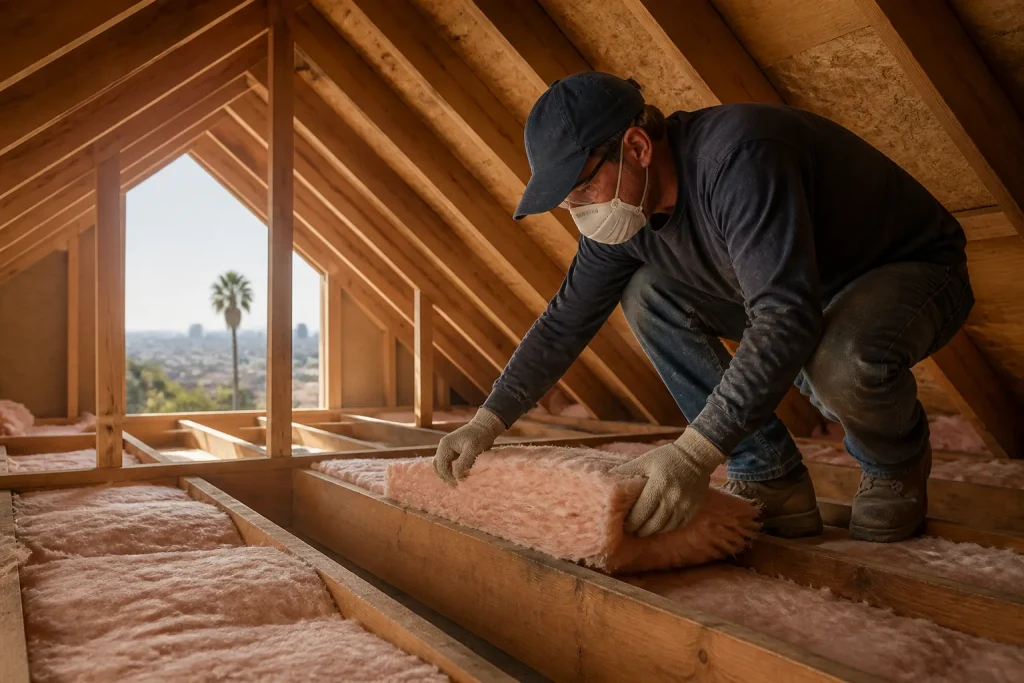
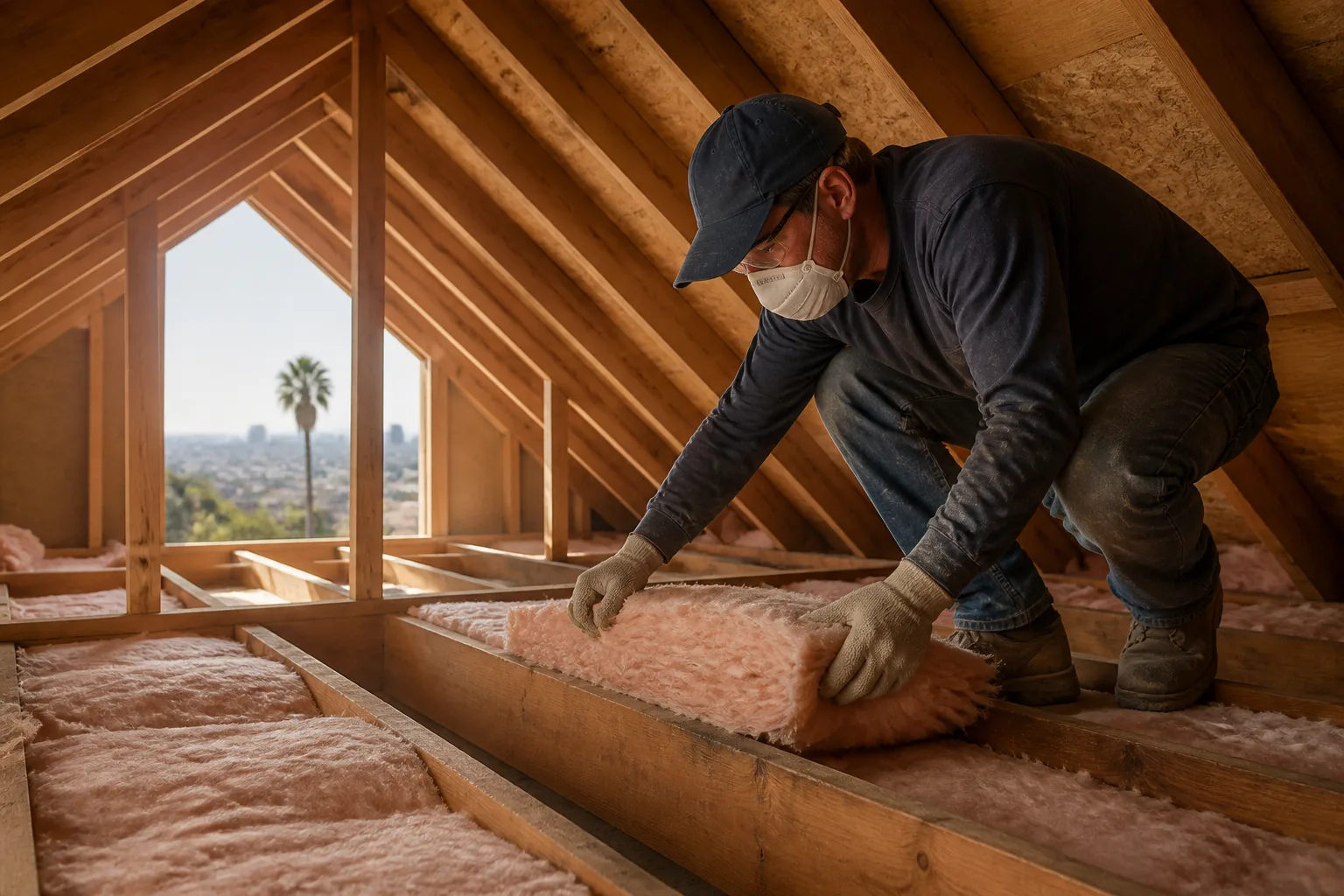
Preparing Your Home’s Insulation for Winter in Los Angeles
Preparing your home’s insulation for winter in Los Angeles comes down to three moves: check what’s actually sitting in your attic right now, fix the cheap thermal leaks most Angelenos never think about (especially the attic hatch), and decide whether what’s up there is worth saving or should be pulled and replaced. If you’d rather skip the ladder and the dust, call (361) 314-0118 and we’ll do a full inspection for free.
Los Angeles averages 35 nights below 50°F every winter. That’s not nothing, and if your attic insulation lost just 20% of its R-value to settling or pest damage, you’ll feel every one of those nights in your heating bill. We’ve been in attics across this city, and the pattern is always the same: homeowners in LA treat insulation like a one-time purchase. It’s not. It’s a system that degrades, settles, and gets fouled by the same wildfire smoke that rolls through every fall.
Why LA Winters Punish Neglected Insulation More Than People Expect
Most insulation guides are written for Minnesota or Chicago. They assume you’re fighting sub-zero temperatures and ice dams. Los Angeles is different, and that’s exactly why so many homes here underperform in January. When overnight lows hang in the mid-40s, there’s only a 20 to 25 degree gap between indoors and outdoors. Your furnace barely cycles. Your attic insulation, if it’s thin or settled, lets heat escape so slowly you never notice the loss until you’re sitting in a room that feels five degrees colder than the thermostat says.
Here’s what most Los Angeles homeowners miss: the smaller the temperature differential, the more your comfort depends on even heat distribution, not raw furnace output. A ceiling with R-38 insulation holds heat steady. A ceiling with effectively R-11 after years of settling creates cold spots, drafts, and that weird feeling where you’re warm standing up but cold sitting on the couch. Your heating system works harder to compensate. Your December and January bills climb 30 to 40 percent beyond what they should be.
And there’s an LA-specific factor almost nobody covers: wildfire season. Every fall, Santa Ana winds push ash and fine particulates across the basin. On newer homes with sealed attics, that’s mostly an outdoor problem. On the majority of Los Angeles homes built before 1980, attic vents pull that same particulate-carrying air through the insulation. Fine ash settles into fiberglass batts and blown-in cellulose, clumping fibers and reducing the material’s ability to trap air. By the time winter arrives in Los Angeles, your insulation isn’t performing at the R-value printed on the bag.
We’ve pulled insulation out of attics in Silver Lake and Van Nuys where the top two inches were gray with settled ash. Homeowners had no idea. Their furnaces were running longer, their upstairs rooms were colder, and the fix was simply removing the fouled material and blowing in fresh product. That’s not something you’ll catch unless you look.
How to Check Your Attic Insulation Before Winter (Without Hiring Anyone)
The first thing to understand is R-value, which is simply the number that measures how well insulation slows heat from moving through your ceiling. The higher the number, the better the resistance. Building code in Los Angeles recommends R-30 to R-38 for attic floors, depending on your home’s age and the type of material used. Older homes often have R-11 or R-19, which was standard in the 1970s and 1980s.
Here’s a basic visual check you can do from the attic hatch. No need to crawl around up there yet.
- Grab a flashlight and look at the depth. Blown-in fiberglass and cellulose should sit consistently across the joists. If the material is below the top edge of the ceiling joists, you’re under R-30 and losing heat. If it’s mounded well above the joists, you’re probably in decent shape.
- Look for bare spots. Insulation shifts. Pests burrow. In Los Angeles, rats and mice are active year-round and love nesting in old fiberglass. Any area where you can see bare drywall is a thermal hole.
- Check for dark patches. Gray or black staining along the edges of your attic usually means air is leaking from the living space below, filtering dust into the insulation. That’s a sign your air-sealing is failing, not just your insulation.
- Look for settling. Blown-in cellulose loses volume as it ages, especially if moisture or humidity compacts it. After 5 to 7 years, most cellulose settles 10 to 20 percent simply from gravity. Blown fiberglass settles less but still shifts.
If any of those sound familiar, you’ve got a winter prep project. We offer Attic Insulation in Los Angeles for homeowners who’d rather have a trained technician measure, remove, and install everything with a written price before work begins.
The Attic Hatch: LA’s Most Overlooked Thermal Leak
Every attic has one, and almost nobody insulates it. The pull-down stair or hatch panel that separates your conditioned living space from your unconditioned attic is one of the worst thermal leaks in Los Angeles homes. It’s effectively an uninsulated hole in your ceiling.
In our experience, the attic hatch alone can account for 5 to 10 percent of your home’s total winter heat loss. Here’s why: the panel itself is usually thin plywood or drywall with no insulation attached. The gap around the frame leaks air constantly. And because warm air rises, the air pressure in your home pushes heated air straight toward that hatch whenever your furnace runs.
The fix costs between $40 and $150 in materials and takes an afternoon, which makes it the highest-payback winter prep project in Los Angeles.
- Buy a sheet of rigid foam board. Any 2-inch polyisocyanurate or extruded polystyrene board works. Cut it to fit the top of your hatch panel and glue it in place.
- Add weatherstripping around the hatch frame. Self-adhesive foam tape, the same stuff you’d use on a drafty door, seals the air gap.
- Install latches or hook-and-eye fasteners. The weatherstripping creates upward pressure, so you need something holding the hatch closed to compress the seal.
When we inspect attics in Los Angeles, this is the first fix we recommend for homeowners who aren’t ready to replace their insulation entirely. It’s cheap, immediate, and it works.
Insulate Your Pipes Before the Next Cold Snap Hits Los Angeles
The 2023 cold snap caught a lot of Los Angeles homeowners off guard. Temperatures dropped below freezing in parts of the Valley and the foothills, and pipe-freeze damage hit homes that had never seen a frozen line in thirty years. Your attic, especially if it’s unconditioned, is where exposed water lines live in older Los Angeles homes.
Foam pipe insulation is a 30-minute job. You can buy pre-slit polyethylene pipe sleeves at any hardware store for about $3 to $8 per six-foot section. Slide them over exposed copper or PEX lines in your attic, seal the seams and joints with duct tape or zip ties, and you’ve eliminated the freeze risk for the winter. This also helps your water heater hold temperature longer, since running hot water lines through a cold attic saps heat from the system.
Is this glamorous? No. But in our line of work, we’ve seen the alternative. A burst line in an attic drips for hours before anyone notices, and by then the insulation below is soaked, the drywall is ruined, and you’re looking at a four-figure repair instead of a ten-dollar fix. The pipe wrap is cheaper.
What a Pre-Winter Insulation Inspection in Los Angeles Should Include
If you’d rather have a professional look at what’s above your ceiling, here’s what a proper pre-winter inspection in Los Angeles should cover, and what you should expect to pay.
The inspection itself should be free. Not “free with purchase,” not “credited toward your job.” Free. Any insulation contractor who charges for an inspection before giving you a price is one to avoid.
A proper inspection includes:
- Depth and R-value measurement across at least six points in your attic, not just one spot near the hatch
- An air-leak check around the attic hatch, recessed lights, plumbing penetrations, and any chimney or flue chase
- A moisture check in the insulation and on the underside of the roof decking
- An assessment of pest activity and any damage done to the existing material
- A written recommendation with a dollar figure attached
Here’s the red flag: if a contractor walks through your attic for five minutes and quotes you a price without measuring R-value, that’s not an inspection. That’s a guess. The R-value measurement is the single most important step. Without it, any quote is built on assumptions.
For hiring decisions, expect to pay roughly $200 to $350 for the inspection labor if you’re hiring someone solely to diagnose the attic. If you move forward with insulation work, that cost should be rolled into the job. Most attic insulation jobs in Los Angeles run $900 to $2,400 for a full replacement, depending on square footage and the R-value you’re targeting. Spray foam costs more upfront but delivers higher R-value per inch and seals air leaks simultaneously. For more on that, see Spray Foam Insulation in Los Angeles.
I own Laurel Attic Insulation, and I was in an attic over in Eagle Rock last December where the homeowner had paid another contractor four years earlier for blown-in fiberglass. The material had settled below the joists in a third of the attic. The receipt said R-38. The actual reading was R-19. That’s why we measure and document everything before we touch anything.
What Settled, Damaged, or Ash-Fouled Insulation Means for Your Winter
If your insulation has settled, been fouled by wildfire ash, or been chewed apart by rodents, you have two choices: add more on top or remove the old material and start fresh. The right call depends on what you find.
Adding fresh blown-in material over settled or compressed insulation helps, but it’s a bandage if the existing layer is contaminated. Ash and pest droppings don’t just disappear because you covered them. The air quality issue remains, and the old material continues to hold moisture longer than it should. For homes that have been through multiple fire seasons or had any kind of roof leak, removal is the better long-term play. We handle Insulation Removal in Los Angeles daily, and the difference in heating performance after a clean removal and fresh install is immediate.
As for materials, we source from brands like Owens Corning, Rockwool, Knauf, and CertainTeed, and we match the product to the job rather than whatever happens to be on hand. Rockwool and Knauf both make excellent blown-in and batt products that hold up well in Los Angeles attics, and CertainTeed’s fiberglass has held up consistently for us over the years. Your attic isn’t a one-size-fits-all situation, and the material choice should reflect that.
When to call a pro: If your attic has any signs of moisture, mold, pest nesting, or significant settling, or if you’re simply not comfortable climbing a ladder and crawling around up there, hire it out. Insulation work is physically demanding and dusty, and a trained technician with the right respirator and camera gear will find problems in twenty minutes that you’d miss entirely. The inspection is free, and the written price you get is the price you’ll pay.
Related services in Los Angeles: Laurel Attic Insulation home | Attic Insulation in Los Angeles | Spray Foam Insulation in Los Angeles | Insulation Removal in Los Angeles
The Bottom Line
Getting your home’s insulation ready for winter in Los Angeles doesn’t take much, but skipping it has consequences. You’ll run your furnace longer, pay more, and still end up with cold rooms and a drafty house. The priorities are simple: look at what’s in your attic, seal the hatch, wrap the pipes, and if the insulation is compromised, replace it before January.
Key takeaways:
- Los Angeles homes lose the most heat through attics that were under-insulated from the start or have settled over five to seven years
- Wildfire ash in attic insulation reduces R-value and shortens the material’s useful life
- The attic hatch is a $40-$150 fix that pays for itself in a single winter
- Foam pipe wrap takes half an hour and prevents the kind of freeze damage Los Angeles saw in 2023
- A professional insulation inspection should always include R-value measurement and a written quote, both of which should be free
If you’re in Los Angeles and want a professional to handle the prep work, Laurel Attic Insulation offers free estimates and a written price before anything begins. Call (361) 314-0118 to schedule yours.
Frequently Asked Questions
Check the depth first. If your blown-in insulation sits below the top of your ceiling joists, its R-value has likely dropped below R-30 and replacement or a top-up is warranted. Dark staining, bare patches, visible pest damage, or gray ash buildup are all signs the material has degraded. A free inspection from a pro will give you exact R-value readings and a clear recommendation. Call (361) 314-0118 and we’ll come out and check it.
If you only need to seal the attic hatch and wrap exposed pipes, you’re looking at $50 to $200 in materials and an afternoon of work. A full attic insulation replacement in Los Angeles typically runs $900 to $2,400 depending on square footage and target R-value. Spray foam costs more upfront but delivers higher R-value per inch. We provide a written quote before any work starts, so you’ll know the exact number before committing.
Yes. Fine ash and particulate matter from fall wildfire season gets pulled into attic vents by airflow and settles into fiberglass and cellulose insulation. It clumps the fibers, reduces air-trapping capacity, and lowers the material’s effective R-value. Homes in wildfire-adjacent areas of Los Angeles often see measurable performance loss after a single bad fire season.
It depends on what’s up there. If the old material is dry, clean, and just below ideal depth, adding fresh blown-in insulation on top is a cost-effective fix. If it’s wet, moldy, pest-infested, or heavily fouled with ash, removal is the better move. Covering contaminated insulation traps the problem and degrades indoor air quality. Call (361) 314-0118 for an honest opinion and a free estimate.
Written by the team at Laurel Attic Insulation.
Need Insulation Help?
Call Laurel Attic Insulation - licensed & insured, here with fast after-hours help in Los Angeles.
(361) 314-0118