
Owens Corning Attic Insulation in Los Angeles: A Homeowner’s Guide
Most Los Angeles homeowners who ask for Owens Corning by name end up with whatever product the installer happens to have on the truck. That’s the honest truth, and it’s a problem because Owens Corning actually makes seven distinct attic insulation products, each designed for a different attic scenario. In LA’s climate zones, installing the wrong one usually means paying too much for R-value you don’t need, or not enough for the heat that builds up under a tar-and-gravel roof in August.
If you’re weighing Owens Corning attic insulation in Los Angeles, this guide maps the full product line to real LA attic types, with pricing, R-value requirements, and warranty fine print most contractors won’t explain. And if you’d rather skip the research and just get a straight answer for your specific attic, call (361) 315-4177 and we’ll walk you through it.
Key Takeaways
- Title 24 requires R-38 minimum for attics in most of Los Angeles; Climate Zone 10 calls for R-49 in new construction and major remodels.
- Owens Corning EcoTouch batts cost roughly $1.20 to $1.80 per square foot installed in LA; AttiCat blown-in runs $1.50 to $2.50 per square foot installed.
- PINK Next Gen fiberglass is formaldehyde-free, which matters in tightly sealed LA attics where heat bakes trapped air.
- The “lifetime limited” warranty covers material defects only, not installation errors, and can be voided by improper ventilation or roof leaks.
- The most common mistake we see in LA is installing R-38 batts in a Climate Zone 10 attic that needs R-49, then wondering why the upstairs rooms never cool below 80°F.
Owens Corning’s Product Line, Mapped to LA Attic Scenarios
Owens Corning isn’t one product. It’s a family of products, and the right choice depends almost entirely on what kind of attic you actually have. After working on hundreds of Los Angeles attics since 2003, we can tell you exactly which product fits which scenario.
EcoTouch Batts: Best for Accessible Joist Bays
If you have a standard attic with open, regularly spaced joist bays you can walk through, EcoTouch batts are usually the right call. They come pre-cut in 16-inch and 24-inch widths, unfaced or kraft-faced, and install cleanly between joists. In Los Angeles, where many homes were built between 1920 and 1980, you’ll find a mix of 16-inch on-center framing in older craftsman bungalows and 24-inch spacing in 1960s and 1970s tract homes. EcoTouch covers both.
What most homeowners don’t realize is that batt installation quality matters more than brand. A batt compressed to fit a shallow joist bay loses R-value fast. If your 2×6 rafters only give you 5.5 inches of depth, a standard R-19 batt actually performs closer to R-13 once it’s squeezed in. That’s where blown-in often wins in LA’s older homes.
AttiCat Blown-In: Best for Irregular Spaces and Deep Attics
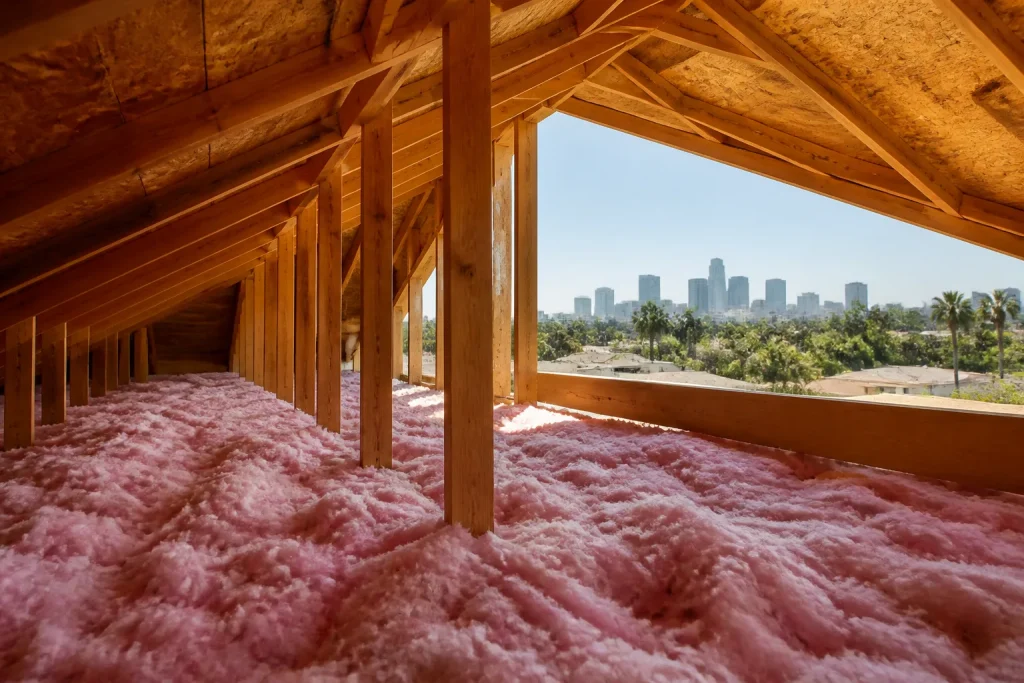
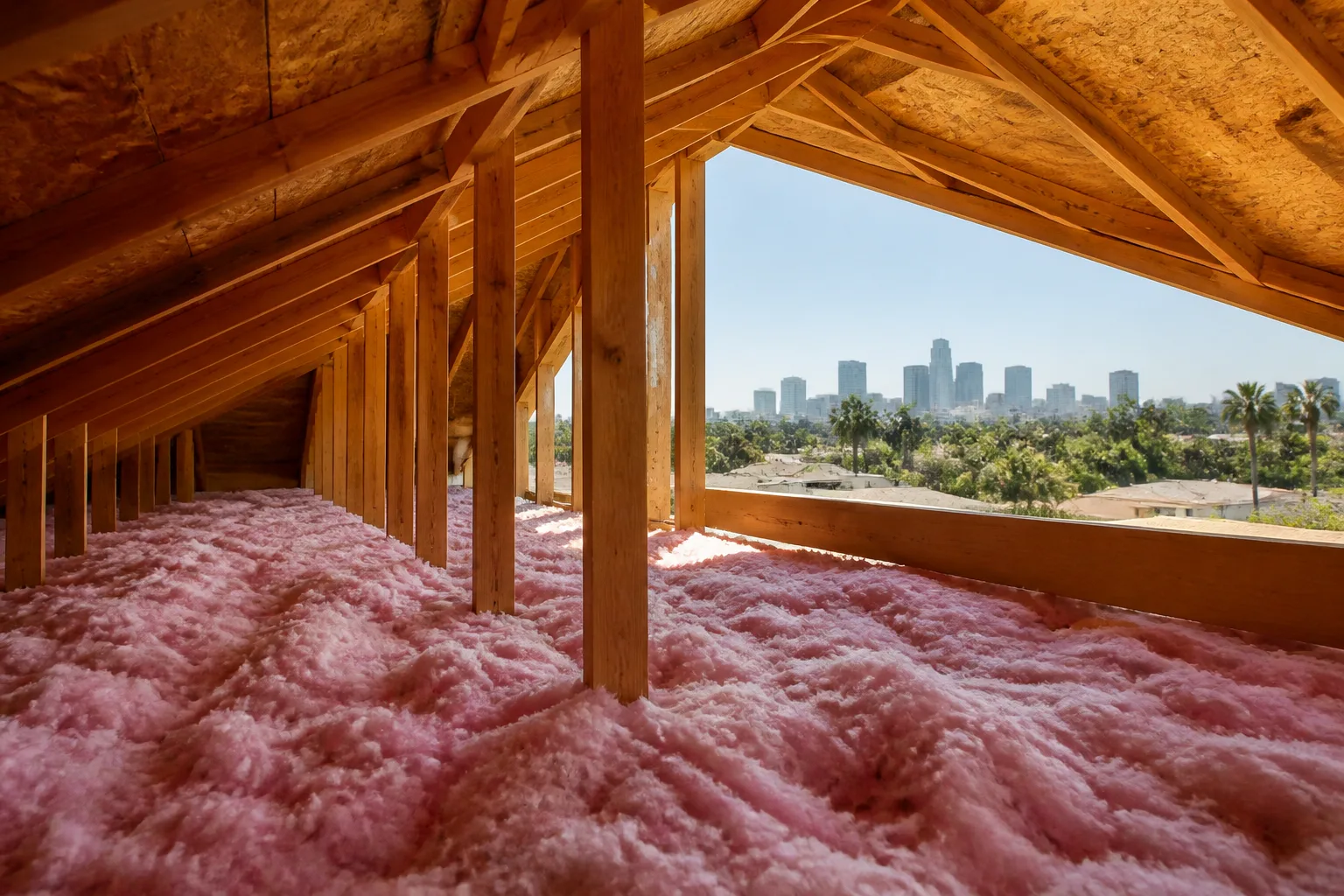
AttiCat is Owens Corning’s blown-in fiberglass system. It’s the product we recommend most often in Los Angeles attics with irregular rafters, cross-bracing, recessed can lights, or shallow eaves. The blow-in process fills gaps that batts simply can’t reach, and it lets you hit any R-value by adjusting depth.
For LA’s Climate Zone 9, which covers most of coastal Los Angeles, R-38 is the Title 24 minimum for attic insulation in new construction and additions. AttiCat hits R-38 at roughly 13 inches of settled depth. For Climate Zone 10, which kicks in as you move inland toward the San Fernando Valley, Pasadena, and the San Gabriel Valley, the requirement jumps to R-49. That’s about 17 inches of AttiCat. This distinction matters, because a lot of LA homeowners think R-38 is “good enough” everywhere and then wonder why their air conditioner runs nonstop through September.
ProPink L77: When Tight Access Calls for a Hybrid
Then there’s ProPink L77, Owens Corning’s spray-applied fiberglass insulation. It’s the product we reach for in Los Angeles attics where blown-in material would blow through knee walls, weird ceiling planes, or open soffits. L77 is designed for open-cavity installation with a water-based adhesive, which means it stays put where loose-fill would shift. It’s less common than EcoTouch or AttiCat, but in certain LA attic geometries, nothing else does the job correctly.
Our team at Laurel Attic Insulation home carries Owens Corning alongside seven other brands specifically so the product gets matched to the attic, not to whatever was left over from the prior job.
R-38 vs. R-49: What Title 24 Actually Requires in Los Angeles
Here’s the short answer: R-38 is the minimum for attic insulation in Los Angeles Climate Zone 9, which includes the Westside, South Bay, Long Beach, most of the San Fernando Valley floor, and the LA Basin. R-49 is required in Climate Zone 10, which covers the hotter inland swaths of Los Angeles County, including most of the San Gabriel Valley, Pomona, Claremont, and parts of the Santa Clarita Valley. Climate Zone 10 also extends into the high desert edges near Palmdale and Lancaster, but those aren’t typically considered Los Angeles proper.
It’s worth checking which zone your home falls in. The California Energy Commission publishes a climate zone map, and it’s broken down by city and even by ZIP code in some cases. The practical difference between R-38 and R-49 in an LA attic is about four inches of blown-in depth or a second layer of batts. The practical difference in your upstairs bedroom in August is measurable: R-49 holds back noticeably more heat than R-38, especially under a dark shingle roof with two hours of afternoon sun beating down on it.
We’ve seen the impact firsthand. We pulled an old fiberglass batt job out of a garage in Eagle Rock last month where the previous installer had laid R-30 over a 1972-era original layer that had settled to maybe R-11. The homeowner’s upstairs bedroom was running eight degrees warmer than the downstairs. After we pulled everything and blew new AttiCat to R-49, the difference was immediate. That’s not a marketing claim; it’s what happened.
Pink vs. White Fiberglass: Does the Formaldehyde-Free Claim Matter?
Owens Corning’s PINK Next Gen line is certified formaldehyde-free. White fiberglass from other manufacturers may or may not be. Here’s why that matters in a Los Angeles attic specifically: attics in LA trap heat. When the sun pounds a roof all day, attic temperatures routinely hit 140°F or higher in July and August. That heat accelerates something called off-gassing, which is the slow release of volatile compounds from building materials. Formaldehyde is one of those compounds, and while the science on long-term exposure from insulation is still debated, the precautionary case is straightforward: if you’re sealing and conditioning your attic, you don’t want a known irritant baking off into air that eventually circulates through your home.
For most LA homeowners, the bigger attic air quality issue isn’t formaldehyde anyway. It’s dust. Old batt insulation in 60-year-old Los Angeles homes is often full of rodent droppings, construction debris, and decades of pulverized dust that finds its way into the HVAC system. Formaldehyde-free is a meaningful differentiator, but it doesn’t replace the need to remove old, contaminated insulation before installing new material. That’s why Insulation Removal in Los Angeles should be part of the conversation if your attic has seen better decades.
Realistic Installed Cost in Los Angeles: Batt vs. Blown-In
Most attic insulation jobs in Los Angeles run $900 to $2,400 depending on square footage, R-value target, and whether old insulation needs to come out first. That’s the realistic range we see in this market, not the national averages you’ll find on home improvement blogs.
Here’s how the math breaks down in Los Angeles as of 2025:
- EcoTouch batts: $1.20 to $1.80 per square foot installed, including labor. For a typical 1,000 square foot LA attic, that’s $1,200 to $1,800.
- AttiCat blown-in to R-38: $1.50 to $2.00 per square foot installed. Same attic: $1,500 to $2,000.
- AttiCat blown-in to R-49: $1.80 to $2.50 per square foot installed. Same attic: $1,800 to $2,500.
- Old insulation removal: Add $1.00 to $2.50 per square foot if the existing insulation is water-damaged, rodent-infested, or compacted below its original R-value.
Those numbers include labor, equipment, and a written price before any work starts. The lowest legitimate bids in LA tend to land around $900 for a small attic and climb from there. If you’re getting quotes below $800 for a full attic, someone is skipping something, usually either the R-value verification or the air sealing that should happen before insulation goes in.
For sprayed ProPink L77, prices run higher because the installation process is different. Budget $2.50 to $3.50 per square foot installed. It’s the right product for certain Los Angeles attic geometries, but it’s not the budget choice.
The Warranty Fine Print: What ‘Lifetime Limited’ Actually Covers
Owens Corning advertises a lifetime limited warranty on their fiberglass insulation products, and that phrase sounds great until you read past the headline. The warranty covers manufacturing defects only. If the product fails because of a manufacturing flaw, Owens Corning will replace the material. It does not cover installation errors, settling beyond the stated rate, compression, moisture intrusion, rodent contamination, or a roof leak that soaks the insulation. It also requires proof that the product was installed to Owens Corning’s specifications.
What voids the warranty in a Los Angeles attic? The big one is improper ventilation. If your attic lacks proper intake and exhaust ventilation, and heat and humidity build to the point where the insulation degrades or the roof deck rots, that’s not a manufacturing defect. It’s an installation or ventilation failure. Roof leaks are another common voided claim. A leak that soaks fiberglass and compresses it is a home maintenance issue, not an Owens Corning problem.
This is where the installation contractor matters as much as the brand. Our Attic Insulation in Los Angeles work includes air sealing and ventilation assessment as part of the job, because insulation without proper airflow in an LA attic is a recipe for moisture problems. And every job includes our 365-Day Done Right Promise: if it’s not right, we make it right, in writing, on every job. That’s a workmanship guarantee, and it’s the layer of protection the Owens Corning material warranty doesn’t provide.
When to Call a Pro
Attic insulation is one of those home improvement projects where the material matters, but the installation matters more. If your attic has open, accessible joist bays and you’re simply adding a second layer of batts, a confident DIYer with the right safety gear can handle it. But if you’re dealing with recessed lights that need baffles, old wiring that needs to be inspected before you bury it, or an attic with existing contaminated insulation that needs removal, that’s not a weekend project anymore. That’s a job for a trained professional with the right equipment.
We pull rodent-infested insulation out of Los Angeles attics in neighborhoods like Highland Park, Silver Lake, and Van Nuys every single week. It’s not a job you want to do without a respirator and a plan. And if your attic has vermiculite insulation from before 1990, it needs to be tested for asbestos before anyone touches it. That’s not a DIY project under any circumstances.
The Bottom Line
Owens Corning makes excellent attic insulation, and in Los Angeles, the brand’s AttiCat blown-in fiberglass and EcoTouch batts are the two products that make sense for the majority of homes. The key is matching the product to your attic type and your climate zone, not just asking for “pink fiberglass” and hoping the installer knows what they’re doing. Get the R-value right: R-38 in Climate Zone 9, R-49 in Climate Zone 10. Understand the warranty limitations. And don’t ignore what’s already in your attic, because new insulation over old contamination is a waste of money.
If you’re in Los Angeles and want a straight answer for your specific attic, Laurel Attic Insulation offers free estimates. We’ll tell you exactly what you need, what it costs, and what you can skip, with a written price before anything starts. Call (361) 315-4177 and mention this guide.
Frequently Asked Questions
Owens Corning attic insulation installed in Los Angeles typically costs $1.20 to $2.50 per square foot depending on the product, which is competitive with other premium fiberglass brands. The value comes from matching the right product to your attic type and climate zone, not from the brand name itself. Call (361) 315-4177 for an exact quote for your attic, free of charge.
R-38 is the minimum for Climate Zone 9, which covers most of coastal and central Los Angeles. R-49 is required in Climate Zone 10, which covers inland areas including the San Gabriel Valley and parts of the San Fernando Valley. Check your specific ZIP code against the California Energy Commission climate zone map to confirm.
Yes, Owens Corning’s PINK Next Gen fiberglass insulation is certified formaldehyde-free. This matters more in Los Angeles attics than in cooler climates because high attic temperatures accelerate off-gassing of volatile compounds in sealed spaces.
No. Owens Corning’s lifetime limited warranty covers manufacturing defects only. Installation errors, settling, compression, moisture damage, and rodent contamination are not covered. Workmanship is covered by the installer’s own warranty, which is why we back every Los Angeles job with our 365-Day Done Right Promise in writing.
Written by Chase Whitaker, Owner at Laurel Attic Insulation, serving Los Angeles since 2003.
Need Insulation Help?
Call Laurel Attic Insulation - licensed & insured, here with fast after-hours help in Los Angeles.
(361) 315-4177