
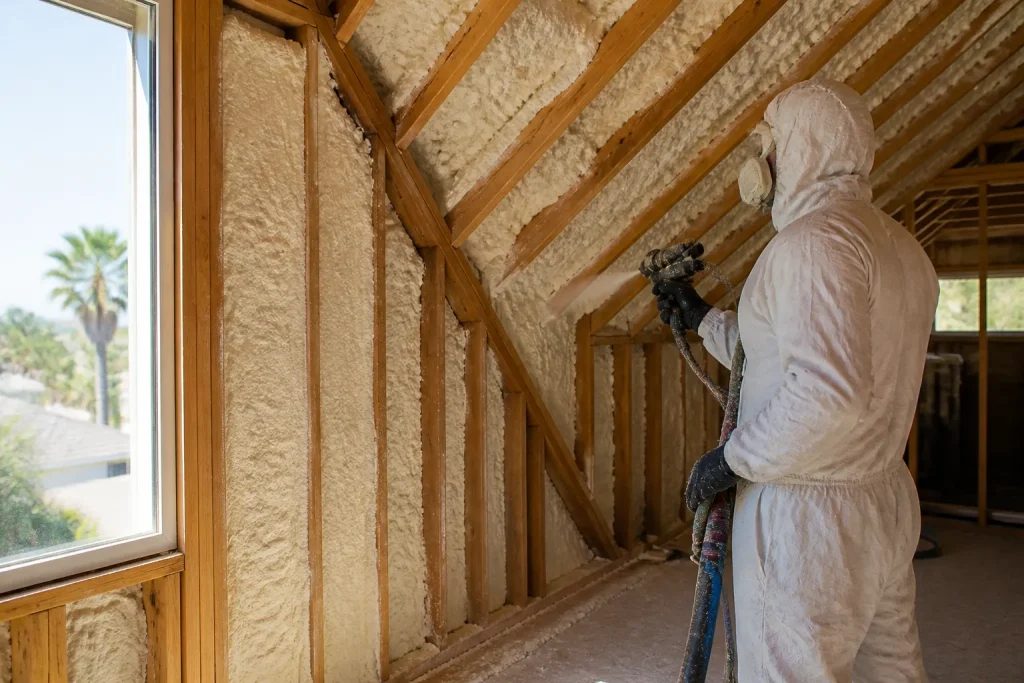
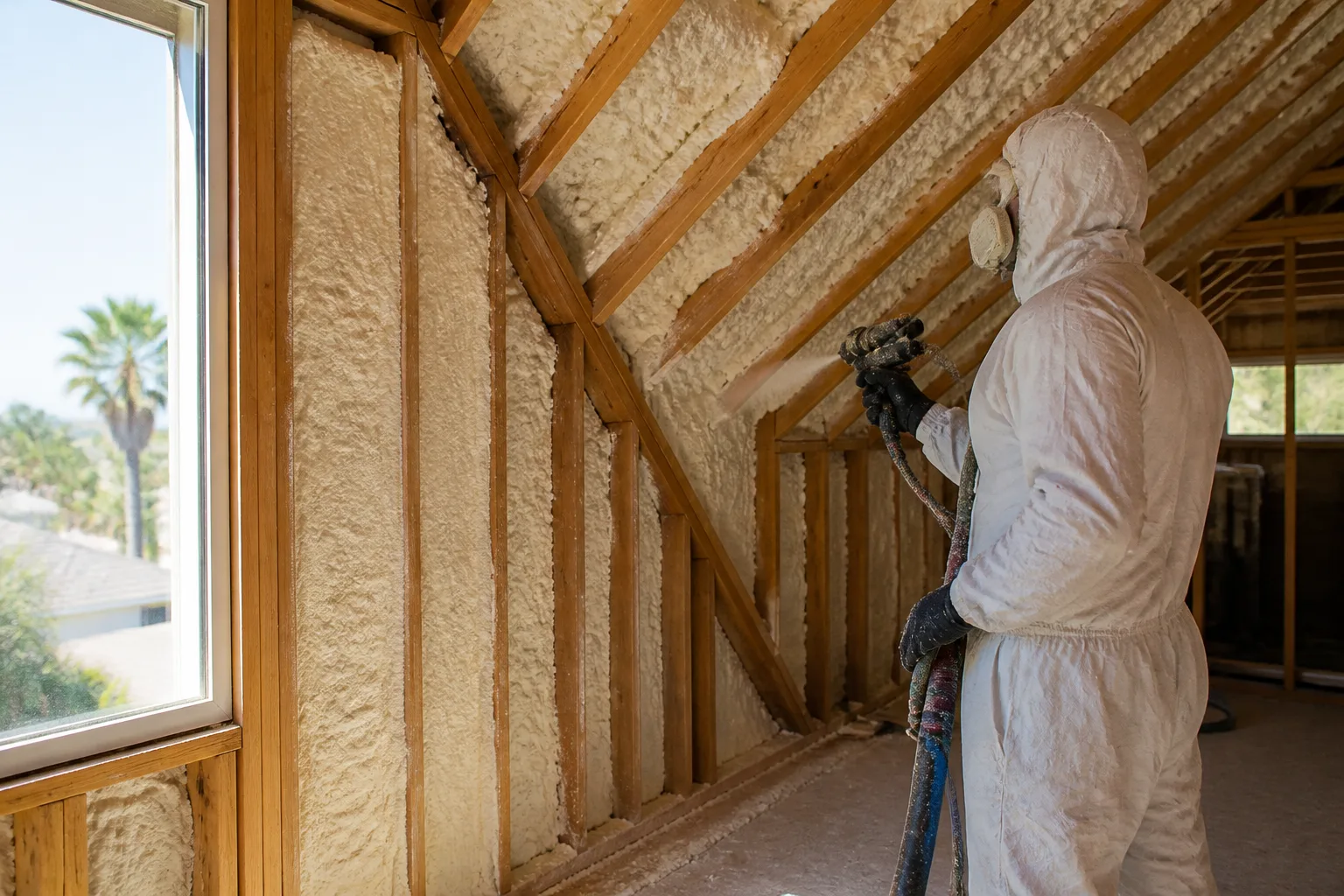
5 Mistakes to Avoid With Spray Foam Insulation
Most spray foam mistakes happen before the foam ever leaves the gun, and you won’t see them from below your attic hatch until your energy bill stays stubbornly high or a home inspector flags the work at resale. In Los Angeles, where cooling costs drive summer bills and older housing stock hides structural quirks, five specific on-the-job errors account for nearly every failed foam job we’re called to fix: wrong substrate temperature, skipped vapor barrier assessment, overspray thickness, unsealed penetrations, and missing certification paperwork. Here’s what each one looks like in the real world, and how to avoid paying for it twice. If you’d rather skip the troubleshooting and have a pro check your attic, call (361) 314-0118 and we’ll schedule a free estimate.
Mistake #1: Applying Foam to a Substrate That’s Too Cold or Too Hot
Spray foam is a chemical reaction, not a paint job. It needs surface temperatures between 50°F and 90°F to cure correctly, and when the substrate falls outside that range, the foam either won’t adhere or won’t reach its stated R-value. In Los Angeles this rule plays out in a specific way: morning installs matter. A crew that starts at 7 a.m. on a winter day in the Valley may be spraying onto roof decking that’s still in the low 40s from the previous night, even though the air temperature feels fine by 9 a.m. The foam skins over, looks normal, and then delaminates from the decking within weeks. By summer, the same attic might hit 120°F before noon, and foam applied to a scorching substrate can cure too fast, creating a brittle cell structure with lower insulation performance.
A professional crew carries an infrared thermometer and checks the actual surface temperature before the first pass, not just the ambient air. If the decking is out of range, they wait or they condition the space. If a contractor can’t tell you the substrate temperature rule, that’s not a scheduling conflict, it’s a skill gap.
Mistake #2: Skipping the Vapor Barrier Question on Closed-Cell Foam
Closed-cell spray foam acts as its own vapor barrier at roughly two inches of depth, which sounds convenient until you understand how moisture moves through older Los Angeles homes. Bungalows built before 1970 weren’t designed with air-sealed attics in mind, and they often lack proper roof ventilation or have original framing that breathes in ways modern construction doesn’t. When you spray closed-cell foam directly against unconditioned roof decking in these homes without assessing the existing vapor profile, you can trap moisture against the wood. In coastal neighborhoods like Santa Monica or San Pedro where marine air pushes humidity into attics year-round, that trapped moisture becomes a slow-rot problem that nobody sees until a section of roof sheathing fails.
The fix isn’t complicated, but it has to be decided before installation: determine whether the home’s climate zone and existing assembly call for a vapor barrier, a vapor retarder, or the foam’s own permeability characteristics. In Los Angeles, the answer varies by neighborhood and by attic construction. A competent installer evaluates this first and writes it into the scope of work. One that skips the conversation is guessing.
Mistake #3: Overspraying in a Single Pass
Spray foam generates heat as it cures. That’s chemistry: the A-side and B-side components react exothermically. When an installer tries to hit a three-inch target depth in a single pass instead of building it up in lifts, that heat builds faster than it can dissipate. The result is a foam core that can reach internal temperatures high enough to compromise cell structure, reduce R-value, and in rare cases leave a scorched or discolored pattern inside the foam itself. We’ve cut into foam from a Silver Lake attic job where the homeowner’s previous contractor had done exactly this, and the center of the foam was dark amber instead of the proper cream color. The foam looked fine from the outside. The insulation value was measurably lower, and the only fix was removal and reapplication.
Proper technique means applying foam in controlled passes, usually one to two inches per lift, allowing the exothermic reaction to stabilize before building the next layer. R-value depends on the foam’s cell structure remaining uniform, and uniform cell structure needs staged application. Anyone who tells you a single thick pass saves time is trading your insulation performance for their schedule.
Mistake #4: Not Air-Sealing Penetrations Before Foaming
This one surprises homeowners because spray foam is supposed to be the air-sealing product. But here’s the catch: foam seals around existing gaps; it doesn’t always seal into them. When an attic has recessed light housings, plumbing vents, electrical wire runs, or flue penetrations, those openings need to be addressed before or during the foam application. If the installer simply sprays over them, the foam creates a cap that looks sealed from the attic side, while conditioned air continues to leak into the cavity behind it. The homeowner gets a lower-than-expected energy improvement and, when someone finally investigates, the revelation that the expensive foam job never actually addressed the biggest air leakage points.
In Los Angeles homes, recessed lighting is everywhere, and older can lights often aren’t IC-rated for insulation contact. A proper spray foam job includes mapping every penetration, installing the appropriate barriers or blocking, and then applying foam so it fully encapsulates the opening. It’s a methodical step that adds an hour or two to prep and saves years of underperformance.
Mistake #5: Not Getting the Installer’s Certification Documentation
If you’re paying for Icynene or Demilec foam, the installer should hold current certification from that manufacturer, and it’s reasonable to ask to see it. This isn’t a formality; it’s the difference between someone who has demonstrated proper equipment calibration and application training, and someone who bought a spray rig last month and learned on your ceiling. Certified contractor credentials from Icynene and Demilec are issued after hands-on training and typically include a contractor ID number you can verify with the manufacturer. A reputable installer will show you the documentation without hesitation. One that hedges, says it’s “at the office,” or tells you certifications don’t matter is telling you something useful.
We run crews trained on materials from several manufacturers, including Icynene and Demilec, because different foam chemistries perform differently in different Los Angeles attics. Open-cell foam makes sense in some assemblies; closed-cell in others; sometimes the right answer is a hybrid approach tied to the home’s orientation and ventilation. Matching the material to the specific job, not to whatever’s on hand, is how you get the R-value you paid for.
When to Call a Pro
Spray foam application involves pressurized equipment, reactive chemicals, and confined attic spaces. If you’re noticing high energy bills after a recent foam job, seeing foam pulling away from the decking, or smelling an odor that hasn’t gone away after a week, stop and get an assessment from a trained installer. Most failed foam jobs can be remediated, but the remediation gets more expensive the longer a moisture or adhesion problem sits. If you’re in Los Angeles and want us to take a look, we’ll give you a straight answer and a written price before any work starts. It’s how we’ve operated as part of the Relay Home Co. family.
Related: spray foam insulation services in Los Angeles and attic insulation in Los Angeles.
The Bottom Line
Spray foam works exceptionally well when it’s applied to the right surface at the right temperature, in the right lift thicknesses, with penetrations sealed first, and by an installer certified for the specific material. It fails quietly when any one of those things goes wrong. The most expensive spray foam job in Los Angeles is the one that looks fine and doesn’t perform, because you pay for the foam, then you pay to find the problem, then you pay to fix it. Before you sign a contract, ask about substrate temperature checks, vapor barrier assessment, lift thickness, penetration sealing, and manufacturer certification. A pro will welcome every one of those questions.
If you’re in Los Angeles and need help with spray foam, attic insulation, or removal, Laurel Attic Insulation offers free estimates. Call (361) 314-0118 and we’ll walk your attic with you, show you what’s actually going on, and give you a written price before anything starts. You’ll get a live arrival time, before-and-after photos, and a Done Right Promise on every job. Laurel stays green all year, and so should your home’s comfort. That’s the idea behind the name.
Frequently Asked Questions
Surface temperatures need to sit between 50°F and 90°F for spray foam to cure and bond correctly. In Los Angeles, morning installs in winter can fall below that range even when the air feels mild, so a professional crew checks decking temperature with an infrared thermometer before spraying.
Yes, and it’s most common in older Los Angeles homes where the existing roof assembly wasn’t designed for air-sealed insulation. Closed-cell foam is a vapor barrier at around two inches, and without a proper vapor profile assessment first, it can hold moisture against roof decking and cause slow rot. The assessment should be part of any professional scope of work.
No more than one to two inches per pass for most foam formulations. Applying more creates excessive heat during curing, which damages the foam’s cell structure and reduces its real-world R-value. Oversprayed foam often looks fine from the outside but performs below spec.
Only if the installer addresses those penetrations deliberately. Foam sprayed over an existing gap seals the surface but doesn’t stop air movement behind it. Proper technique involves mapping every penetration, installing appropriate barriers, and encapsulating each opening fully before building the foam to target depth.
Written by the team at Laurel Attic Insulation.
Need Insulation Help?
Call Laurel Attic Insulation - licensed & insured, here with fast after-hours help in Los Angeles.
(361) 314-0118