
Rockwool Attic Insulation in Los Angeles: A Homeowner’s Guide
Rockwool attic insulation in Los Angeles costs between $0.80 and $1.20 per square foot installed, making it roughly 40 to 60 percent more expensive than fiberglass upfront. The reason LA homeowners increasingly choose it anyway comes down to two properties that matter more in Southern California than almost anywhere else in the country: fire resistance to 2,150°F and dimensional stability through wild temperature swings. If you’d rather not sort through R-values and fire ratings yourself, call Laurel Attic Insulation at (361) 314-0118 for a written quote before any work starts.
During the 2018 Woolsey Fire, homes with mineral wool insulation in their attic assemblies showed measurably slower internal temperature rise than comparable homes with fiberglass. That detail never made it into most contractor sales pitches, because most LA insulation crews were selling whatever was loaded on hand that morning. We think that’s a problem worth correcting.
What Is Rockwool, and Why Does It Behave Differently in LA’s Climate?
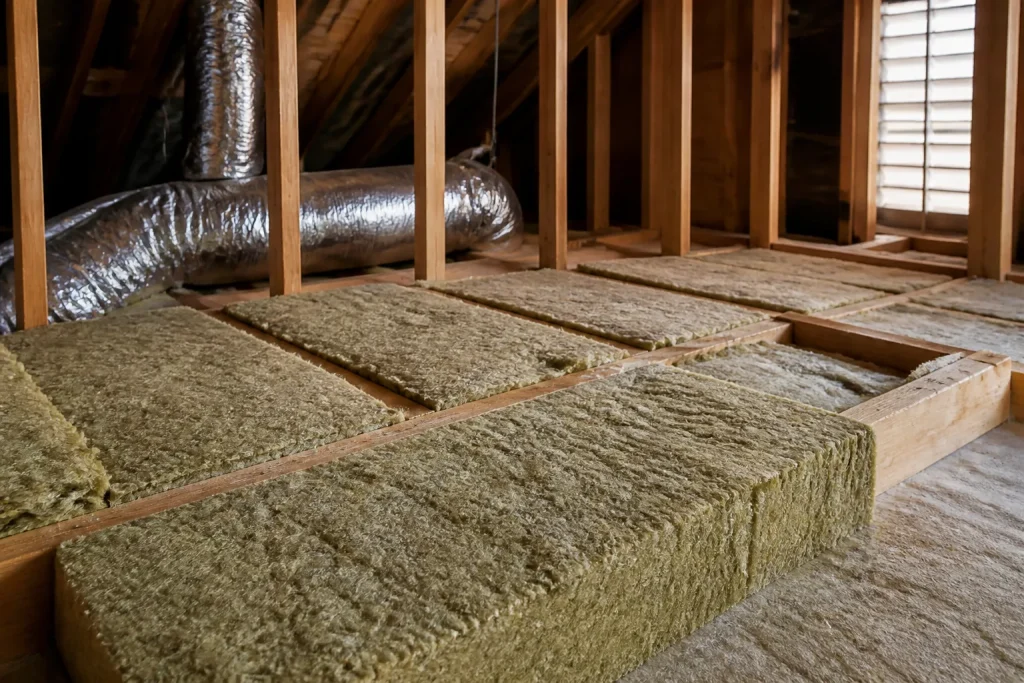
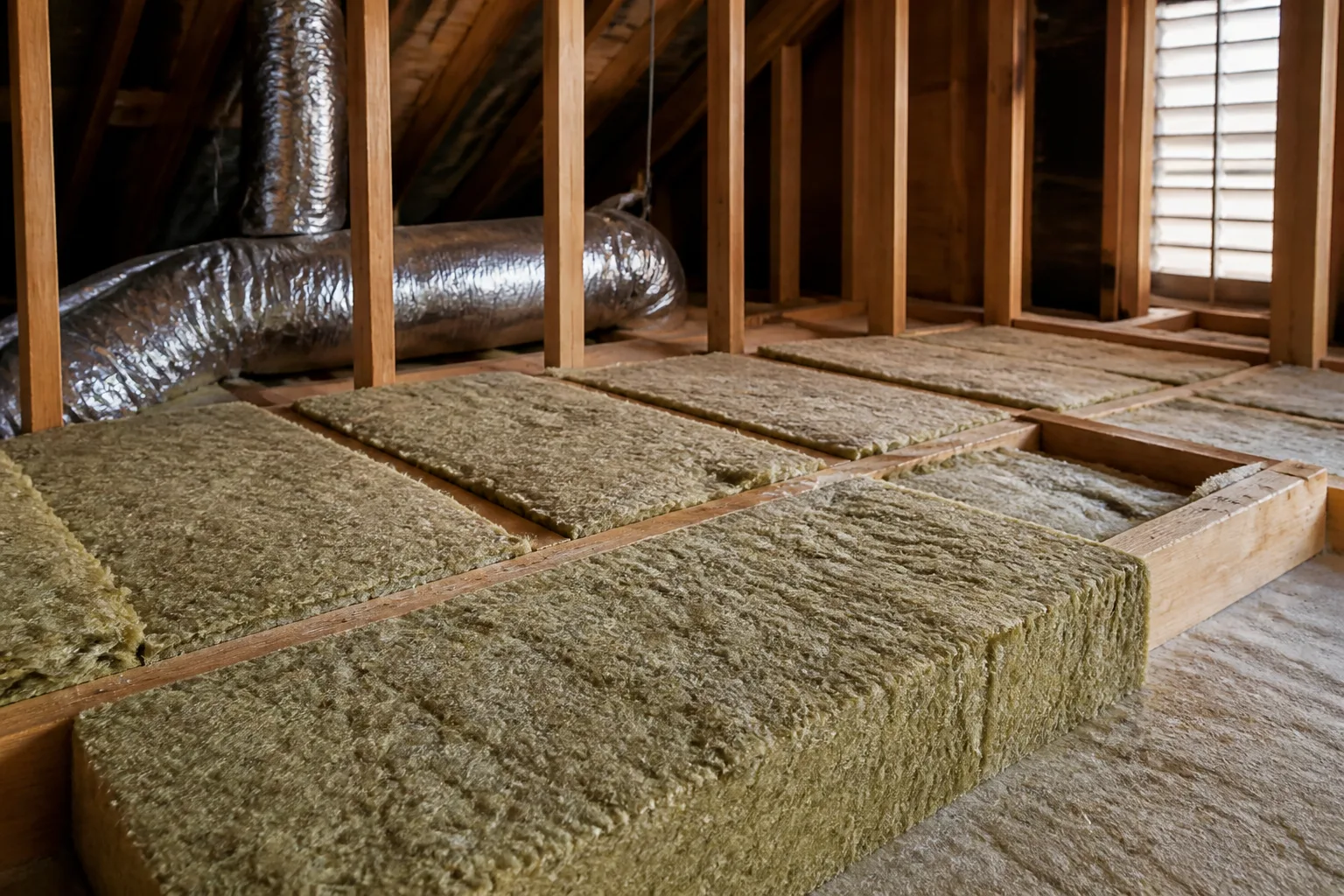
Rockwool is a specific brand of mineral wool insulation, made by spinning molten basalt rock and recycled slag into fine fibers, then compressing those fibers into dense batts. It’s not fiberglass, which is spun glass. It’s not cellulose, which is shredded paper. The raw material difference matters, because rock doesn’t burn and rock doesn’t soak up water.
In Los Angeles, those two facts translate into something practical. Attics along the Westside and South Bay deal with marine layer condensation from May through August. That moisture settles on insulation, and fiberglass batts absorb it, losing R-value and sometimes sagging away from the joists. Rockwool is hydrophobic. Water beads and drains off rather than soaking in, which means the insulation in a coastal LA attic keeps performing through the June gloom instead of quietly degrading.
We’ve pulled fiberglass out of attics in Mar Vista and Playa del Rey that looked like damp laundry after a few seasons of marine layer exposure. Rockwool, by contrast, holds its shape and its stated R-value. The performance difference isn’t theoretical; it’s visible in the material when you handle it.
Fire Resistance: What a Class A Rating Actually Means in a High Fire Hazard Severity Zone
Rockwool insulation carries a Class A surface burning classification under ASTM E84, which is the strongest rating available for a building material. In practical terms, that means the material itself won’t contribute fuel to a fire and will resist flame spread. The fibers can withstand temperatures up to 2,150°F before melting. Fiberglass, by comparison, melts around 1,000°F.
Los Angeles sits inside one of the highest concentrations of High Fire Hazard Severity Zones (HFHSZ) in California. Neighborhoods in the Santa Monica Mountains, the Verdugo Hills, and large sections of the San Fernando Valley fall within these designations. For homeowners in those areas, an attic insulated with Rockwool creates a slower-burning assembly between the exterior and the living space. That can buy time, and time is what determines outcomes during a wind-driven fire event.
This doesn’t mean Rockwool makes your home fireproof. It means you’re not adding a petroleum-based or paper-based fuel source directly beneath your roof deck. In our experience working with LA homeowners in fire-prone foothill communities, that distinction drives many purchasing decisions once it’s explained clearly.
Rockwool vs. Fiberglass vs. Blown-In: Honest Cost Comparison for Los Angeles Homeowners
If you’re weighing materials, here’s what you’ll pay in the current Los Angeles market:
- Fiberglass batts: $0.50 to $0.80 per square foot installed. Lowest upfront cost, but loses R-value when compressed or damp, and offers no meaningful fire resistance.
- Rockwool batts: $0.80 to $1.20 per square foot installed. Higher upfront cost, but hydrophobic, Class A fire rated, and dimensionally stable across LA’s temperature swings.
- Blown-in fiberglass or cellulose: $0.60 to $1.00 per square foot installed. Good for irregular joist spacing and hard-to-reach corners, but cellulose settles over time and neither material approaches Rockwool’s fire rating.
Where the payback comes from with Rockwool depends on your home. If you live east of the 405, where summer attic temperatures routinely hit 140°F, Rockwool’s density resists heat transfer more effectively than comparable depth in fiberglass. If you’re in a coastal zone, the moisture resistance prevents the slow R-value loss that fiberglass experiences. And if you’re in a HFHSZ, the fire rating is a one-time insurance policy built into the structure.
We tell homeowners in Los Angeles the same thing every time: if you’re planning to stay in the house for five years or more, the Rockwool premium usually justifies itself through durability and performance alone. If you’re flipping or selling within two years, fiberglass gets the job done at the lowest cost, and there’s nothing wrong with that.
Where Rockwool Falls Short, and How a Good Installer Works Around It
Rockwool has one genuine weakness in attic applications: it comes in batts, which means it needs consistent, regularly spaced joist bays to install cleanly. Older Los Angeles homes, particularly craftsman bungalows in Highland Park and Spanish-style builds in the Mid-City area, often have irregular joist spacing that doesn’t match standard batt widths. Forcing a batt into a bay that’s an inch too narrow compresses the material, which reduces its effective R-value. Leaving a gap on either side creates a thermal bypass.
A competent installer handles this in one of two ways. The first is time-consuming but straightforward: cut each batt to fit the actual bay width, rather than assuming the nominal spacing is accurate. The second is hybrid installation, where Rockwool batts cover the regularly spaced sections and a blown-in product fills the irregular areas. If that hybrid approach appeals to you, we’d point you toward attic insulation in Los Angeles that combines materials strategically rather than forcing one product everywhere.
The point is that Rockwool isn’t a universal answer. It’s the best answer for most LA attics, and when it isn’t, a skilled installer adjusts the approach instead of pretending the problem doesn’t exist. That honesty matters, because an attic with gaps and compressions loses efficiency no matter how good the material is.
Brand Partnerships and Why Certified Installation Matters
Rockwool’s warranty terms are strongest when the product is installed by a certified contractor. The same holds true for Owens Corning and Johns Manville, both of which offer extended or enhanced warranty coverage through their certified installer networks. What this means in practice: if you buy Rockwool batts at a big-box store and hire a handyman to staple them in, you’re getting the product warranty but not the installation workmanship coverage that comes through a certified channel.
At Laurel Attic Insulation, we install Rockwool, Owens Corning, and Johns Manville, and we’re set up to honor the manufacturer’s terms because we install to spec. That matters in Los Angeles, where building code enforcement varies by municipality and a failed inspection can cost you weeks of delay. We also stock Knauf products when a job calls for a specific R-value at a tighter budget.
Here’s the bottom line on brands: the material selection should match the job, not the inventory on hand. A homeowner in Sherman Oaks with a 1990s tract home needs something different than a homeowner in Brentwood with a flat roof and no attic access. When a contractor only offers one brand, you’re not getting a recommendation. You’re getting whatever they bought in bulk.
What Actually Matters When You Book an Insulation Job in Los Angeles
Insulation is one of the few home improvements you’ll never see after installation day. It’s buried under attic framing or behind drywall, which means the difference between a good job and a bad one is invisible unless you know what to check. Here’s what we tell homeowners to demand, and what we deliver on every job at Laurel Attic Insulation:
- A written price before work starts. Not a verbal estimate with caveats. A number on paper, in advance, that doesn’t change when the crew shows up. Most attic insulation jobs in Los Angeles run $900 to $2,400 depending on square footage and target R-value.
- Photo documentation. You should see your attic before and after. If a contractor won’t show you pictures, you have no way to verify the coverage, the depth, or the cleanup.
- A live arrival time. Not a four-hour window. Not “sometime between 8 and noon.” A trackable time you can watch from your phone, the same way you track a delivery.
- A written guarantee. The workmanship should be covered in writing for a full year. If it’s not right, it gets fixed for free.
These aren’t premium features. They’re the baseline for what a professional insulation job in a city like Los Angeles should include. The Relay Standard, which we follow on every job we run, is simply this: book in a tap, get a live arrival time, receive before-and-after photos, and pay from a link. Most contractors can’t do it. We’ve done it this way since we started.
The Bottom Line
Rockwool attic insulation in Los Angeles costs more than fiberglass upfront, but the combination of 2,150°F fire resistance, hydrophobic structure that shrugs off marine layer moisture, and dimensional stability through brutal attic heat cycles makes it the strongest material choice for most LA homes. The exceptions are older homes with irregular joist spacing, where a hybrid approach with blown-in product fills the gaps.
If you’re in Los Angeles and want a straight answer about what your attic actually needs, Laurel Attic Insulation offers free estimates with a written price delivered before any work begins. Call (361) 314-0118 and talk to a live person, 24/7, not a voicemail.
Frequently Asked Questions
For most LA homeowners planning to stay in their home five years or more, yes. Rockwool runs $0.80 to $1.20 per square foot installed versus $0.50 to $0.80 for fiberglass, but it doesn’t absorb marine layer moisture, doesn’t lose R-value when temperatures swing, and carries a Class A fire rating that fiberglass can’t match. Call Laurel Attic Insulation at (361) 314-0118 for an exact comparison for your attic.
Rockwool won’t make a house fireproof, but it doesn’t contribute fuel to a fire and withstands temperatures up to 2,150°F before melting. In a High Fire Hazard Severity Zone in Los Angeles, that means your attic assembly burns slower, which can buy critical evacuation time. Homes with mineral wool insulation showed measurably slower internal temperature rise during the 2018 Woolsey Fire.
Yes, but it requires care. Batts must be cut to the actual bay width rather than forced into place, and irregular sections may need blown-in insulation. Our team handles this by combining Rockwool with blown-in product where needed. If you’re curious whether your attic is a candidate, spray foam insulation in Los Angeles is another option for irregular framing.
Rockwool doesn’t settle, doesn’t absorb moisture, and doesn’t degrade under normal attic conditions. The effective lifespan is the life of the structure, barring physical damage from pests or roof leaks. That durability is part of why the higher upfront cost makes sense. If your existing insulation is old, damaged, or underperforming, insulation removal in Los Angeles is the first step before fresh installation.
Written by the team at Laurel Attic Insulation.
Need Insulation Help?
Call Laurel Attic Insulation - licensed & insured, here with fast after-hours help in Los Angeles.
(361) 314-0118