
Knauf Attic Insulation in Los Angeles: A Homeowner’s Guide
When a contractor quotes you “pink insulation,” they might mean Owens Corning EcoTouch, or they might mean Knauf EcoBatt, which costs less per roll and performs nearly identically. Knauf is actually one of the largest insulation manufacturers on the planet, yet most Los Angeles homeowners have never heard the name. That knowledge gap is exactly what less scrupulous contractors count on when they pitch a material without explaining what it is, why they chose it, or whether you’re getting what you paid for. This guide closes that gap.
If you’d rather skip the research and just get a straight answer about your attic, call us at (361) 315-4177. We’ll tell you honestly whether Knauf makes sense for your house, and our estimate is free.
What Is Knauf Insulation, and Why Does It Matter in Los Angeles?
Knauf Insulation is a German-owned company that manufactures fiberglass batts, rolls, and blown-in insulation in plants across North America. In Los Angeles, the Knauf product you’ll most likely encounter is EcoBatt, a fiberglass batt sold in R-values from R-13 up to R-38 and beyond. It’s made with what Knauf calls ECOSE technology, a plant-based binder that replaces the petroleum-derived formaldehyde binders used in older fiberglass products. That’s a meaningful health credential, and we’ll get to why in a moment.
The reason Knauf deserves your attention isn’t that it’s exotic. It’s that it’s everywhere. Walk through the insulation aisle of any Los Angeles building supply yard and you’ll see Knauf stacked right next to Owens Corning and Johns Manville. Contractors buy it because it’s dependable and usually a touch cheaper. The question isn’t whether Knauf is a legitimate product. It absolutely is. The question is whether the contractor recommending it is making a material choice based on your attic’s needs, or just shaving a few dollars off their supply run.
In Climate Zone 9, where Los Angeles sits, attics routinely hit 130 to 150°F in July and August. That heat doesn’t just make your upstairs rooms uncomfortable: it pushes your air conditioner to run longer cycles and drives your summer electric bill up. The insulation you put between your ceiling and that superheated attic space is doing real work every single day. So the brand on the batt matters less than whether the product meets the specified R-value and gets installed at full, consistent depth. Knauf EcoBatt does that job as well as anything on the market, when it’s installed correctly.
Knauf EcoBatt vs. Owens Corning EcoTouch: The Three Specs That Actually Matter
Here’s the comparison most Los Angeles homeowners never get, because most contractor quotes don’t include spec sheets. We’re comparing Knauf EcoBatt against Owens Corning EcoTouch, the two fiberglass batts you’re most likely to see specified for an attic in this city. Three numbers tell you almost everything.
R-Value Per Inch
Both Knauf EcoBatt and Owens Corning EcoTouch land at roughly R-3.7 to R-3.8 per inch for standard fiberglass batts. That means a 10-inch batt gets you to about R-37 or R-38, which is the code-recommended minimum for attics in Los Angeles. Neither product has a meaningful edge here. Any contractor who tells you one brand insulates “better” per inch is either misinformed or selling something.
Formaldehyde Content
Both products are formaldehyde-free. Knauf markets this through its ECOSE binder, Owens Corning through its PureFiber process. The distinction matters because older fiberglass insulation contained formaldehyde-based binders that off-gassed into the home, and plenty of homeowners still associate fiberglass with that smell and those health concerns. With either Knauf or Owens Corning, the modern formulation eliminates that issue. Whichever brand you choose, you’re not bringing formaldehyde into your attic.
Binder Technology: ECOSE vs. PureFiber
This is the part nobody explains. Knauf’s ECOSE binder is made from plant-based materials, primarily glucose derived from renewable sources. Owens Corning’s PureFiber uses a different chemistry but achieves the same goal: a binder that holds the glass fibers together without formaldehyde. For the installer, the practical difference is that ECOSE has a slightly lower odor during installation and the batts can feel a bit softer to handle. For the homeowner, that difference evaporates the moment the attic hatch closes. Neither binder confers a thermal performance advantage. Both are safe, modern products.
If you’re weighing these two brands for a Los Angeles attic, the honest take is this: install either one to the full required depth and you’ll get the same measured performance. We’ve installed both brands in homes from Sherman Oaks to Eagle Rock, and the thermal results come down to coverage and depth, not the logo on the wrapper. For a broader look at how attic insulation performs across the city, see our Attic Insulation in Los Angeles guide.
What Does Knauf Actually Cost in Los Angeles?
Let’s talk dollars, because “it depends” is not an answer. In our experience buying both products for Los Angeles jobs, Knauf EcoBatt R-38 batts typically run $0.05 to $0.10 less per square foot than the equivalent Owens Corning product at the contractor level. On a 1,500 square foot attic, that translates to a material cost difference of roughly $75 to $150 on the entire job. That’s real money, but it’s not enough to drive your decision. Installation labor, attic prep, air sealing, and disposal of old insulation all dwarf that material delta.
| Job Component | Typical Los Angeles Range |
|---|---|
| Knauf EcoBatt R-38 material, 1,500 sq ft | $600 – $900 |
| Labor, install crew, and attic prep | $900 – $1,800 |
| Air sealing (recommended before insulating) | $300 – $600 |
| Old insulation removal (if needed) | $1,200 – $2,000 |
| Total typical Knauf attic job | $2,100 – $4,400 |
For the most common scenario, a 1,500 square foot attic needing R-38 blown or batt insulation from scratch, most Los Angeles homeowners pay between $2,100 and $4,400 all-in. That’s the honest range. If someone quotes you $900 for the whole job, they’re cutting corners somewhere, usually depth or coverage. If someone quotes you $7,000 for a straightforward 1,500 square foot attic, you’re paying for someone’s boat. Get three quotes, ask for the product spec sheet each time, and compare line items, not just bottom lines.
When Knauf Makes Sense for a Los Angeles Attic, and When It Doesn’t
Here’s where we give you the straight answer we’d give a friend. Knauf EcoBatt has one genuinely useful advantage that almost no one mentions: its brown color. Against standard wood framing, brown batts make gaps, compression spots, and uneven depth far easier to spot than pink batts do. Pink blends into the eye after a while, especially under dim attic lighting. Brown reads as a contrast against raw lumber. For a homeowner inspecting a finished job with a flashlight, or reviewing photos the crew sends afterward, that brown color is a genuinely practical installation-quality benefit. It helps you see whether the installer actually filled every cavity.
But here’s when Knauf isn’t the right call. If you already have Knauf in your attic and you’re adding more, any fiberglass batt works, but blown-in products from brands like CertainTeed or GreenFiber often cover uneven surfaces more effectively than batts do. If you need to air-seal around can lights, plumbing vents, and electrical penetrations, a spray foam product like Icynene or Demilec will outperform any batt, Knauf included. And if you’re in a Los Angeles neighborhood with older construction, like parts of Highland Park or West Adams, you may need Insulation Removal in Los Angeles first to clear out old, compressed fiberglass or vermiculite before anything new goes in.
One anecdote from the field: we pulled a load of old batts out of an attic in Van Nuys last fall where the previous contractor had installed half the required depth and laid batts over the tops of ceiling joists instead of between them. The homeowner had a perfectly good product up there, just installed wrong. The brand wasn’t the problem. The installation was. That’s the pattern we see most often in Los Angeles attics, regardless of what product got used.
What to Ask Any Contractor Who Specifies Knauf
If a contractor hands you a quote that says “Knauf insulation” and nothing else, that’s not a specification, it’s a brand name. Ask for the following three things. A legitimate insulation contractor in Los Angeles will have all three at their fingertips.
- Ask for the product spec sheet showing R-value at installed depth. Knauf EcoBatt comes in multiple densities and thicknesses. The spec sheet tells you what R-value that specific product achieves at the depth they plan to install. If they can’t produce it, walk away.
- Confirm the batt meets ASTM C665 Type III for faced batts. That’s the standard covering the facing material and flame-spread characteristics. Faced batts in an attic have to meet specific fire-safety requirements. This isn’t paperwork for its own sake; it’s the difference between a product rated for attic use and one that isn’t.
- Ask to see post-job depth photos. This is the most important one. A contractor who won’t show you the finished attic, either by bringing you up to the hatch or sending photos from inside the space, is telling you something about the quality of the installation without meaning to. Knauf, Owens Corning, or any other brand only works if it’s installed to the full specified depth across the entire attic floor, not just the easy-to-reach middle sections.
The brand matters far less than whether the product was installed to spec. We say that as a company that has installed Knauf EcoBatt in Los Angeles attics for years. It’s a good product. But a good product installed poorly is still a fail.
When to Call a Pro
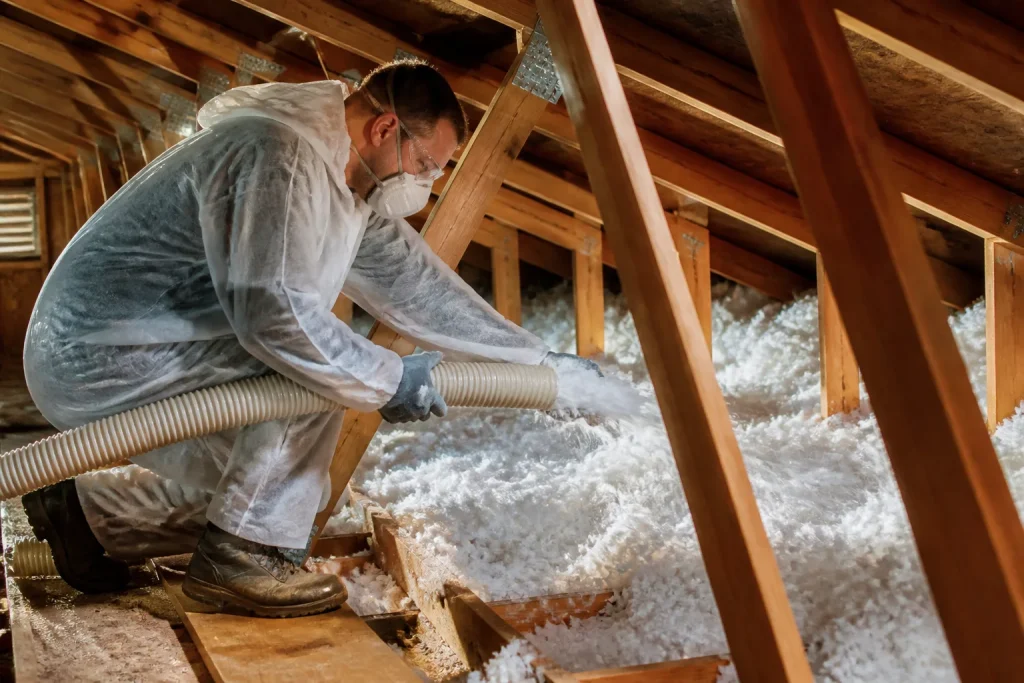
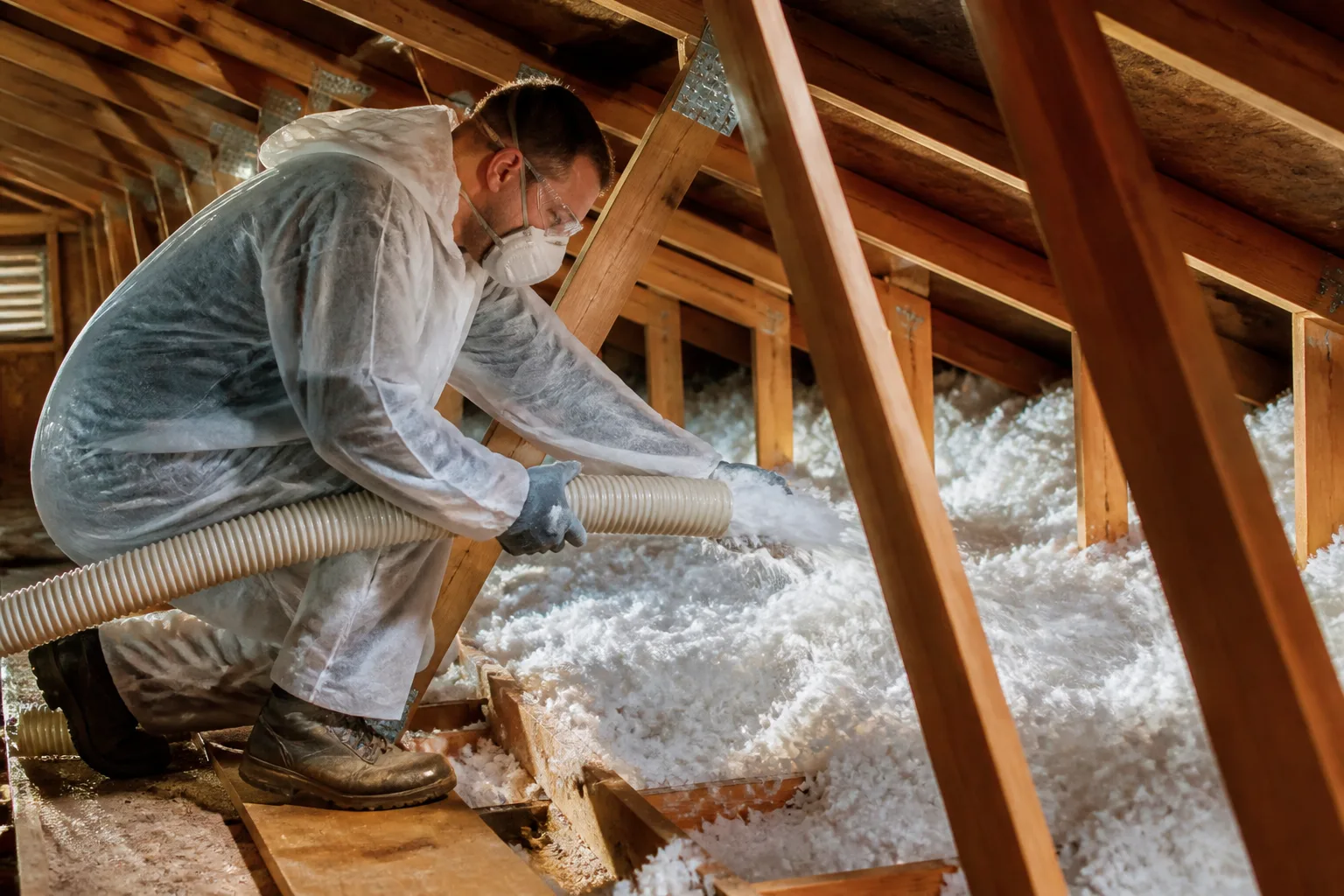
If your Los Angeles attic has never been insulated, or the existing insulation is compressed, water-damaged, or full of rodent droppings, this is not a weekend project. Working in a 130-degree attic with fiberglass batts is physically punishing and genuinely hazardous without proper respirator protection, knee boards, and lighting. Fiberglass particles irritate skin and lungs. Vermiculite from pre-1990 homes in Los Angeles can contain asbestos and should never be disturbed without testing. If any of that describes your attic, call a professional who carries proper equipment and knows what they’re looking at.
Related services in Los Angeles: Spray Foam Insulation in Los Angeles and Laurel Attic Insulation home.
The Bottom Line
Knauf EcoBatt is a legitimate, high-performing fiberglass insulation that meets or matches Owens Corning on R-value per inch and formaldehyde-free manufacturing. In Los Angeles attics, the performance difference between the two brands is negligible; the real variable is installation depth and coverage. Knauf’s brown color makes installation gaps easier to spot, which is a genuine quality-control benefit for homeowners. And while Knauf costs $0.05 to $0.10 less per square foot at the contractor level, that savings shouldn’t drive your decision. Choose the contractor who specifies the product properly, installs it to full depth, and shows you proof.
If you’re in Los Angeles and need help with attic insulation, Laurel Attic Insulation offers free estimates and written prices before any work starts. Call (361) 315-4177 and we’ll walk your attic, evaluate what’s up there, and give you an honest recommendation, whether that’s Knauf, spray foam, or something else entirely.
Frequently Asked Questions
Yes. Knauf EcoBatt fiberglass batts perform equivalently to Owens Corning EcoTouch at R-3.7 to R-3.8 per inch, which meets R-38 code recommendations for Los Angeles Climate Zone 9 when installed at full depth. Call (361) 315-4177 for an exact recommendation for your attic. Estimates are free.
Knauf EcoBatt R-38 material for a 1,500 square foot Los Angeles attic typically runs $600 to $900, with total job costs between $2,100 and $4,400 including labor and prep. Knauf runs $0.05 to $0.10 less per square foot than Owens Corning at the contractor level. Call (361) 315-4177 for a written quote on your specific attic.
Neither brand has a meaningful performance advantage. Both are formaldehyde-free, both deliver R-3.7 to R-3.8 per inch, and both meet code in Los Angeles when installed to full depth. Knauf’s brown color makes installation gaps easier to spot against wood framing. Choose based on installer quality, not brand. Call (361) 315-4177 for an honest assessment.
In many cases, yes. A standard Los Angeles attic insulation job takes one day from start to finish once the estimate is approved. We schedule live arrival times and send photo proof of the finished attic before we leave. Call (361) 315-4177 to check current availability.
Written by Chase Whitaker, Owner at Laurel Attic Insulation, serving Los Angeles since 2003.
Need Insulation Help?
Call Laurel Attic Insulation - licensed & insured, here with fast after-hours help in Los Angeles.
(361) 315-4177